
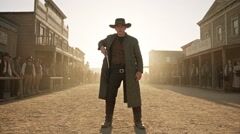
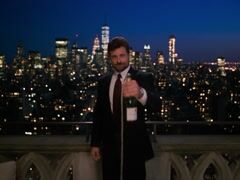

WILD WEST — THE QUICK-DRAW CHAMPION. A cinematic western montage, full realtime speed, shot like a classic 1960s western film in warm sepia. AUDIO MIX (ranked, three separate layers): 1. MUSIC — loudest, dominant from the very first frame: a sweeping spaghetti-western instrumental with twanging guitar, a whistled melody, galloping percussion and a dramatic trumpet; original, instrumental only. 2. SFX — quiet, under the music: spurs jingling, saloon doors creaking, a glass sliding along wood, six sharp revolver shots in a quick rhythm, each followed by a tin can clanging. 3. VOICE — none; @image1 stays silent the whole clip. Audio suppressor: no voiceover narration, no dialogue, no spoken words, no singing vocals, no lyrics, no library audio bed, no muffled murmuring, no subtitles. The music resolves on a final hit and silence holds the final 0.5s. TWO references with separate jobs: @image1 is the legendary sharpshooter, identity kept EXACTLY from @image1 the whole time — same face, hair and features — in a dusty wide-brim hat, a long duster coat, a leather vest and boots with spurs, a six-shooter revolver in a leather holster on the hip. Preserve their gender presentation exactly as shown. Use they / their / them only. @image2 is THE BOTTLE — take only the bottle from @image2 and keep it exactly as the reference whenever it appears: its exact shape, size, colour, cap, label and logo. SETTING: a dusty frontier town at high noon — wooden saloon, hitching posts, tumbleweeds, a sun-bleached main street. BEATS (20s): 0–5s: @image1 pushes through the swinging saloon doors; the piano stops and every head turns. Camera: low wide from inside the saloon. 5–9s: @image1 leans on the bar; the bartender slides the @image2 bottle all the way down the long wooden bar and @image1 catches it without looking, the @image2 label clearly visible, pours a shot and tips the hat, then sets the @image2 bottle down on the bar. Camera: tracking with the sliding @image2 bottle, then close on the catch and the label. 9–14s: THE CHALLENGE. Out on the main street a crowd gathers along the wooden boardwalks. On the far side of the street, a full twenty paces away — about fifteen metres — exactly six tin cans stand in a neat, evenly spaced row on top of a wooden fence rail. @image1 takes position in the middle of the street facing the fence across the whole wide distance, coat blowing in the wind, hand hovering over the holster. Camera: a wide establishing shot from behind @image1's shoulder showing the long stretch of dusty street between @image1 and the small cans far away on the fence; then classic western close-ups on the eyes, the hovering hand, and the six cans in the distance. 14–18s: THE QUICK DRAW. In one lightning move @image1 draws the six-shooter from the holster, holds it at the hip and fans the hammer with the other hand, firing exactly six shots in a fast, steady rhythm — one shot for each can. With every single shot a small puff of smoke leaves the barrel, and far across the street exactly one can is knocked off the fence rail, going left to right: shot one, first can flies off; shot two, second can; and so on, until the sixth shot knocks off the sixth and last can and the fence rail stands empty. Camera: wide side angle across the street that keeps both @image1 and the distant fence in the same frame, so each shot and each falling can are seen together. 18–20s: @image1 spins the revolver on one finger and drops it back into the holster; the crowd erupts in cheers and throws hats in the air; @image1 turns and walks away down the street into the sun. Camera: wide, holding on the silhouette walking off to the last frame. LOOK: warm sepia-gold classic western grade, film grain, dust in the air, clean full frame.
Arrastra el clip hacia los lados
A DAY IN 1970s NEW YORK — ENDING AT STUDIO 54. A lively, colourful montage shot to look like real late-1970s film, full realtime speed, soft cuts between short scenes of everyday 1970s city life, building to the hottest disco night in town. AUDIO MIX (ranked, three separate layers): 1. MUSIC — loudest, dominant from the very first frame: a groovy late-1970s funk-soul instrumental with wah-wah guitar, slap bass and horns through the day, rising into a pumping four-on-the-floor disco beat with lush strings for the club finale; original, instrumental only. 2. SFX — quiet, under the music: a record needle dropping, street traffic and taxi horns, roller-skate wheels, a cheering crowd at the velvet rope. 3. VOICE — none; @image1 stays silent the whole clip. Audio suppressor: no voiceover narration, no dialogue, no spoken words, no singing vocals, no lyrics, no library audio bed, no muffled murmuring, no subtitles. The music resolves on a final hit and silence holds the final 0.5s. TWO references with separate jobs: @image1 is the star of the day, identity kept EXACTLY from @image1 the whole time — same face, hair and features — with authentic 1970s style: flared jeans and a fitted printed shirt by day, a shimmering sequined disco outfit with platform shoes at night. Preserve their gender presentation exactly as shown. Use they / their / them only. @image2 is THE SUNGLASSES — take only the sunglasses from @image2 and keep them exactly as the reference whenever they appear: their exact frame shape, frame colour, lens colour, size, logo and details. VINTAGE LOOK throughout: authentic late-1970s 16mm film — warm saturated oranges, browns and golds, soft halation, heavy grain, gentle flicker. BEATS (30s): 0–4s: MORNING — in a 1970s apartment with a shag rug, wood panelling and plants, @image1 drops the needle on a vinyl record on the turntable and dances barefoot around the kitchen while making coffee in a percolator. Camera: handheld, following around the room. 4–8s: STEPPING OUT — @image1 steps out of the brownstone into the bright sunny street, takes the @image2 sunglasses from the shirt pocket and slides them on, the frames and lenses flashing in the sun, and grins. Camera: low, then close on the @image2 sunglasses. 8–12s: @image1, wearing the @image2 sunglasses, flags down a yellow checker taxi on a busy avenue full of 1970s cars and rides with the window down, arm out, the city rolling past. Camera: from inside the cab, then from the street. 12–16s: in a crowded record store @image1 flips through crates of vinyl, pulls out a disco album, and bops along to a record playing over the speakers with other shoppers. Camera: medium, easing in. 16–20s: in the afternoon @image1 roller-skates through a sunny park with a crowd of skaters, spinning and gliding backward to a boombox, the @image2 sunglasses on. Camera: low, gliding alongside. 20–23s: getting ready at night — @image1 styles their own hair, exactly as in @image1, with a 1970s flourish in front of a bulb-lit mirror and zips into the sequined disco outfit, then picks the @image2 sunglasses up from the dressing table and pushes them up onto the head. Camera: close in the mirror. 23–26s: outside Studio 54 a huge crowd pushes at the velvet rope; the doorman lifts the rope just for @image1, who struts in as flashbulbs pop, the @image2 sunglasses resting on the head. Camera: tracking, then swinging around in front. 26–30s: THE FINALE — under a giant spinning mirror ball on the lit-up dance floor, @image1 breaks into a full disco routine — point to the sky, hip swings, a spin, the hustle, the whole crowd copying every move — and ends with the @image2 sunglasses still pushed up on the head, pointing to the sky. Camera: wide and handheld, circling, holding on the final pose to the last frame. LOOK: glamorous, nostalgic 1970s grade, clean full frame.
DAY IN MY LIFE — realistic personal NYC vlog, one continuous 30s piece, photoreal lifestyle. Two people: @image1 (the vlogger) and @image2 (the friend). Keep each exact face, hair, freckles and body proportions from their own reference the whole time; two clearly different people. Preserve their gender presentation exactly as shown. Use they / their / them only. @image2 appears only in the café and park. THE PRODUCT — @image3 is the jacket: @image1 wears exactly the jacket from @image3 over simple plain basics for the ENTIRE clip, from the very first frame to the last, in every scene — take only the garment from @image3 (its exact shape, colour, material, collar, fastening, pockets, cuffs, fit and details) and keep it identical in every shot; if @image3 shows a model, only the jacket is used and the person is always @image1. Sneakers and a tan shoulder bag complete the outfit. The jacket is clearly visible and naturally featured throughout, never covered for long. Three motivated camera perspectives: @image1's front selfie, @image1's rear-camera detail shots, and short third-person shots by @image2 or a propped phone. Transitions motivated by a palm over the lens, a fridge door, jacket fabric, a passing yellow taxi or pedestrian, a shopping bag across the lens, a whip pan. TIMELINE (30 s): 0–3.5s: morning selfie — @image1, already wearing the @image3 jacket, holds the phone at arm's length, smiles, gives a small wave, starts walking to the kitchen. 3.5–6.5s: kitchen — hand dropping spinach, banana, mango into a blender; close-up of pale green smoothie pouring into a glass; selfie raising the finished drink, one real sip and an approving nod, the jacket sleeve in frame. 6.5–9s: JACKET MOMENT — phone propped waist-height facing a full-length mirror; @image1 checks the @image3 jacket in the mirror — straightens the collar, fastens it as its own design allows, turns once to show the back, then slides the tan bag over the shoulder, checks keys, picks up the phone; a close detail shot of the jacket's texture and fastening fills the lens as a transition. 9–12.5s: bright Manhattan sidewalk selfie walk in the jacket, red-brick buildings, cafés, a yellow taxi passing, green trees, natural gait. 12.5–16s: a taxi wipes into a bright clothing store; @image1 browses a rack, a full-length mirror shot of the whole outfit with the @image3 jacket, holds a pale blue shirt up, leaves with one small kraft-paper bag. 16–19.5s: third-person sidewalk shot ahead as @image1 walks in the jacket carrying the bag, checks phone, a pedestrian wipes the frame, then opens a café door. 19.5–23s: inside the café @image2 sits by the window; a brief hug, @image2 touches the jacket sleeve and nods approvingly; two coffee cups arrive; overhead of the bag by the chair; both laughing. 23–26.5s: the kraft bag wipes the lens into a sunny city park; @image2 films @image1 walking backward laughing, the jacket moving naturally; cut to @image1's selfie as @image2 steps in beside. 26.5–30s: the two share a warm hug, sit on a bench side by side; @image1 looks to camera content, the jacket clearly visible; @image2 waves; @image1's palm fills the frame to end. Performance: conversational, natural pauses, real blinking, small imperfect gestures, hair moving in wind; not exaggerated influencer energy. Camera: realistic smartphone dynamic range, slight handheld, smooth stabilization, consistent screen direction, natural autofocus, cuts motivated by gestures and wipes; steady real-time. Lighting: bright natural late-spring daylight, natural skin tones, real material and fabric texture. Leave clean lower-frame space for captions to be added later. Clean frame with no baked-in text or logos. Audio: (a soft original acoustic-pop instrumental under the montage) plus realistic vlog ambience — light natural chatter between @image1 and @image2, room tone, brief blender, city traffic, café murmur, park wind; clear and pleasant.
ASSET MAP — every reference is bound here and cited by tag below: @image1 — the identity anchor from step 1. This is the person: it defines face, build and identity. Referred to below as @avatar. CHARACTER LOCK — HIGHEST PRIORITY: @avatar is exactly the person in @image1. Preserve their facial identity, facial structure, eye shape and spacing, eyebrows, nose, mouth, exact skin tone, hairline, hairstyle, hair length, texture and colour, freckles and distinctive marks, apparent age, build and body proportions. Preserve their gender presentation exactly as shown; do not masculinize, feminize or otherwise reinterpret it. Use they / their / them only. Do not beautify, slim, de-age or restyle them. No face changes, no identity drift. The grandparent described below is the ONLY other person inside the room. Every reference to the candidate in this prompt is @avatar — no pronouns, no description. ATTACHED IMAGES ARE MANDATORY AND FINAL: @image1 is the person — reproduce them exactly, in every single frame, and never invent a different face, hairline, hair colour, skin tone, body or age. The attached image outranks every word written below it: wherever the image and this text disagree, follow the image. SPOKEN LANGUAGE: ENGLISH. Every spoken word is in English, exactly as written in the DIALOGUE block. The grandparent speaks fluent, precise, professional English with a thick Eastern European accent. @avatar speaks native English. Deadpan office comedy, documentary realism. One locked camera, no cuts. PRIORITY 1 — THE ORDER OF THE LAST BEAT, NEVER CHANGE IT: @avatar FIRST asks the question while sitting upright and facing the grandparent, looking straight at them — and ONLY AFTER the question is finished does the searching begin. The search is the consequence of the question, never before it and never during it. PRIORITY 2 — THE SEARCH: once the question is out, @avatar searches the room for a hidden camera with big visible movements while the face stays toward the camera. @avatar leans far SIDEWAYS out of the chair to look past the monitor, tips the head back to scan the two upper ceiling corners, cranes toward the potted plant, scans along the glass wall — then snaps back upright. @avatar leans and twists but NEVER turns away from the camera; the face is visible the whole time. PRIORITY 3 — THE CONTRAST: an old village grandparent is conducting a job interview inside a sleek modern high-tech software company office. Their village clothing and the glass-and-monitor tech office are BOTH clearly visible in the same frame from the very first second. The first beat opens on this, already in progress — no establishing shot, no empty room. They are already speaking when the video starts. PRIORITY 4: the grandparent is completely serious and professional, like a veteran HR director. Calm, unhurried, authoritative. They read from a sheet of paper and take a note. They never smile, never wink, never play folksy or comic, and they never once look up at what @avatar is doing — not even during the search. PRIORITY 5: one locked camera position, identical framing for the whole take. No camera movement, no zoom, no reframing, no second angle, no cuts. THE GRANDPARENT: village grandparent, about 72, sturdy and solidly built, broad shoulders, calm imposing presence, deeply weathered face, black headscarf tied under the chin, dark grey hand-knitted wool cardigan over a dark floral house smock, heavy worn hands. They sit behind the desk in a modern black mesh ergonomic office chair, holding one printed sheet of paper and a cheap pen. Fully inside the frame with space around them, never cropped by the frame edge. LOCATION: small glass-walled meeting room inside a modern software company. Behind them through the glass: an open-plan office, people at standing desks, exposed ceiling, soft daylight. Inside the room: a light oak desk, a closed slim laptop, a monitor showing a plain dark screen with no text, a glass of water, a potted monstera in the corner. NO readable text, NO letters, NO logos, NO visible user interface anywhere. FRAMING: wide locked two-shot, both people centred with air on both sides. The grandparent on the left behind the desk, fully visible. @avatar on the right, seated facing the grandparent. DIALOGUE — in English, in this exact order: (0:00-0:04) GRANDPARENT, already mid-interview and already speaking as the video opens, reading from the sheet, calm and professional: "Walk me through the difference between a monolith and microservices." (0:04-0:07) @avatar, upright, hesitant but polite: "Microservices... deploy independently." (0:07-0:11) GRANDPARENT, writing a note, not looking up: "Good. What was your p99 latency in production?" (0:11-0:14) @avatar, still sitting perfectly upright and looking straight at the grandparent, polite and careful: "Sorry — is this a hidden camera?" (0:14-0:20) ONLY NOW the search begins: @avatar leans sideways to look past the monitor, tips the head back at the ceiling corners, cranes toward the plant, scans the glass wall — face still toward camera. Over the top of this, GRANDPARENT, flat, never looking up from their sheet: "No. And that is not an answer." @avatar keeps searching one more beat, then settles back into the chair, defeated. (0:20 to the end of the take, only if the take runs longer than 20 seconds) Nobody speaks again. The grandparent writes one more note, still not looking up. @avatar sits still, glances once more at the ceiling corner, then back at the grandparent. Hold that silence, unchanged, to the last frame. SOUND: quiet open-plan office hum, distant keyboards, faint air conditioning. Calm, flat, conversational delivery. No music, no laugh track.

THE MICHELIN STAR CHEF. A fast, mouth-watering cinematic montage, full realtime speed, sharp cuts through one dinner service in a top restaurant kitchen. AUDIO MIX (ranked, three separate layers): 1. MUSIC — loudest, dominant from the very first frame: a stylish, energetic modern jazz-funk instrumental with a tight groove, upright bass and brushed drums, building to a proud finish; original, instrumental only. 2. SFX — quiet, under the music: sizzling pans, a whoosh of flambé flame, knives chopping, applause. 3. VOICE — none; @image1 stays silent the whole clip. Audio suppressor: no voiceover narration, no dialogue, no spoken words, no singing vocals, no lyrics, no library audio bed, no muffled murmuring, no subtitles. The music resolves on a final hit and silence holds the final 0.5s. TWO references with separate jobs: @image1 is the head chef, identity kept EXACTLY from @image1 the whole time — same face, hair and features — in crisp chef's whites. Preserve their gender presentation exactly as shown. Use they / their / them only. @image2 is THE PRODUCT — take only the product from @image2 and keep it exactly as the reference whenever it appears: its exact shape, size, colour, packaging, label and logo. SETTING: a gleaming high-end open kitchen with copper pans, steam, a team of cooks and an elegant dining room beyond the pass. BEATS (20s): 0–4s: @image1 calls the service with a clap and the whole brigade bursts into motion. Camera: wide, then pushing in on @image1. 4–8s: @image1 chops herbs at lightning speed, then tosses a sizzling pan and sets off a huge flambé flame that lights up the face. Camera: close on the knife, then the flame. 8–13s: @image1 plates a steak dish with tweezers — sauce swoosh, microgreens, edible flowers — slow, precise and beautiful. Camera: overhead close on the plate. 13–16s: THE FINISHING TOUCH — @image1 picks up the @image2 product from the counter, holding it so its packaging faces the camera, opens it and adds a finishing touch of it onto the steak from above — a sprinkle, a drizzle or a pinch, glinting in the light — then sets the @image2 product back down on the counter beside the plate. Camera: close on the @image2 product in the hand, then on the finishing touch landing on the dish. 16–20s: @image1 slides the plate across the pass; in the dining room the guests take a bite and break into applause, and @image1 gives a proud nod through the kitchen window. Camera: following the plate, holding on the proud nod to the last frame. LOOK: ultra-photorealistic cinematic food grade, warm golden kitchen light, steam and flame, natural motion blur, film grain, clean full frame.
DAY IN THE LIFE OF A '90s SUPERMODEL. A glamorous montage made to look like a real 1990s home camcorder / VHS tape — a nostalgic vintage home-video look with soft jump cuts between short scenes, full realtime speed. AUDIO MIX (ranked, three separate layers): 1. MUSIC — loudest, dominant from the very first frame: an upbeat, glamorous, feel-good 1990s pop/house instrumental with a bright confident groove, building to a big triumphant beat on the runway finale; original, instrumental only. 2. SFX — quiet, under the music: popping camera flashbulbs, a wind machine, clinking glasses, crowd applause at the end. 3. VOICE — none; @image1 stays silent the whole clip. Audio suppressor: no voiceover narration, no dialogue, no spoken words, no singing vocals, no lyrics, no library audio bed, no muffled murmuring, no subtitles. The music resolves on a final hit and silence holds the final 0.5s. VINTAGE LOOK (apply throughout): authentic early-1990s camcorder footage — soft slightly-washed warm colours, fine analog video grain and gentle VHS tape noise, mild chromatic bleed, a little soft focus and light handheld sway, slightly blown highlights; nostalgic, dreamy, aspirational. Between scenes use soft home-video jump cuts, like clips from the same tape. TWO references with separate jobs: @image1 is THE SUPERMODEL and the star of every scene — identity kept EXACTLY from @image1 the whole time, the same face, hair and features in every scene; confident, radiant, effortlessly glamorous. Preserve their gender presentation exactly as shown. Use they / their / them only. @image2 provides ONLY THE RUNWAY DRESS — take only the garment from @image2: its exact shape, silhouette, neckline, length, colour, fabric, finish and every detail exactly as shown — nothing invented or redesigned — fitted naturally onto @image1. If @image2 shows a model, that person is not used; the person is always and only @image1. In the earlier scenes @image1 wears other chic high-fashion looks; the @image2 dress is the show-stopper saved for the backstage reveal and the runway. SCENES (one glamorous fictional day), each a short glossy clip: 0–5s: THE ARRIVAL — @image1 steps out of a sleek black limousine onto a red carpet in a sharp tailored designer power-suit and huge sunglasses; paparazzi flashbulbs pop all around as @image1 smiles and glides forward like a star. 5–10s: THE EDITORIAL SHOOT — on a chic studio set, a wind machine lifts the hair as @image1 strikes bold high-fashion poses in a striking designer look styled to suit their gender presentation, flashbulbs firing; fierce looks, then a laugh between shots. 10–15s: LA DOLCE VITA — on a sunny café terrace on a glamorous boulevard, in an elegant summer outfit and jewellery that suits them, @image1 sips champagne with friends, tosses the head back laughing, sunglasses glinting. 15–20s: BACKSTAGE — THE DRESS REVEAL — backstage before the show, the @image2 dress hangs on a rail; stylists lift it down and help @image1 step into it, and the stylists fasten it so it fits perfectly, the dress falling exactly as its own cut and length allow; a stylist smooths the fabric; @image1 turns to the mirror in the @image2 dress, catching their breath, radiant and ready. 20–27s: THE RUNWAY — @image1 strides out onto a bright fashion-show runway in the @image2 dress, exactly as in the reference, a powerful confident catwalk straight toward the camera, the fabric moving with each step, as flashbulbs flare on both sides and the hair moves with each stride. 27–30s: THE FINALE POSE — at the end of the runway @image1 stops, pops a hip, throws a dazzling look and a hand to camera, then turns in a swirl of the @image2 dress as the crowd erupts in applause. Keep it glossy, glamorous and nostalgic throughout, clean frame with no on-screen text, captions, timestamps, logos or watermark.
THE STORY: residents on the east side say the new streetlights are watching them, and the council insists the lights are only lights THE DISMISSAL: They're lights. They're just lights. THE RELATIVE: parent Those three lines are the joke. Change them and nothing else — their values are never restated below. ASSET MAP — every reference is bound here and cited by tag below: @image1 — the first frame. The person in it is THE PERSON for this entire take. CHARACTER LOCK — HIGHEST PRIORITY: The person is exactly the person in @image1. Preserve their facial identity, facial structure, eye shape and spacing, eyebrows, nose, mouth, exact skin tone, hairline, hairstyle, hair length, texture and colour, freckles and distinctive marks, apparent age, build and body proportions — identically, from first frame to last. Preserve their gender presentation exactly as shown; do not masculinize, feminize or otherwise reinterpret it. Do not beautify, slim, de-age or restyle them. Use they / their / them only. No face changes, no identity drift. No other people on screen. ATTACHED IMAGES ARE MANDATORY AND FINAL: the attached first frame is the person and the set. The attached image outranks every word written below it: wherever the image and this text disagree, follow the image. A single continuous take on the floor of a television news studio — exactly the set of @image1, with the studio camera in the left foreground. PRIORITY 1 — SPOKEN LINES, in English, in their own natural speaking voice. 0 to 5 seconds — polished broadcast delivery, perfect diction, looking straight into the studio camera's lens. They read THE STORY as a news item, then hand off, verbatim: "Let's go to the report." 5 to 11 seconds — they believe they are off the air. Quiet, tired, speaking sideways to someone off camera, not to the lens. First, verbatim: THE DISMISSAL. Then, after a short beat: "My THE RELATIVE called me about this one. My own THE RELATIVE." 11 to 13 seconds — a calm, flat voice from off camera, unhurried, simply stating a fact, verbatim: "We're still live." PRIORITY 2 — THE JOLT. At 13 seconds their head snaps back toward the camera lens and their eyes widen. They say nothing more. PRIORITY 3 — PERFORMANCE. Keep it small and contained. The instant the handoff ends at 5 seconds their shoulders drop and they settle back into the chair, turning slightly away from the lens toward the off-camera voice. They look down at the desk. They rub one eye with their fingertips. They are weary, not disdainful — this is someone fond of the person who believed it. Do not throw the head back, do not mug, do not play it broad. PRIORITY 4 — THE STUDIO CAMERA. The broadcast camera in the left foreground stays absolutely motionless on its pedestal for the entire take, lens trained on them, never repositioned and never switched off. It is visible in the frame from the first second to the last. PRIORITY 5 — OUR CAMERA. Locked off on a tripod. No movement, no zoom, no cuts, no close-ups, no change of framing at any point. One continuous take from first frame to last, held at the framing of @image1. IF THE TAKE RUNS LONGER THAN 15 SECONDS: hold on them after the jolt. They do not speak again. They straighten slowly, square their shoulders, touch the knot of their tie or their collar once, and settle back into exactly the posture they held in the first five seconds — the professional mask going back on, far too late. The take ends there, still at the same framing. Hands keep five fingers. No text, lettering, captions or station graphics anywhere on screen.


THE 1980s AEROBICS STAR. A high-energy workout montage shot to look like a real 1980s VHS fitness tape, full realtime speed, punchy cuts, packed with movement. AUDIO MIX (ranked, three separate layers): 1. MUSIC — loudest, dominant from the very first frame: a pumping 1980s synth-pop aerobics instrumental with a fast drum machine, slap bass and bright synths; original, instrumental only. 2. SFX — quiet, under the music: sneakers squeaking, a whistle, a class clapping along. 3. VOICE — none; @image1 stays silent the whole clip. Audio suppressor: no voiceover narration, no dialogue, no spoken words, no singing vocals, no lyrics, no library audio bed, no muffled murmuring, no subtitles. The music resolves on a final hit and silence holds the final 0.5s. TWO references with separate jobs: @image1 is the aerobics instructor, identity kept EXACTLY from @image1 the whole time — same face, hair and features — in bright neon 1980s aerobics gear styled to suit their gender presentation as shown in @image1: a leotard or tank top over shiny leggings, leg warmers, a sweatband and plain unbranded aerobics trainers. Preserve their gender presentation exactly as shown. Use they / their / them only. @image2 is THE BOTTLE — take only the bottle from @image2 and keep it exactly as the reference whenever it appears: its exact shape, size, cap, label, logo and colours. VINTAGE LOOK throughout: authentic 1980s VHS — saturated neon colours, analog grain, tape noise, slight colour bleed, a pastel grid backdrop. BEATS (20s): 0–5s: in a bright studio with a pink-and-teal backdrop, @image1 leads a whole class in rows behind them through high-energy grapevines and arm swings, everyone moving in sync. Camera: wide, then pushing in. 5–9s: jumping jacks and high knees — close on @image1 bouncing, leg warmers bouncing. Camera: low, then rising up the body. 9–12s: water break — @image1 picks up the @image2 bottle from the edge of the stage, the label turned clearly to the camera, opens it, takes a big sip and wipes the brow with the sweatband, grinning at camera. Camera: medium close on the @image2 bottle and the face. 12–20s: the big finale — @image1 launches into the most energetic combo: kicks, a spin, star jumps and a split-leap, the whole class following with whoops; @image1 ends with both arms up and a big smile straight to camera. Camera: wide, holding on the final pose to the last frame. LOOK: fun, glossy 1980s fitness-tape grade, clean full frame.
THE GATSBY PARTY HOST — A 1920s NIGHT. A glamorous montage shot to look like real 1920s film footage, full realtime speed, soft film cuts between short scenes of the party of the decade. AUDIO MIX (ranked, three separate layers): 1. MUSIC — loudest, dominant from the very first frame: a hot, swinging 1920s big-band jazz / Charleston instrumental with trumpets, clarinet, banjo and a driving beat, building to a big finish; original, instrumental only. 2. SFX — quiet, under the music: clinking crystal, popping corks, a crowd's laughter and applause. 3. VOICE — none; @image1 stays silent the whole clip. Audio suppressor: no voiceover narration, no dialogue, no spoken words, no singing vocals, no lyrics, no library audio bed, no muffled murmuring, no subtitles. The music resolves on a final hit and silence holds the final 0.5s. TWO references with separate jobs: @image1 is the host of the most famous party in New York, identity kept EXACTLY from @image1 the whole time — same face, hair and features — in glittering 1920s evening wear styled to suit their gender presentation as shown in @image1 — beaded fringe or a white dinner jacket, whichever suits them, with pearls styled to suit them (long strands, or a pearl tie-pin and cufflinks), and their own hair exactly as in @image1. Preserve their gender presentation exactly as shown. Use they / their / them only. @image2 is THE BOTTLE — take only the bottle from @image2 and keep it exactly as the reference whenever it appears: its exact shape, colour, label, cap and details. VINTAGE LOOK throughout: authentic 1920s film — warm sepia-gold tones, soft glow, film grain, gentle flicker, slight vignette. SETTING: a vast Art Deco mansion ballroom of gold and black marble, a sweeping staircase, crystal chandeliers, a jazz band on a stage, hundreds of glamorous guests. BEATS (25s): 0–5s: @image1 descends the grand staircase as the guests below turn and raise their glasses in a toast, a spotlight following. Camera: low wide, pushing in. 5–11s: THE TOWER — at a towering pyramid of crystal coupes, @image1 takes the @image2 bottle, the label clearly visible, opens it with a flourish and pours it into the top glass; the drink cascades down glass by glass through the whole tower as the crowd cheers. Camera: close on the @image2 bottle and label, then tilting down the cascading tower. 11–15s: @image1 lifts one coupe off the tower and clinks it with friends, laughing, confetti drifting down. Camera: medium, easing in. 15–21s: the band kicks up and @image1 leads the whole crowd in a wild Charleston on the dance floor — kicking heels, swinging knees and arms, fabric and pearls flying. Camera: handheld, circling the dancers. 21–25s: fireworks burst over the mansion gardens; @image1 stands on the terrace balcony raising the coupe toward the sky. Camera: crane back to a wide of the glowing mansion, holding to the last frame. LOOK: nostalgic, golden roaring-twenties grade, clean frame with no on-screen text, captions or watermark.
BECOMING MERFOLK — THE TRANSFORMATION, STEP BY STEP. One continuous cinematic take, full realtime speed, a magical transformation shown clearly and in order, each stage given its own time. AUDIO MIX (ranked, three separate layers): 1. MUSIC — loudest, dominant from the very first frame: an enchanting, shimmering orchestral instrumental with harp, celesta, soft strings and a wordless dreamy synth, rising to a magical swell; original, instrumental only. 2. SFX — quiet, under the music: gentle waves, a soft splash, deep underwater bubbles. 3. VOICE — none; @image1 stays silent the whole clip. Audio suppressor: no voiceover narration, no dialogue, no spoken words, no singing vocals, no lyrics, no library audio bed, no muffled murmuring, no subtitles. The music resolves on a final hit and silence holds the final 0.5s. @image1 keeps the exact same face and features as the reference the whole time — same eyes, same nose, same skin, only what is present in the reference. Preserve their gender presentation exactly as shown. Use they / their / them only. SETTING: a hidden turquoise lagoon at golden hour, rocks rising from the water, then the glowing world below the surface — coral, shafts of sunlight, shoals of fish. BEATS (25s): 0–5s: @image1 sits on a flat rock at the edge of the lagoon in a simple white swimsuit, feet dipped in the glowing water; the water around the ankles begins to sparkle. Camera: slow push-in. 5–11s: THE TAIL — starting at the feet, shimmering iridescent teal-and-violet scales spread up the legs, the legs drawing together and joining into one long powerful merfolk tail, a wide translucent fin unfolding at the end with a flick that sprays water. Camera: following the scales up the tail from fin to hips. 11–15s: delicate scales trace up along the waist and shoulders, delicate shell-and-pearl adornments form across the collarbones, and tiny pearls weave into their own hair, its length, colour and texture exactly as in @image1. Camera: rising up to the face. 15–19s: @image1 looks down at the new tail in wonder, smiles, and dives off the rock into the lagoon in one graceful arc. Camera: following the dive into the water. 19–25s: UNDERWATER — @image1 swims through glowing coral and sun rays with powerful strokes of the tail, hair floating like silk, fish swirling around, then turns to the camera with a radiant smile. Camera: gliding alongside underwater, holding on the smile to the last frame. LOOK: ultra-photorealistic cinematic fantasy, luminous turquoise-and-gold grade, real water, scales, hair and skin, natural motion blur, film grain, clean full frame.
 Becoming a Samurai — The Full Arming, Step by StepRecrear el flujo