

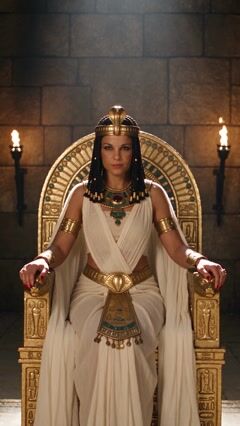
ANCIENT EGYPT — BECOMING PHARAOH. One continuous cinematic take, 25 seconds, full realtime speed, a regal historical transformation. (music only, mixed loud and full so the score dominates from the first frame: an ancient-Egyptian-flavoured cinematic score — frame drums, plucked lyre and oud, a breathy reed flute and low horns, building through swelling strings to a regal orchestral peak on the final reveal) <soft crackle of torch flame, a faint chime of gold, a low resonant chord> IDENTITY — @image1 is the person, identity kept EXACTLY from the reference the whole time; keep the exact same face and natural features as the reference — same nose, same eyes, same skin, same face shape — only what is present in the reference. Only their adornment and styling change, never their identity. Preserve their gender presentation exactly as shown. Use they / their / them only. AUTHENTIC PTOLEMAIC-EGYPTIAN STYLING ONLY — real ancient tools and materials, using only the methods of ancient Egypt. JEWELLERY IS ALWAYS HAND-PLACED — every garment and every piece of jewellery is physically carried into frame in the attendants' hands and put onto @image1 with a clear, visible physical action: lifted up to them, wrapped around, clasped, or slid into place by their fingers. Each piece exists in an attendant's hands first and is then placed on their body, settling naturally with real weight. BEATS (25s): 0–4s: @image1 stands in a torch-lit sandstone chamber in a plain undyed linen tunic; their own hair is exactly as in @image1, ALREADY finished and dressed with a few small gold rings where its length allows, complete from the first frame and left untouched. Warm low torchlight. Camera: slow push-in. 4–9s: two attendants step in from either side holding the garments and jewels in their hands; they drape a finely pleated white linen robe over their shoulders, then one lifts a broad gold-and-carnelian wesekh collar up to their chest with both hands and fastens its clasp behind their neck, while the other slides carved gold armlets up each of their upper arms one at a time. Camera: slow orbit following the hands as they place each piece. 9–15s: an attendant lines @image1's eyes using a slender kohl rod drawn from a small alabaster kohl tube — a single bold matte-black line along the lash line, extended in one long tapered stroke toward the temple, authentic ancient kohl kept as a simple bold flat line; then a fingertip presses a little red ochre onto their lips and cheeks, kept to suit their gender presentation as shown in @image1. Camera: tighten to the face. 15–19s: an attendant lifts a golden uraeus circlet with a rearing cobra in both hands and lowers it onto @image1's head, settling it into place with deft fingers; @image1 opens their eyes fully — dark kohl-lined, commanding and serene — as faint gold dust drifts in the torchlight. Camera: ease back. 19–25s: @image1, now a full pharaoh-era ruler, turns to camera and settles onto a carved gilded throne with a slow, sovereign expression as the score peaks; torch flames flicker across the gold. Camera: slow push-in to the final portrait. LOOK: ultra-photorealistic historical cinematic, 50mm close and 35mm wide, shallow depth of field, warm torch glow against cool stone shadow, drifting gold dust, authentic finely pleated linen, broad gold wesekh collar, kohl-lined eyes with a touch of red ochre, their own hair with small gold rings, uraeus circlet, natural motion blur, film grain, photoreal throughout, clean frame with no on-screen text or logos.

Arrastra el clip hacia los lados
VERTICAL 9:16 30 seconds. TikTok talking-head UGC. Handheld selfie, medium close-up, slight sway. Jump cuts. No full-screen app B-roll cuts — they stay on camera. CHARACTER LOCK: the person is exactly @image1. Preserve face, hair, skin, age, build, gender presentation. Use they / their / them only. @image1 = FACE only. Photocopy this person. Glasses only if they wear them in @image1. Their own top from @image1. Small black lavalier mic clipped to it. Phone in one hand. @image2 = THE APP on the phone. Photocopy this screen UI onto the phone when it is readable. SET: bright home office, wood-paneled walls, potted plant. 0.0–4.0s Lean in, eyebrows up, point at camera. “Okay, if you travel and you’re still buying SIM cards at the airport, stop. Watch this.” 4.0–11.0s Head-shake, eye-roll. “Last trip I landed in Vietnam, no data, standing in a line for a SIM card, trying to figure out which plan wasn’t a scam. Never again.” 11.0–21.0s Phone up next to the face. Screen shows @image2 as they tap. “Now I use this app. You type where you’re going, it shows me eSIM plans for that country, you pick one, buy it, and install it right in the app. Took me two minutes on my couch.” 21.0–25.0s Lower phone, count on fingers. “And it works alongside your normal SIM, so you still get texts from home.” 25.0–30.0s Smile, shrug. “Landed, connected, done. Just grab it in your app store. You’re welcome.” Same person. No extra people. Never a studio still as frame 0.
COSTUME REVEAL — DÍA DE MUERTOS / LA CALAVERA. One continuous cinematic take, full realtime speed, a big dramatic transformation. (music only, mixed loud and full so the score dominates from the very first frame: a haunting Spanish guitar and mariachi-tinged motif building through swelling strings into a big dramatic orchestral swell on the final reveal) <a soft rush of wind through petals, a warm candle crackle, a low resonant chord> @image1 is the person, identity kept exactly from the reference the whole time — the same face before, during and after; an adult, fully clothed and decent. Only the look and costume change, never the identity. BEATS (20s): 0–4s: @image1 stands in a candlelit room among marigold flowers and glowing ofrenda candles; a warm gust suddenly stirs the petals into the air. Camera: slow push-in. 4–9s: a swirl of glowing marigold petals and candle-smoke spirals up @image1's body; where it passes, the clothing becomes an ornate black charro suit with rich silver embroidery. Camera: orbit @image1. 9–14s: the swirling petals sweep across @image1's OWN face and an intricate calavera sugar-skull design paints itself over it — black-ringed eye sockets, delicate white filigree lines and dots across the same face — the eyes catching a warm glow. Camera: tighten to the face. 14–17s: an ornate decorated Mexican sombrero settles onto @image1's head as the swirl calms into softly drifting petals; @image1 lifts their head, elegant and commanding. Camera: ease back to a full figure. 17–20s: @image1 turns fully to camera in the complete La Calavera charro look with the ornate sombrero, marigold petals drifting around them, with a slow, striking, confident expression as the score peaks. Camera: slow push-in to the final portrait. LOOK: ultra-photorealistic cinematic horror-glamour, 50mm close and 35mm wide, shallow depth of field, warm candle-and-marigold glow against cool shadow, drifting petals, rich black-and-silver charro and Day-of-the-Dead detail, natural motion blur, film grain, photoreal throughout, clean frame with no on-screen text or logos.
HAUNTED HOUSE TOUR — THE GRAND STAIRCASE. One continuous eerie cinematic take, full realtime speed, a connected build to one loud terrifying climax. (music only, mixed loud and full so it dominates the entire soundtrack from the very first frame: creeping strings and low groaning drones rising through swelling dread into a violent orchestral stinger at the final scare) <a slow chandelier creak, a heavy door groan, a cold rushing wind, a sudden shriek> @image1 is the person and the only living person in frame, identity kept exactly from the reference the whole time, an adult, fully clothed and decent, carrying a lit candelabra. SETTING — a vast dark foyer of an abandoned mansion at night: a grand sweeping staircase, a huge cobwebbed chandelier, tall shadowed portraits, a checkered marble floor, cold moonlight through high windows, drifting dust, a heavy front door; real, richly detailed depth. THE HAUNT — a tall pale figure in a tattered dark old-fashioned gown, its face bone-white with hollow black eyes, moving in slow, wrong, jerking lurches. BEATS (20s), one connected build: 0–4s: @image1 steps into the vast foyer at the foot of the grand staircase, candelabra raised; the chandelier above sways and creaks. Camera: slow push toward the stairs. 4–8s: at the top of the staircase a tall door slowly creaks open into pure darkness; a cold wind rushes down and gutters the candles; @image1 looks up. Camera: tilt up to the dark doorway. 8–12s: the pale figure steps out of the darkness at the top and begins to descend the staircase toward @image1 with slow, jerking, wrong movements. Camera: hold on the descending figure. 12–16s: with each flicker of the chandelier the figure is suddenly closer — halfway down, then near the bottom — hollow-eyed and reaching; @image1 backs toward the front door. Camera: match the flickers, snapping closer. 16–20s: @image1 turns to flee out the front door but it will not open; they spin around — the figure is right at the foot of the stairs, its bone-white face inches away, lunging with a shriek that fills the frame as the last candle dies to black. Camera: whip to the face, snap to black. LOOK — eerie ultra-photorealistic cinematic horror, 35mm and 50mm, shallow depth of field, cold moonlight and warm candle glow, drifting dust, real grand-mansion and Gothic detail, natural motion blur, film grain, photoreal throughout, clean frame with no on-screen text or logos.
GHOST APPARITION #2 — THE POSSESSION. One continuous eerie cinematic take, full realtime speed, a connected build that resolves at the very end. (music only, mixed loud and full so it dominates the entire soundtrack from the very first frame: cold ethereal strings and a ghostly choir shimmer rising through swelling dread and warping demonic drones to a peak, then softening and clearing as it passes at the end) <a low spectral wind, a rising whisper, a bone crack, then a soft release and a settling breath> @image1 is the person and the only person in frame, identity kept exactly from the reference the whole time. SETTING — a dim candlelit room at night, old furniture, drifting mist, cold moonlight through a window, real depth. BEATS (20s), one connected build that resolves: 0–4s: @image1 stands alone in the dim room, then their whole body suddenly stiffens and jerks violently on its own, head snapping sharply to one side, as the candles flare and objects on the shelves tremble. Camera: slow push-in. 4–8s: @image1's body rises up off the floor on its own, arms falling limp, head tipping back, hair and clothing streaming upward as a cold wind swirls around them. Camera: crane up with the rising body. 8–12s: @image1's body arches into a deep unnatural backbend in mid-air, fingers splayed and rigid; the furniture slides across the floor and the candles gutter. Camera: slow orbit around the levitating figure. 12–16s: @image1's head snaps forward and their eyes roll back to solid, flat, blank white — no pupils and no irises at all, dull and matte with no glow or light coming from them; the possession peaks at its most intense. Camera: tighten on the face. 16–20s: it passes all at once — @image1's body sinks gently back down to the floor, the white clears from their eyes as their own normal pupils and living face return; they straighten up, themselves again, breathing hard but calm, as the mist clears and the candles steady. Camera: ease in on the restored, normal face, held to the last frame. LOOK — eerie ultra-photorealistic cinematic ghost-horror, 35mm and 50mm, shallow depth of field, cold blue moonlit grade with warm candle glow, drifting mist, real spectral refraction and cold rim glow, natural motion blur, film grain, photoreal throughout, clean frame with no on-screen text or logos.
HAUNTED HOUSE TOUR — THE BANQUET OF THE DEAD. One continuous eerie cinematic take, full realtime speed, a connected build to one loud terrifying climax. (music only, mixed loud and full so it dominates the entire soundtrack from the very first frame: creeping strings and a warped waltz motif rising through swelling dread into a violent orchestral stinger at the final scare) <a faint clink of silverware, a slow chair scrape, a cold wind, a sudden shriek> TWO SEPARATE PEOPLE — never merged, never the same face: • @image1 is the LIVING GUEST — the person in @image1, identity kept EXACTLY from the reference from the first frame to the last. Their face stays a NORMAL, LIVING, HUMAN face the entire time and NEVER changes, greys, decays, or turns into a skull or skeleton. They are an adult, fully clothed and decent, holding a lit candelabra. • The DEAD HOST is a DIFFERENT person from @image1 — a tall gaunt spectral figure in decayed black Victorian robes with a long tattered veil; the HOST's face is the skeletal one — a bare skull-like face with hollow black eye sockets and shrivelled grey skin. The skull face belongs ONLY to the host, never to @image1. SETTING — a grand candlelit dining hall in an abandoned mansion at night: a very long banquet table set with tarnished silver, cobwebbed candelabra and wax-dripped candles; rows of high-backed chairs holding silent seated corpse-guests in decayed formal Victorian dress with hollow eyes; faded tapestries, a great stone fireplace with dying embers, cold blue moonlight through tall arched windows, drifting dust motes and cobwebs; real, richly detailed depth. BEATS (20s), one connected build: 0–4s: @image1 pushes open the tall double doors and steps into the long hall, candelabra raised, their breath faintly visible in the cold; the seated dead are motionless, facing the table. Camera: slow push-in from behind @image1 down the length of the table, their living face lit warm by the candles. 4–8s: as they walk past, the gaunt seated corpses slowly turn their heads in sequence to watch them, jaws slack; they stop, frightened, their normal living face clear in the candlelight. Camera: track past the turning heads. 8–12s: the candles snuff out one by one down the table toward the far end; at the head of the table the tall DEAD HOST rises and LIFTS OFF THE FLOOR — floating upward into the air, hovering HIGH ABOVE the table with the host's feet dangling a full metre above the tabletop and the long robes trailing beneath, hollow eye sockets fixed on @image1. Camera: tilt up to reveal the airborne host well above the table. 12–16s: the DEAD HOST GLIDES THROUGH THE AIR high above the length of the table toward @image1 — drifting, weightless, floating, NEVER once touching, standing on, walking or running along the tabletop, the host's feet always off the surface — while the seated corpses rise in unison; @image1 turns and flees back toward the doors. Camera: whip and track their retreat. 16–20s: @image1 reaches the tall doors but they SLAM SHUT in their face; they spin around — the DEAD HOST is now directly in front of them, the host's skeletal SKULL-face and hollow eye sockets inches from @image1's terrified LIVING human face, the host's jaw wrenching open into a deafening shriek that fills the frame as the last candle dies to black. Throughout this, @image1's own face stays fully human, living and unchanged — only the host is skeletal. Camera: whip to the two faces side by side, snap to black. IDENTITY LOCK: @image1 (the living guest) and the DEAD HOST are two distinct separate people who appear together in the same frame at the climax. The skull / skeletal face is the HOST's alone. @image1's face stays a living human face the entire clip. Preserve their gender presentation exactly as shown. Use they / their / them only. LOOK — eerie ultra-photorealistic cinematic horror, 35mm and 50mm, shallow depth of field, cold blue moonlight and warm candle glow, drifting dust, real decayed Victorian and banquet detail, natural motion blur, film grain, photoreal throughout, clean frame with no on-screen text or logos.
ZOMBIE TRANSFORMATION — THE LUNGE. One continuous cinematic body-horror take, full realtime speed, violent and dramatic throughout. (music only, mixed loud and full so the score dominates from the very first frame: sickly rising dread and low drones that build through convulsing stingers into a violent hit and huge swell on the final lunge) <a ragged choking breath, a wet sinew crackle, fluorescent tubes bursting, a low guttural rasp> @image1 is the person and the only person in frame, identity kept exactly from the reference the whole time, an adult, fully clothed and decent; the clothing may tatter slightly but stays on. Tasteful body-horror — ashen pallor, dark veins and undead posture, never gore or open flesh. BEATS (20s): 0–3s: @image1 stumbles into a flickering morgue corridor, gasps, and doubles over as a violent spasm hits, dark veins erupting across a hand. Camera: hard handheld shove-in. 3–6s: the greying races up the arm; @image1 slams back against the wall, convulsing, as the fluorescent tubes burst one by one down the corridor. Camera: shaking, following the body. 6–10s: @image1 claws at their own face as the change floods it — the skin greying, the eyes rolling milky-white, the jaw wrenching; they thrash and knock a metal gurney crashing over. Camera: whip around them. 10–14s: the fight ends violently — the head snaps up, the spine arching into a feral hunch, a silent guttural snarl baring teeth, dark purple-black veins webbing the ashen face, sunken bloodshot eyes. Camera: settle hard on the monstrous face. 14–17s: the zombie's head twitches and locks onto the camera, breathing fast and feral, taking a lurching step forward. Camera: slow creep in. 17–20s: the zombie EXPLODES into a lunge straight at the camera with a violent silent snarl, slamming into the lens to a hard black-out on impact. Camera: rushed toward, snap to black. LOOK: ultra-photorealistic cinematic horror, 50mm close and 35mm wide, shallow depth of field, sickly cold flickering grade, real ashen veined skin, natural motion blur, film grain, photoreal throughout, clean frame with no on-screen text or logos.
Your pale spectral double — wearing your exact face — peels out of a fogged mirror behind you, drifts closer, then rushes straight at the camera. Upload a photo, you keep your own face. One continuous cinematic take with a loud score. 15s.
CHARACTER LOCK — HIGHEST PRIORITY: The person in every shot is exactly the person in @image1. Preserve their facial identity, facial structure, eye shape and spacing, eyebrows, nose, mouth, exact skin tone, hairline, hairstyle, hair length, texture and colour, freckles and distinctive marks, apparent age, build and body proportions — identically, shot to shot. Preserve their gender presentation exactly as shown; do not masculinize, feminize or otherwise reinterpret it. Do not beautify, slim, de-age or restyle them. Use they / their / them only. ATTACHED IMAGES ARE MANDATORY AND FINAL: The attached images outrank every word written below them. Wherever an attached image and this text disagree, follow the image — including the product’s exact shape, features and proportions. ASSET MAP: @image1 — the tiny person. @image2 — the product, exactly as shown, unchanged and not regenerated — same shape, colour, materials, label and logo text in every shot it appears. HANDS: hands are always anatomically correct with five fingers each, naturally proportioned, in every shot they appear. SINGLE SUBJECT: only @image1 appears in this video — no other people or hands enter frame at any point. SCALE REALISM: @image1 is shrunk to only a few centimeters tall relative to @image2, which sits at its true full size, towering like a landmark. PROP CONTINUITY: a natural loop, strap, fold, or edge on the product — whatever @image2 actually shows — is established in the opening frame as the thing @image1 grabs. It does not appear out of nowhere later. CAUSALITY LOCK: @image1 only swings because they grab and push off from that natural feature of the product — the motion has a shown, deliberate cause throughout, not an unexplained swing. Do NOT default to a calm, mostly-still shot. Shot 1 must open already in motion. SCENE: @image1, shrunk down, stands at the base of the product (@image2), which towers beside them at full size, a natural loop/strap/edge of its own design within reach, design/label/logo unchanged. 0–2s: Already reaching up, @image1 grabs that natural feature with both hands and kicks off, starting to swing. 2–5s: They swing in a wide, confident arc past the side of @image2, close enough that its real texture and details are clearly visible passing by. 5–7s: At the peak of the swing, they let go, sailing briefly through the air before landing in a controlled crouch on another part of the product’s surface. 7–10s: They rise from the crouch and stand tall, looking out over the towering product with a proud grin — the full scale contrast between them and @image2 clearly visible in this final frame. STYLE: whimsical live-action macro realism, warm natural lighting, shallow depth of field, believable physical interaction with the product’s real surface — no invented parts that don’t match @image2's actual design. AUDIO: natural foley only. No music, no BGM, no voiceover, no narration. No on-screen text, no watermark, no subtitles.
Stand in a ring of candles as embers sweep up and transform your look into a dark horned demon ruler — same face, glowing ember cracks, a menacing final grin. Upload a photo, you keep your own face. One continuous cinematic take with a loud score. 15s.
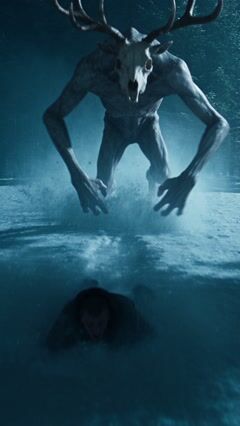 Monster Escape — The Antlered (Snowbound)Seedance 2.5 · 9:16 · 15sRecrear el flujo