
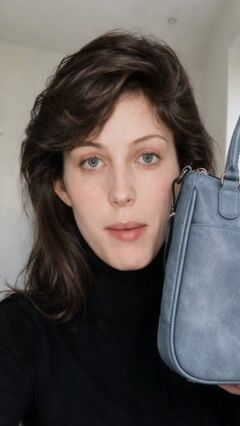
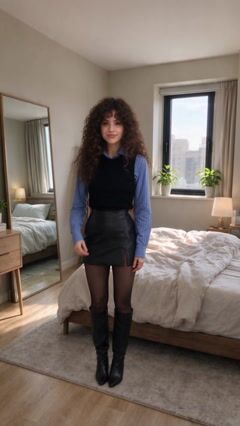

Authentic smartphone UGC, filmed vertically by the person on camera holding their own phone at arm's length. Natural indoor and outdoor daylight only, slight constant handheld movement, casual off-centre framing, realistic skin texture, genuine expressions, natural pauses, imperfect but believable camera movement, relatable creator energy and spontaneous social-media storytelling. It must feel like a real creator filmed it for TikTok or Instagram, not a polished commercial or a cinematic product advertisement. No cinematic cinematography, no studio lighting, no dramatic slow motion, no elaborate camera moves, no professional voiceover, no dramatic music, no product-only sequences and no excessive product close-ups. @image1 is the reference board and is an absolute lock on both the person and the bag. The person is the large portrait in its left zone — face, build, apparent age, hair and colouring are taken from it exactly, with no drift and no reinterpretation in any shot, and the face in every shot matches it. Preserve their gender presentation exactly as shown. Use they / their / them only. Whatever clothing it shows is what they wear throughout. The bag is the set of views in its right zone — same silhouette, proportions, materials, colour, hardware, closure and label artwork, and the same carry system in the same number and placement. Never redraw, restyle or substitute either. Only that bag exists; no second bag appears at any point. @image2 is the storyboard and is followed exactly, panel for panel: six shots in that order, matching its framing, subject scale, pose and composition. One person is on camera throughout and stays the main subject; the bag is always clearly visible, but never at the expense of their face and reactions. STAGING — follow @image2 for this in every shot; it is drawn correctly there. HANDS: the camera is the phone, so the hand holding it is never seen. A shot is either HELD — filmed at arm's length by the person, that hand off-frame, exactly ONE hand visible — or PROPPED, phone set down, both hands free, exactly TWO hands visible. Never more than two hands, never a second phone, never a spare arm entering frame. DEPTH: the bag is in one plane per shot. Either held out clear of the body with visible air between it and the torso, or worn or resting on a surface with the camera back far enough to see it sit. Never close to the lens and on the body at once. Where it touches them the contact is a named point — shoulder, forearm, hip — and any strap passes visibly in front of or behind the body, never through it. SUBJECT SCALE — wherever the bag is handled it is the largest object in frame and may crop at the edges rather than shrink to fit. Never let it sit so far back that its closure, hardware, interior or carry fixings stop being readable. Shot 1 (0–5s) — HELD, one visible hand. They hold the bag out to one side of their face, arm extended toward the lens with clear air between it and their body, so it fills much of the frame and crops at that side. Their face stays clear on the other side as they speak straight to camera in a warm, offhand tone: "Okay, I think I just found my new everyday bag." Shot 2 (5–9s) — PROPPED, two visible hands. The phone is set down and both hands turn the bag over in front of them, held away from the torso against the room behind, filling the frame edge to edge. They let the outside, the closure and the way it is carried come round to the lens in turn, still talking to camera. Shot 3 (9–14s) — PROPPED, two visible hands. The camera is close over the table and the bag lies open on it, filling most of the frame, nothing of the body between it and the lens. They load in the things they carry — a laptop, a phone, a wallet, sunglasses, a notebook, a few small cosmetics — working through the compartments the way someone actually packing would, with no scripted demonstration. The laptop and the interior read clearly. Shot 4 (14–19s) — the mirror shot, and the only time the phone is seen, in the reflection in one raised hand. Two visible hands: that one, and the other resting at the bag. They wear it in its natural carry position, the strap or handle passing clearly over the shoulder or through the hand, and turn slightly to see how it looks with what they are wearing, the free hand adjusting how it sits. They say: "I love that it actually looks cute without feeling like I'm carrying a huge bag." Shot 5 (19–23s) — HELD, and no hands on the bag: the camera hand is off-frame and the other swings naturally at their side. Outside, walking, the bag worn against the shoulder or hip at a visible contact point and riding in the lower part of the frame. They glance between the lens and the street ahead and the frame sways with their stride. Shot 6 (23–30s) — PROPPED, two visible hands. Sat in a café, the camera low and close, the bag on the chair beside them filling the lower two thirds of the frame. Both hands go to its open mouth, lift the laptop clear, then pack it back away. Then they step back outside, turn the camera around to themselves and finish: "It fits everything I need, looks good with basically everything, and honestly… this is definitely my new everyday bag." They hold a warm smile on the lens to the final frame at 30s. Audio is the phone's own: their voice close and conversational, ordinary room tone indoors, ordinary street and café noise outdoors. No music bed, no voiceover. No subtitles, captions or watermark are burned into the frame.
Arrastra el clip hacia los lados


Generate a glossy music video of two people strutting down a white corridor in giant puffy suits.

A product sits forgotten on a shop shelf. A mouth opens on its front and it quietly talks about being ignored, until a hand reaches in, lifts it off the shelf and finally uses it.

CHARACTER LOCK — HIGHEST PRIORITY: The person in every shot is exactly the person in @image1. Preserve their facial identity, facial structure, eye shape and spacing, eyebrows, nose, mouth, exact skin tone, hairline, hairstyle, hair length, texture and colour, freckles and distinctive marks, apparent age, build and body proportions — identically, shot to shot. Preserve their gender presentation exactly as shown. Use they / their / them only. Do not masculinize, feminize or otherwise reinterpret it. Do not beautify, slim, de-age or restyle their face or hair. No face changes, no identity drift. No other people share their face. @image1 is identity only — photocopy face, hair, eyes, skin and age. Do not wear the clothing or any jewellery from the still. The still has no gym set — wardrobe and setting come from this prompt. ASSET MAP: @image1 — the character. SINGLE SUBJECT: Only this one person appears. No other people in frame. HANDS: hands are always anatomically correct with five fingers each, naturally proportioned, in every shot they appear. Hands never hold a phone, never hold a camera, never hold a speaker. Empty hands, laces, barbell, plates, or a water bottle only. NO PHONE — HIGHEST PRIORITY: There is no phone anywhere on this person. No phone in either hand, no phone at the ear, no phone in a selfie grip, no phone on a selfie stick, no phone in a pocket being pulled out. The camcorder is already rolling on a rack or mirror — they never film themselves with a device in hand. A small speaker can sit on a bench in the background, untouched. UNBRANDED SNEAKERS — HIGHEST PRIORITY: The training sneakers are plain, generic, unbranded. No logos, no wordmarks, no letters, no numbers, no swoosh, no stripes that read as a brand, no heel tabs with type, no recognizable designer marks. Same pair, clearly visible, every shot. CAMERA/LOOK: Authentic DV/16mm camcorder POV, already propped on a mirror or rack — never held as a phone. Shaky framing, imperfect focus, clumsy zooms, occasional face cutoffs, soft tape blur, subtle tape noise, bloomed gym lights, flickering exposure, muted contrast, realistic skin. Sweat gradually increases. Music plays throughout from the off-screen speaker. STYLE: Playful new-sneakers intro → rising tension before the squat PR → quiet focus during the lift → energetic triumphant ending. Fast handheld cuts with natural gym ambience. PRODUCT (wardrobe/gear only, not identity): a new pair of unbranded training sneakers, worn with their regular gym clothes, no jewelry. The sneakers are the featured product — kept clearly visible and consistent in every shot. SETTING: Early-evening gym with mirrors, squat rack, barbell, weight plates, a speaker on a bench (not in their hands), water bottle, soft overhead lighting. Any numbers or labels on the plates stay soft and unreadable — amounts are described in speech only, never as on-screen text. 30s / 12 CUTS: 1. 0-3s: Mirror shot. Empty hands. The character poses excitedly, lifting one foot to show off the new unbranded sneakers: “Okay everyone, new kicks — check these out!” 2. 3-5.5s: Close on the sneaker details as they adjust the laces and flex their foot — blank tongue, blank sides, no marks: “So comfy, and the grip is amazing.” 3. 5.5-8s: Bodyweight squats and lunges to warm up. Hands free or on hips. Speaker already playing on the bench, not held: “Playlist’s locked in, let’s get moving.” 4. 8-10s: Quick playful dance between warmup reps, laughing, empty hands. Music only. 5. 10-12.5s: At the squat rack, they load a heavier plate onto the bar: “Okay... today’s the day I try a new squat PR.” 6. 12.5-14.5s: Macro shot of the unbranded sneakers planting firmly and gripping the gym floor as they set their stance, metal clink from the plates, no dialogue. 7. 14.5-17s: Nervous close-up, shaking out their legs, no phone: “Okay. Okay. Deep breath.” 8. 17-19.5s: Side angle as they unrack the bar onto their shoulders, feet set wide and stable in the sneakers. Music lowers; breathing becomes prominent. 9. 19.5-22.5s: They descend into a deep squat, then drive back up with visible effort, heels planted and stable throughout: “Come on—come on—” 10. 22.5-24.5s: Bar racks. They stand up, stunned, breathing heavily, legs slightly shaking. Empty hands after the rack. 11. 24.5-27s: Close reaction, huge grin, hand over mouth: “Wait—I actually did it!” 12. 27-30s: Sweaty look into the propped camcorder, glancing down at the sneakers, triumphant fist toward camera — no phone in frame: “New squat PR! Okay, best gym shoes ever. See you all!” No on-screen text, no subtitles, no watermark, no logos.
Generate a live rally broadcast where a car showers you in dust at a gravel hairpin.
@image1 is the opening frame of the film and the single source of truth for everything in it: the round turntable with its brass rim, the three wedges it is divided into, the colour of each wedge, the three products standing on them, every small object beside them, and the collection bar at the top. Nothing is added, removed, redrawn, recoloured or relabelled. The turntable stays divided into exactly the three wedges shown in @image1 for the whole film — the same three seams meeting at the centre, the same three colours, never a fourth wedge. Each product keeps its exact shape, colours, parts and every mark it carries, as shown in @image1, and always stands upright on its wedge. One continuous 16-second take, 9:16 vertical, premium studio product film. THE POINT OF THE FILM: the turntable presents the three products one by one. Each product in turn is carried by the turning disc into a hero spot right in front of the lens, where it is seen big, sharp and upright at its own height, while the whole studio behind it takes on that product's colour. Then the disc carries it away and brings the next one. TWO THINGS MOVE, NEVER AT THE SAME TIME: 1. THE CAMERA moves only once, in the first three seconds, while the disc is still: from the high view of @image1 it glides down and forward to the HERO POSITION — low, at the height of the products, slightly above them, 50 mm look, facing the front edge of the disc, so the product standing on the front wedge fills the lower middle of the frame, big and sharp, with the studio wall behind it and the neighbouring products soft at the left and right edges. From the third second to the last frame the camera is locked in that hero position on a tripod and never moves again — no orbit, no pan, no drift, no zoom. The camera never travels around the disc. 2. THE DISC turns only from the third second on: it spins around its own centre at one slow, steady speed, a third of a turn every four seconds, clockwise as seen from above. It is the disc that carries the products past the lens: each wedge, with its upright product and its small objects, rides round from the right side of the frame into the hero spot at the front, holds the spotlight there, and rides on out to the left, while the next wedge comes in from the right. The seams visibly sweep past the front as the wedges change. Every product is always solid, upright and on its own wedge, never sliding, fading, doubling or lying down. THE COLOUR RULE: the seamless studio wall behind the turntable and the light in the studio take the colour of whichever product is in the hero spot — a soft, lighter tone of that product's own dominant colour on the wall, a deeper tone of it in the shadows — and flow smoothly to the next product's colour as the next one arrives. THE COLLECTION BAR: the bar at the top of @image1 is a fixed on-screen overlay. It stays exactly as in @image1 in every frame — same position, same size, the same three tiles in the same order — and nothing in it ever lights up, moves or changes. TIMELINE: [0–3 s] Opens on @image1. The disc is still. The camera glides down and forward in one smooth move into the hero position; the product on the front wedge grows big and sharp in the lower middle of the frame, and the wall behind it takes on its colour. [3–7 s] Camera locked. The disc starts turning: that first product rides slowly through the hero spot and out to the left, and the next product rides in from the right into the hero spot, big and sharp; the wall flows to its colour. [7–11 s] Camera locked. The disc keeps turning: the next product rides in from the right into the hero spot, big and sharp; the wall flows to its colour. [11–15 s] Camera locked. The disc keeps turning: the third product rides in from the right into the hero spot, big and sharp; the wall flows to its colour. [15–16 s] Camera locked, the disc still turning slowly; the film ends on that product in the hero spot. NOTES: one turntable divided into exactly three wedges, one take, no cuts. The camera moves only in the first three seconds and is locked after that; after that only the disc turns. Exactly three products, each always on its own wedge, never duplicated, swapped or merged. Nothing in the frame carries added text — each product keeps its own label and logo exactly as shown. No people and no hands. AUDIO: a soft, minimal instrumental pulse under the whole take, the quiet smooth hum of the turning disc, and a faint airy whoosh each time the colour flows to a new product. No subtitles.

CHARACTER LOCK — HIGHEST PRIORITY: The person in every shot is exactly the person in @image1. Preserve their facial identity, facial structure, eye shape and spacing, eyebrows, nose, mouth, exact skin tone, hairline, hairstyle, hair length, texture and colour, freckles and distinctive marks, apparent age, build and body proportions — identically, shot to shot. Preserve their gender presentation exactly as shown; do not masculinize, feminize or otherwise reinterpret it. Do not beautify, slim, de-age or restyle their face or hair. No face changes, no identity drift. No other people share their face. @image1 is identity only — photocopy face, hair, eyes, skin and age. Do not wear the clothes or jewellery from the still. The still has no aqua park — wardrobe and setting come from this prompt. ASSET MAP: @image1 — the character. SINGLE SUBJECT: Only this one person appears. No other people in frame. HANDS: hands are always anatomically correct with five fingers each, naturally proportioned, in every shot they appear. STYLE: Vertical selfie-style UGC action-camera review, shot on iPhone front and back camera mix, natural daylight, handheld authentic energy, casual “showing a friend how I film everything” vibe, real skin tones, no filters. SETTING: A sunny outdoor aqua park — water slides, splash pools, palm-lined decks, bright open sky. Water spray and natural sunlight throughout. PRODUCT/OUTFIT (wardrobe/gear only, not identity): a lightweight quick-dry rash guard over swimwear. They hold a compact rugged action camera — small waterproof body, wide lens. No jewelry. Action and spoken dialogue (native sound, they speak these lines): 0.0-4.0s SHOT 1 — Front camera: They hold the action camera close to the lens, poolside spray drifting past, relaxed smile. They say: “Okay, I’ve been filming everything with this.” 4.0-8.0s SHOT 2 — Back camera: They walk along the aqua park deck toward a water slide, camera capturing stable forward motion despite the wet, busy surroundings. They say: “It stays smooth even when I’m moving.” 8.0-12.0s SHOT 3 — Neck-mounted POV: The camera now hangs from their neck, lens facing outward, capturing natural walking motion past pools and slides. They say: “I just wear it and film — even here.” 12.0-15.5s SHOT 4 — Medium-wide third-person: The camera is set on a poolside ledge. The action camera is visible neck-mounted on them as they walk toward frame, a light splash of water passing nearby. They say: “I don’t really think about it.” 15.5-18.5s SHOT 5 — Close-up back camera: They bring the camera close to the lens, showing buttons and lens detail, a few water droplets beading on the waterproof body. They say: “And it just shrugs off the water.” 18.5-22.0s SHOT 6 — Final front camera: They hold the camera beside their face, water slides and pool splashes behind them, calm confident smile. They say: “Yeah, I’m definitely bringing this everywhere I go.” Direct every second through 22.0s. Never freeze. Never cut to the attached still. Never open on a studio headshot. No on-screen text, no subtitles, no logos.
The flight begins at the end of the drawn route that lies nearest the left edge of the map and travels along the route to the end nearest the right edge. The opening dive goes down onto that starting point, not into the middle of the map. @image1 is the first frame: an illustrated map with a marked route drawn across it, whatever map it is and wherever in the world it goes. Use it as the opening frame and as the geography of the flight. Do not keep its drawn lines, its lettering or its paper texture once the flight begins. One continuous 28 second high-speed first-person flight in a single unbroken take, diving out of that map into the real world and racing the whole marked route from its left end to its right end, everything fully photorealistic. [Route] The flight follows the route drawn on @image1 from its left end to its right end, passing the landmarks the map shows in the order the drawn route connects them. Every landmark on the map appears exactly once, each gets a roughly equal share of the 28 seconds, and no landmark the map does not show is invented. The order the map draws is the order the flight takes. [Point of view] The camera itself is the thing flying. This is a pure first-person FPV view looking straight ahead, and the frame holds only the world in front of it: ground, sky and open air. The picture stays empty of any machine, vehicle or flying object, and the ground below carries no machine's shadow. Nothing that carries the camera is ever seen, because the viewer is inside it looking out. [Camera behaviour] Wide-angle FPV lens with slight barrel distortion at the edges of the frame, immersive and low to the ground. Constant aggressive forward momentum that never stops, never hovers and never reverses. The horizon rolls and tilts steeply into every turn, motion blur streaks at the edges of the frame, the ground rushes underneath. One single continuous take with no cuts, no edits and no black frames. [Look] Fully photorealistic live-action aerial footage throughout, as if shot on a real cinema FPV camera. Every place is rendered in its own real materials and its own real weather, with natural sunlight, real shadows and atmospheric haze, exactly as that place looks in life. Clean untouched landscape with nothing drawn, painted or marked on the ground anywhere. TIMELINE (28 s): 0–4s: OPENING. The flat map from @image1 seen from straight above. The camera accelerates and dives down onto the left end of the drawn route, and as it falls the paper dissolves away into the real photorealistic terrain of that place, real ground, real light. The camera levels out, races low toward the first landmark and banks around it. Everything from here on is live-action photoreal. 4–24s: MIDDLE. The camera races from each landmark to the next along the route without ever stopping. At each one it does one thing and moves on: banks hard around it, climbs its face, races low straight at it, drops into the terrain around it, or weaves once through it. Between them it crosses the real landscape that lies in between, low over whatever forest, mountain, water, plain or desert the geography puts there. 24–28s: CLOSING. The last 4 seconds belong to the final landmark at the right end of the route: the camera races at it, then pulls up hard and climbs fast and high until the ground falls away into real cloud and haze and the horizon curves. This closing climb is not rushed. [Maintain Consistency] One single unbroken flight, always moving forward, always travelling left to right along the route. Fully photorealistic live-action footage in every second, from the moment the map dissolves at the start to the end. The ground and the sky stay clean and unmarked: bare natural terrain with no line, no path, no ribbon, no glowing trail and no marking of any kind drawn across it. The frame holds only the world ahead, empty of any machine or flying object. [Audio] (sweeping cinematic orchestral adventure score, building continuously from a quiet single string note to a full brass finale) <constant rushing wind and a steady high propeller whine running under the whole take> <the natural ambience of each place the flight passes through> No dialogue. No subtitles.
HORIZONTAL 16:9 29 seconds. UGC product review. Hard cuts. @image1 = THE PRESENTER, the person in @image1. Photocopy FACE only. Preserve their gender presentation exactly as shown. Use they / their / them only. Ignore the clothes in @image1. Wardrobe: comfortable at-home loungewear that suits the presenter. Their own hair exactly as in @image1, worn loose (drying demo). @image2 = the hair dryer. Photocopy THIS tool exactly: the exact body, colour, nozzle, markings and buttons shown in @image2. Never invent a different dryer. Bright modern living room, beige couch, pillows, minimalist walls. No on-screen captions except the printed logo on the dryer. Lip-sync the English lines. 0:00–0:04 INTRO. Static medium, sofa. They hold the @image2 dryer in both hands, talk to camera, warm smile. VO: “Okay, I finally got this new hair dryer, and I have to show you all why I’m loving it.” 0:04–0:09 MACRO handle. Thumb presses the dryer's speed/heat buttons. VO: “It has multiple heat and speed settings, and I love how lightweight it feels in my hand.” 0:09–0:14 Medium sofa. Wet hair section in one hand, dryer in the other, airflow visibly moving strands. VO: “The airflow is really strong, but the dryer itself feels so easy to handle...” 0:14–0:17 Over-the-shoulder to a large arched floor mirror. They dry their hair while watching their reflection, hair smoothing. VO: “...and it dries my hair quickly while leaving it looking smooth and styled.” 0:17–0:20 Extreme close-up nozzle along wet strands. Dryer sound only. No talk. 0:20–0:24 Front close-up portrait. Dryer low. They touch their smooth hair, confident smile. Soft music, no talk. 0:24–0:27 Sofa medium. Dryer up next to their face, big smile. VO: “Honestly, this might be my new favorite hair tool.” 0:27–0:29 Tight product hero. Hand holds the dryer. The dryer's own printed logo from @image2 reads clearly, exactly as printed. Music fade. No talk. Same presenter. Same dryer. Never a studio packshot as frame 0.
VERTICAL 9:16 30 seconds. ONE continuous handheld selfie. Medium close-up. They walk forward down a sunny city sidewalk. Slight sway from their steps. No cuts. @image1 is THE PERSON. Photocopy FACE and hair exactly as in @image1, with this outfit: a casual summer outfit with sneakers. Preserve their gender presentation exactly as shown. Use they / their / them only. NOT the top from @image1. NOT a studio grey void as frame 0 — they are already walking on the street. Iced coffee with a straw in their RIGHT hand the whole time. Lip-sync the English lines. They talk to the lens like a vlog. 0:00–0:11 Walking, looking into the lens: “Okay, walk with me. I’m meeting my best friend for brunch, and I’m, like, 10 minutes early for once. I love this street in the morning before all the people...” 0:11–0:15 Flower stall on their LEFT, colorful bouquets in white buckets. Glance left, back to camera: “Oh, the flower stall’s out again. So pretty.” 0:15–0:26 Bakery on their RIGHT, window of round pastries. Look right, back, laugh: “And that bakery? No. Be strong.” 0:26–0:30 Keep walking, smile, small wave: “Okay, it’s just up here. I’ll show you what we get. Bye!” Trees, storefronts, parked cars. No on-screen text. No logos. Same face every frame. The best friend is only mentioned in the lines and never appears on screen; passers-by are generated background extras, not a second lead.
 Mango GelatoRecrear el flujo