
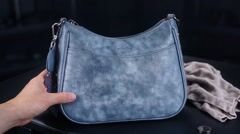

A cinematic product-creation film follows one maker making the exact object shown in @image1 (product plate) completely from scratch. MATERIAL TRUTH — this governs every stage below: Read the object's materials from @image1 and make it the way that object is genuinely made. The pieces, joins, tools and hand actions in every stage must be the ones its materials actually require. Leather, textile and canvas: cut panels, skiving, linings, interfacing, glue, stitching by hand or machine, edge finishing and burnishing, rivets, zips, buckles, straps and hardware set by hand. Wood: cut stock, joinery, glue, clamps, sanding, oil or lacquer. Ceramic, glass and metal: forming, shaping, joining, grinding and polishing appropriate to the material. Cosmetics, food and liquids: vessel, contents, seal, closure and label applied by hand. Rigid and electronic goods: chassis, internal components, wiring, fasteners, screws and press-fits. A chassis, circuit board, wiring, brackets, screw bosses or screws may appear ONLY if @image1 is itself a rigid or electronic product. If it is not, none of them appear at any point, and no screwdriver ever touches it. If a stage below has no equivalent in this object's making, spend that stage on the nearest real step in its craft rather than inventing a part it does not have. REFERENCE PRIORITY: @image1 is an absolute lock on the finished object's design: overall silhouette, proportions, geometry, curvature, part and hardware placement, seams, materials, surface finish, colors, lighting zones, logo placement, and all other distinctive visible details. Match these features as closely as possible. No drift or reinterpretation in any shot. Ignore @image1's background, framing, lighting, hands, desk, and unrelated objects. ENVIRONMENT: @image2 (environment plate) is the work surface and lighting for the entire film. Take the surface, its finish, the light direction and the falloff from it exactly. STORYBOARD: @image3 (storyboard) is to be followed exactly — matching shot order, framing, hand position and stage of making panel for panel. CAMERA: Use a stable front three-quarter overhead macro product view, approximately 35-45 degrees above the work surface. Keep the object centered and fully readable throughout. Shallow but usable depth of field; the developing object remains sharply readable. ONE MAKER RULE: There is exactly one maker throughout, represented only by the same consistent left and right hands and forearms. Maximum two hands visible at any moment. Every piece must be physically carried, positioned, joined, glued, stitched, fastened, pressed, fitted, or adjusted by these hands. TIMELAPSE: The work occurs as a fast, precise timelapse, returning to normal speed only for the final reveal. Hands move rapidly and purposefully with restrained natural motion blur. Use short jump cuts to compress repetitive work, but ONLY after the current physical action has visibly completed. Every cut must preserve exact continuity. The object must retain all pieces and progress established in the previous shot. No piece may magically appear between cuts. FIRST PIECES: One hand enters frame already holding the object's first and lowest piece — the first cut panel, the base, the first formed piece, whichever its making actually begins with — and lays it precisely at the center of the surface. The second hand steadies it. The next piece is brought into frame by hand and positioned beside or upon it. The object begins at its earliest stage, flat or loosely formed, nothing like the finished shape. BODY: The maker joins the first pieces so the object takes its basic form, working each join by the method its materials require — stitched, glued and clamped, fitted and fastened, or formed and set. Small pieces are brought into frame between two fingers and set into place. Everything remains physically believable and correctly scaled. CLOSURES AND HARDWARE: The maker sets whatever the object closes, fastens, carries or hangs with — the closures, fittings, trims and hardware visible in @image1 — each worked in with the correct tool for that material. The maker tests any moving part with one finger to confirm it works. Nothing activates or moves independently. OUTER SURFACE: The recognizable body of the object now takes shape. The maker works the main outer surface into place over what is beneath it — lowered and pressed, wrapped and smoothed, stitched down or joined, as the material demands. Separate panels, sections, inserts, trims or straps seen in @image1 are fitted individually. Every seam, edge and join follows the geometry of @image1. Any textured, perforated, woven, glossy, matte, metallic or transparent areas in @image1 are produced through visible physical hand interaction. FINISHING: The maker performs rapid final detailing with the tools that material calls for — a needle, a burnisher, a glue brush, a mallet, tweezers, a cloth, and a small screwdriver only if @image1 actually has screws. The hands refine alignment, gaps, seams, edges, surface transitions and small decorative elements. Any remaining visible details present in @image1 are set — inserts, accent pieces, hardware, closures, cabling or labelling. The exterior progressively reaches the exact proportions, colors, materials, surface finish, and distinctive appearance of @image1. One hand steadies the object while the other performs every final adjustment. REVEAL: The maker makes one final precise adjustment, sets the tool down, gently wipes or straightens the object once, then withdraws both hands completely from frame. The accelerated timelapse smoothly returns to normal speed. If @image1 is a powered object it now switches on and any lighting zones visible in @image1 softly illuminate; if it is not, the light on the surface lifts instead and the object settles into its finished pose. The camera performs a subtle, restrained cinematic push-in toward the finished object. Hold on a pristine premium product hero shot, matching @image1 as closely as possible. PHYSICAL CONTINUITY RULES: Every new piece enters the frame already held by one of the maker's hands. Every piece must be visibly placed before becoming part of the object. Pieces remain exactly where they were set. No piece floats or moves independently. No spontaneous material changes. No instant construction. No magical morphing. No disappearing or duplicated pieces. No unexplained changes between cuts. No machined chassis, circuit board, metal rails, brackets, screw bosses or screws unless @image1 is itself a rigid or electronic product. No screwdriver touching leather, textile, canvas or any other soft material. Nothing that resembles an electronics teardown or a repair bench. No more than two hands. No assistants. No detached or floating tools. No drawing or sketching phase. No software interface. No cursor. No menus. No annotations. No added labels — the product's own label and logo stay exactly as shown. No text overlays. The entire sequence must feel like an impossibly fast but physically believable piece of premium making, filmed as a cinematic macro product commercial.
Arrastra el clip hacia los lados


Photoreal luxury product film, shot as one unbroken take. Commercial studio lighting, crisp specular highlights travelling across polished metal, true reflections, rich saturated colour, the products held sharp throughout. No stylisation, no grade shift, no filter. Three products take turns on a round pedestal table — a glossy black top with a polished chrome rim on a slim black column — against a deep crimson seamless backdrop, with a polished stainless steel cloche covering whatever is on the stand. A hand in a white satin glove, with three chunky gold bangles stacked at the wrist, works the dome. Hold each product, the set, the dome and the hand consistent from the first frame to the last. The camera is locked off on a tripod for the whole take — front-on, centred on the pedestal, no pan, no tilt, no push, no zoom, no orbit. One continuous shot with no cuts. The hand enters from the top of frame and its fingers close around the knob of the dome. The hand raises the dome in one smooth vertical lift until it clears the pedestal, and the first product stands centred on the tabletop beneath it. The hand lowers the dome back down over the pedestal until it seats on the tabletop with a small settling weight. The hand lifts the dome again in the same smooth vertical move, and the second product now stands centred on the tabletop where the first one was. The hand lowers the dome once more until it seats on the tabletop again. The hand lifts the dome a final time, and the third product now stands centred on the tabletop. The hand carries the dome up and out of the top of frame, leaving the third product alone and centred on the pedestal, the light still working across its surface as the take ends. Every lift and every lower moves at the same unhurried pace, and each beat takes the same amount of time as the one before it. The hand never blocks the product. Audio: quiet studio room tone, a soft metallic ring each time the dome seats on the tabletop, and a light airy chime on each reveal. No music bed, no voice.


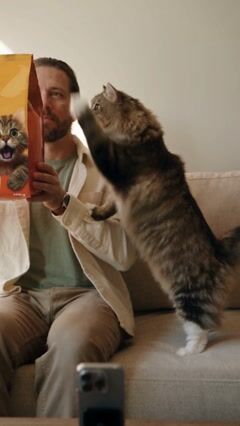
Two dogs dance the wiggle beside a pallet of dog food, in one unbroken take. One dog opens alone, the second walks in from the right and rears up, and both finish the last beats in sync facing the lens.


CHARACTER LOCK — HIGHEST PRIORITY: The person in every shot is exactly the person in @image1. Preserve their facial identity, facial structure, eye shape and spacing, eyebrows, nose, mouth, exact skin tone, hairline, hairstyle, hair length, texture and colour, freckles and distinctive marks, apparent age, build and body proportions — identically, shot to shot. Preserve their gender presentation exactly as shown; do not masculinize, feminize or otherwise reinterpret it. Do not beautify, slim, de-age or restyle them. No face changes, no identity drift. No other people share their face. ATTACHED IMAGES ARE MANDATORY AND FINAL: If an avatar image is attached, that is the person — reproduce them exactly, in every single frame, and never invent a different face, hairline, hair colour, skin tone, body or age. The attached images outrank every word written below them: wherever an attached image and this text disagree, follow the image. ASSET MAP: @image1 — the character. SCENE vs STILL: @image1 is the person — photocopy their face, hair, makeup, jewellery and clothing exactly as shown. The colourful backstage room, clothing racks, vanity bottles, oval frame and any extra figures in the still are NOT the set. The set is a dark live venue under a single warm spotlight that can die and snap back. SINGLE SUBJECT — HIGHEST PRIORITY: Only this one person is ever in frame. The audience is never shown as distinct people or faces — it exists only as implied presence through stage lighting, distant silhouette-dark space beyond the light, and crowd sound. No other individual person or hand ever appears on screen. The unseen crowd is generated background presence only, never a second lead. HANDS: hands are always anatomically correct with five fingers each, naturally proportioned, in every shot they appear. Tell the following story in exactly 3 shots, same character throughout, with a clear external cause for the interruption and a clear recovery once it resolves. Clear visual beginning, twist and ending — never ambiguous or faded-out. STORY: The character is already mid-performance under a single stage spotlight, guitar in hand, singing into a microphone, fully in the moment — confident, present. Mid-note, the power cuts: the spotlight dies instantly, the amplified sound drops out, and the stage plunges into near-darkness, only a faint ambient glow left. Their voice and guitar trail off into the sudden quiet, hand stilling on the strings, eyes adjusting to the dark, a tense pause stretching as the crowd murmurs unseen around them. Then, just as abruptly, the power returns — the spotlight snaps back on, the mic crackles alive again — and instead of restarting politely from the top, they take one breath and pick the song back up exactly where it left off, quieter and rawer than before, playing it through to the end. STYLE: Live-performance realism, single warm spotlight against a dark venue that cuts to near-total darkness and snaps back, shallow depth of field, camera close on the character throughout — steady through the blackout, settling into a slightly more intimate frame once the light returns. Vertical 9:16. Continuous real motion, no freeze-frame, no cutaways to the crowd. No on-screen text, no subtitles, no watermark, no title card; any emergency or exit lighting visible in the dark stays a soft glow with no readable lettering. AUDIO (native, synced, no BGM, no added score, no voiceover): the character’s own original singing and guitar playing — an original melody, never a famous song and never copyrighted lyrics — a sudden electrical pop and hum-drop as the power cuts, their voice and strings trailing into near-silence, faint unseen crowd murmur in the dark, a tense pause, an electrical hum and mic crackle as power snaps back, one breath, then the song resuming quieter and rawer. SHOT 1 (0-7s): Open already inside the performance — no static establishing beat. Character mid-song under the spotlight, guitar in hand, singing, confident and in motion. Face and hands both readable. SHOT 2 (7-13s): The power cuts. Spotlight dies instantly, sound drops out, the stage goes near-dark. Their voice and playing trail off, hand stilling on the strings, eyes adjusting, a tense pause in the near-darkness with faint crowd murmur. The person remains visible in the faint glow — not a cut to black, not an empty frame. SHOT 3 (13-20s): The power returns. Spotlight snaps back on, mic crackles alive. One breath, and they pick the song back up exactly where they left off — quieter, rawer, more honest — playing it through. A clear, resolute ending, not a fade-out.
30 seconds, 9:16. Cute 3D animation. Static camera per scene. HARD CUT. Lip-sync English. Photocopy the characters from the stills. Do not invent new gadget designs. @image1 = the angry old phone vs the smug smartphone, exactly as drawn in @image1, in the setting shown there. @image2 = the angry old PC vs the smug laptop, exactly as drawn in @image2. @image3 = the angry floppy vs the smug USB stick, exactly as drawn in @image3. @image4 = the angry filament bulb vs the smug LED bulb, exactly as drawn in @image4. 0.0–7.0s @image1. Old phone angry: "I survive wars, you panic at 5% battery." Smartphone smug: "Yeah, but people love touching me, not bricks." Cartoon kick. HARD CUT. 7.0–15.0s @image2. Old PC angry: "I built empires of code before you even had a battery." Laptop smug: "And I run circles around you without needing half the desk." Fist slam, steam puffs. HARD CUT. 15.0–23.0s @image3. Floppy angry: "I stored legends when you did not exist." USB smug: "And needed 10 copies for one song. Move aside, fossil." USB points. Floppy shocked. HARD CUT. 23.0–30.0s @image4. Filament bulb angry: "I sparked the modern world while you sip electricity like a minimalist intern." LED smug: "And I outlast you by decades while you burn out chasing nostalgia." Filament bulb sparks and dims. HOLD. AUDIO: two cartoon voices per scene. No songs. NEGATIVE: overlay type, extra gadgets, humans, recast characters that don't match the stills.
20 seconds, 9:16. TikTok UGC. Static front-facing smartphone. HARD CUT every 5s. Bright indoor, softly blurred WHITE SOFA behind them. IDENTITY LOCK: @image1 is the person — photocopy their FACE and hair exactly as shown, adult. Preserve their gender presentation exactly as shown. Use they / their / them only. IGNORE the clothes in @image1. DRESS: @image2 is the dress (and any shoes shown with it). Photocopy that garment on the person in @image1. IGNORE any model's face in @image2. Same cut, neckline, colour and fabric as shown in @image2. Hair exactly as in @image1. SERUM: @image3 is the bottle — photocopy it exactly as shown — same shape, colour, materials, label and logo, never changing; nothing invented or redesigned. Hold THIS bottle, not a generic vial. They LIP-SYNC English. 0.0–5.0s Holds the serum CLOSE to the lens, then pulls back to show their face. Spoken: "Starting with this serum." HARD CUT. 5.0–10.0s Tilts their head, applies a little of the serum from the @image3 bottle to their cheek. Spoken: "It's made with ingredients my skin loves..." HARD CUT. 10.0–15.0s Both hands massage the serum into their skin. Spoken: "...a little goes a long way..." HARD CUT. 15.0–20.0s Bright smile, dewy skin. Spoken: "...and I love how my skin looks after." HOLD. AUDIO: clear spoken English, room. No songs. NEGATIVE: clothes from @image1, hair different from @image1, extra people, overlay type, a bottle that differs from @image3, slow-mo.
15 seconds, 1:1. MiniMax H3. Cinematic live-action fused with precise black-and-white manga. The person in @image3 is ONE person in two states. @image1 = SCENE_TRAPPED: giant open manga on the floor of the room shown in @image1. The ink version of the person trapped in the page. @image2 = SCENE_BREAKTHROUGH: the ink person tearing through paper, fingers punching out. @image3 = SCENE_EMERGENCE: the REAL person, exactly as shown in @image3, stepping out of the torn page. @image4 = SCENE_ENCOUNTER: the REAL person pointing at their ink self still in the book. PERSON LOCK: photocopy the REAL person in @image3/@image4 — face, hair, age and outfit exactly as shown. The manga figure in @image1/@image2 is the SAME person, same outfit, ink-only. Preserve their gender presentation exactly as shown. Use they / their / them only. 0.0–1.0s Low wide of the giant book (@image1). Fast push-in. The ink person confused, looking around. 1.0–3.3s Hard cuts: face, hands searching the paper wall, profile pushing. Whisper: "Where is this? I can't get out." 3.3–4.6s Low three-quarter. Feet brace, fingers bite paper. "Open up!" Speed lines. 4.6–6.8s Paper bulges into the room. Hands, face, torso, legs convert from ink to the REAL person (@image3) in order. Halftone becomes color. One person only. 6.8–8.4s They land on the floor and steady themselves. "I got out…?" 8.4–10.3s Smile dies. They look back at the book. Whip pan. 10.3–11.2s @image4: the REAL person and the ink person point at each other. Hit-stop. Record scratch. 11.2–12.8s Smash zoom on the ink person: "No way… you actually came out!?" 12.8–15.0s Smash zoom on the REAL person: "Who… are you?" Brief !? graphic. Hold. Do NOT copy speech-bubble lettering from the stills except a brief ink バリッ and a final !?. No extra logos. NEGATIVE: third person, extra people, overlay subtitles, 9:16 crop, recast hair, walking away from the book.
17 seconds, 9:16. Intimate GRWM. Dimly lit room, neutral background. ONE hard cut. Front-facing. IDENTITY LOCK: @image1 is the person — photocopy their face, hair, eyes, outfit and any accessories exactly as in @image1. Preserve their gender presentation exactly as shown. Use they / their / them only. Adult. Same person both scenes. IGNORE any logo in the corner of @image1. COMPACT: @image2 is the blush — photocopy this compact exactly as in @image2 — same shape, colour, materials, label, logo and the shade inside; nothing invented or redesigned. Hold THIS compact, not a generic one. They LIP-SYNC English. 0.0–11.0s CLOSE-UP. They tap the blush from @image2, in its own shade, onto their cheekbone with a brush, smooth it softly, turn their head to show the glow, then POINT at their cheek. Spoken: "More people need to be talking about this blush. Look at how pretty it is. It blends so well, but do you see this glow? It looks just like real skin." HARD CUT. 11.0–17.0s They hold up the compact from @image2 and gestures to it. Spoken: "It's so buildable and so easy to wear." HOLD. AUDIO: clear spoken English, quiet room. No songs. NEGATIVE: overlay type, extra people, hair recast away from @image1, generic compact, outfit different from @image1, watermark on their face.
20 seconds, 16:9. Static FRONT-FACING camera. HARD CUT between scenes. Photoreal 3D. SOFA LOCK: @image1 is THIS sofa-bed, brought to life as a character with a simple friendly face — photocopy its shape, seat count, fabric, colour, pillows and arms exactly as in @image1, and the living room exactly as in @image1. Same sofa both scenes. It LIP-SYNCS English. 0.0–10.0s INTRODUCTION. Warm daylight living room as in @image1. The sofa gestures outward expansively, then POINTS at the camera. Spoken, lip-synced: "Here I am waiting for you to sit, and you're sitting in a plastic chair. No, not like that. It's time to buy a sofa bed that's worth it." HARD CUT. 10.0–20.0s DAY TO NIGHT. Same sofa, same room, starts in warm daylight. As it speaks, lighting smoothly becomes cozy night — warm lamp light dominates. A textured blanket appears draped on the cushions. Spoken, lip-synced: "By day I am your favorite sofa and by night your safe rest. Real comfort without taking up more space." HOLD. AUDIO: clear spoken English, room tone. No songs. NEGATIVE: overlay type, extra sofas, walking away, different fabric color, silent mouth, 9:16 crop.
20 seconds, 9:16. Macro beauty. Soft sparkly bokeh. HARD CUT between the two scenes. Photoreal 3D character. CHARACTER LOCK: @image1 is the cute 3D tub mascot — photocopy this exact character: lid, jar, label face, colours, limbs and shoes exactly as shown. Same character both scenes. Adult-safe cute. It LIP-SYNCS the English lines. 0.0–10.0s HAIR HACK. Static macro. The character stands on a coiled thick strand of brown hair. It holds a wooden spoon with white cream and golden oil. It smiles and WINKS at camera. Spoken, lip-synced: "If you mix this jelly with olive oil in equal amounts, then take a small amount and apply it to the ends of your hair, you won't need to buy expensive hair products." HARD CUT. 10.0–20.0s PERFUME HACK. Static macro. The character stands on a human wrist wearing a delicate gold bracelet. One hand holds a wooden spoon of clear gel, the other a miniature glass perfume bottle. Gentle smile. Spoken, lip-synced: "If you layer this jelly with your perfume and apply it to your skin, it helps lock in moisture and makes the scent last much longer." HOLD. AUDIO: clear spoken English, soft beauty ambience. No songs. No extra people talking. NEGATIVE: overlay type, extra mascots, walking off, different jar, silent mouth.
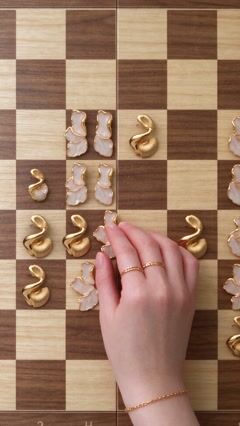 Chessboard JewelleryRecrear el flujo