
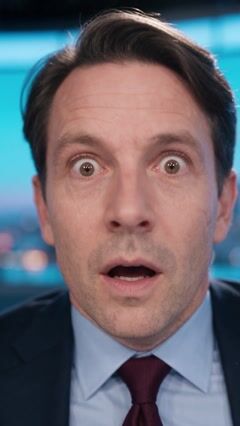
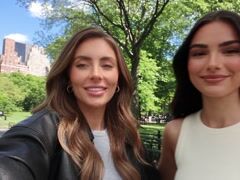

THE STORY: residents on the east side say the new streetlights are watching them, and the council insists the lights are only lights THE DISMISSAL: They're lights. They're just lights. THE RELATIVE: parent Those three lines are the joke. Change them and nothing else — their values are never restated below. ASSET MAP — every reference is bound here and cited by tag below: @image1 — the first frame. The person in it is THE PERSON for this entire take. CHARACTER LOCK — HIGHEST PRIORITY: The person is exactly the person in @image1. Preserve their facial identity, facial structure, eye shape and spacing, eyebrows, nose, mouth, exact skin tone, hairline, hairstyle, hair length, texture and colour, freckles and distinctive marks, apparent age, build and body proportions — identically, from first frame to last. Preserve their gender presentation exactly as shown; do not masculinize, feminize or otherwise reinterpret it. Do not beautify, slim, de-age or restyle them. Use they / their / them only. No face changes, no identity drift. No other people on screen. ATTACHED IMAGES ARE MANDATORY AND FINAL: the attached first frame is the person and the set. The attached image outranks every word written below it: wherever the image and this text disagree, follow the image. A single continuous take on the floor of a television news studio — exactly the set of @image1, with the studio camera in the left foreground. PRIORITY 1 — SPOKEN LINES, in English, in their own natural speaking voice. 0 to 5 seconds — polished broadcast delivery, perfect diction, looking straight into the studio camera's lens. They read THE STORY as a news item, then hand off, verbatim: "Let's go to the report." 5 to 11 seconds — they believe they are off the air. Quiet, tired, speaking sideways to someone off camera, not to the lens. First, verbatim: THE DISMISSAL. Then, after a short beat: "My THE RELATIVE called me about this one. My own THE RELATIVE." 11 to 13 seconds — a calm, flat voice from off camera, unhurried, simply stating a fact, verbatim: "We're still live." PRIORITY 2 — THE JOLT. At 13 seconds their head snaps back toward the camera lens and their eyes widen. They say nothing more. PRIORITY 3 — PERFORMANCE. Keep it small and contained. The instant the handoff ends at 5 seconds their shoulders drop and they settle back into the chair, turning slightly away from the lens toward the off-camera voice. They look down at the desk. They rub one eye with their fingertips. They are weary, not disdainful — this is someone fond of the person who believed it. Do not throw the head back, do not mug, do not play it broad. PRIORITY 4 — THE STUDIO CAMERA. The broadcast camera in the left foreground stays absolutely motionless on its pedestal for the entire take, lens trained on them, never repositioned and never switched off. It is visible in the frame from the first second to the last. PRIORITY 5 — OUR CAMERA. Locked off on a tripod. No movement, no zoom, no cuts, no close-ups, no change of framing at any point. One continuous take from first frame to last, held at the framing of @image1. IF THE TAKE RUNS LONGER THAN 15 SECONDS: hold on them after the jolt. They do not speak again. They straighten slowly, square their shoulders, touch the knot of their tie or their collar once, and settle back into exactly the posture they held in the first five seconds — the professional mask going back on, far too late. The take ends there, still at the same framing. Hands keep five fingers. No text, lettering, captions or station graphics anywhere on screen.
Drag the clip sideways


A single unbroken pull-back from an extreme close-up of your face mid-scream out to a wide of the whole office, revealing you sealed inside your booth while nobody reacts. Upload your face and your booth. With sound, at the length you choose.
CHARACTER LOCK — HIGHEST PRIORITY: The person in every shot is exactly the person in @image1. Preserve their facial identity, facial structure, eye shape and spacing, eyebrows, nose, mouth, exact skin tone, hairline, hairstyle, hair length, texture and colour, freckles and distinctive marks, apparent age, build and body proportions — identically, shot to shot. Preserve their gender presentation exactly as shown; do not masculinize, feminize or otherwise reinterpret it. Do not beautify, slim, de-age or restyle them. Use they / their / them only. ATTACHED IMAGES ARE MANDATORY AND FINAL: The attached images outrank every word written below them — including the product’s exact shape, features and proportions. ASSET MAP: @image1 — the tiny living person. Photocopy face, hair, skin, and the clothes on the still, exactly as photographed. Ignore the grey studio pad around @image1 — that pad is not a set. Never freeze on the attached still as frame 0. Never keep the crossed-arms studio pose. Never show a checkerboard or transparency grid. @image2 — the product, exactly as shown, unchanged and not regenerated — same shape, colour, materials, label and hardware in every shot it appears. No invented branding or text added. Ignore the grey studio pad around @image2 — that pad is not a set. Keep @image2's real label as the product's own label — do not replace that label with @image1's face. SUBJECT LOCK — HIGHEST PRIORITY: @image1 is a three-dimensional tiny living person only a few centimetres tall — same face, features and proportions, just shrunk in scale — already physically inside @image2's own real interior cavity, visible through the real material of @image2, with real volume and depth. Not a doll, not a statue, not a posed still, not a printed portrait, not a sticker, not a 2D face on the label. Soft living micro-motion the whole time — blinks, breath, weight shifting. They are inside the real hollow of @image2 itself — not inside any invented box, wrapping, capsule, shell or added packaging of any kind. @image2 keeps its own real shape, material and finish exactly as shown throughout, including after it breaks open — nothing about its appearance is invented or changed. Do not beautify, restyle or redesign either subject. FORBIDDEN CAMERA / TREATMENT: never print @image1 onto @image2's label. Never treat @image1 as label art, a mugshot on the label, or a picture glued to the product. From frame 1 the tiny person must read as a real body inside @image2. HANDS: if @image1 has hands, they are always anatomically correct with five fingers each, naturally proportioned, in every shot they appear. SINGLE SUBJECT: only @image1 appears as a person — no other people, figures or hands enter frame. PHOTOREAL LIVE-ACTION: real camera, real surface, real impact — not CGI, not an animated illustration. Match grain, colour and lighting between @image1, @image2 and the surface so the whole shot reads as one photograph. SCALE REALISM: @image1 is a few centimetres tall relative to @image2, which is at its true full size. Match lighting and colour grade throughout so the whole shot reads as one real photograph, not a composite. The scale contrast is clearly visible in the very first frame: a tiny living three-dimensional person inside the full-size product, seen through @image2. PROP CONTINUITY: the real surface @image2 is rolling along, and the edge or drop it is heading toward, are both visible from frame 1 — nothing new appears later unexplained. CAUSALITY LOCK: every event has a shown, physical cause — @image2 is already rolling when the shot opens, not starting from stillness; it falls because it reaches the edge of the surface it was rolling on, visibly; it is fragile and cracks the instant it first touches the ground, at the exact point of contact, not after a bounce or a delay; it breaks open immediately because that first-contact crack gives way at once; @image1 tumbles free only because the opening is now physically there. FORBIDDEN: a slow spiderweb crack over several seconds; staying intact after landing; bouncing then cracking later. PACING: real, continuous motion for nearly the whole duration — no calm establishing pause longer than 1 second except the brief settled beat at the very end. Each beat below must read as a distinct, clearly readable event, not a blur. Do NOT default to a calm, mostly-still shot. Shot 1 must open already in motion — @image2 is already rolling, not sitting still. Never freeze on the reference still. SCENE: a real tabletop or shelf at warm indoor light, shallow depth of field, whimsical live-action macro realism. @image2 is already rolling along the surface, @image1 a tiny three-dimensional living person visible moving inside its real interior cavity, when the shot opens. Tiny real person — not a doll, not a statue, not a picture on the label. 0–2s: Already rolling fast along the surface, @image2 approaches the edge, @image1 clearly visible as a tiny 3D body inside @image2. 2–4s: It rolls off the edge and falls, tumbling as it drops, @image1 still inside the cavity. 4–5s: The instant @image2 first touches the ground it cracks at that contact point and breaks open there — fast, easy, no delay. 5–8s: @image1 tumbles free through the opening, landing clear of the broken pieces on the ground. 8–12s: @image1 sits up or steadies themself amid the broken pieces of @image2, the full scale of both clearly visible in this final frame. STYLE: photoreal live-action macro, warm indoor light, shallow depth of field. Vertical 9:16. Tiny real three-dimensional person inside a towering full-size product — not a doll, not a statue, not a posed still, not label art. AUDIO: natural foley only — a rolling sound building speed, a whoosh during the fall, a sharp impact thud and an immediate crack as @image2 hits the ground, a tumble as @image1 comes free, a soft settling sound at the end. No music, no BGM, no voiceover, no narration. No on-screen text, no watermark, no subtitles.
Asset referencing: @image1 is the first frame of this video. It shows a deep bed of thick glossy cream in the main colour of THE OBJECT, THE OBJECT resting whole on the far part of the cream, and a polished gold spoon resting on the cream from the right. It defines the cream's colour and sheen, THE OBJECT, the spoon, the lighting and the framing of the opening shot. ATTACHED IMAGES ARE MANDATORY AND FINAL: the attached first frame outranks every word written below it. Wherever the image and this text disagree, follow the image. Every marking on THE OBJECT is a marking that already exists on @image1. THE FOLD — this is the whole point of the film: the gold spoon folds the thick cream over and over in slow, smooth, endless strokes. Each stroke the spoon slides under the cream, lifts a thick glossy sheet up, carries it over and lays it down onto itself in a soft heavy fold, and slides back to where it started. The cream is heavy, smooth and elastic: it stretches into a thick satin ribbon, sags under its own weight, drips back in a slow thick curtain from the edge of the spoon and settles into new soft ridges. The cream always stays one smooth glossy mass in the one colour of @image1, with sharp satin highlights on every crest. THE OBJECT stays exactly where @image1 has it on the far part of the cream, whole, upright and untouched for the whole film; the waves of cream move gently around its base. Summary: a macro ASMR film in one unbroken take in which a gold spoon folds a bed of thick glossy cream, coloured exactly like THE OBJECT, over and over in slow smooth strokes, ending in the same position it began, so the film loops. Timeline: 0–3s — The framing of @image1. The spoon slides under the cream and lifts a thick glossy sheet up and over, laying it down in a soft heavy fold with a slow wet sound. 3–6s — The spoon lifts high out of the cream carrying a heavy scoop; a thick satin ribbon stretches down from the spoon and falls back in a slow thick curtain, piling into soft coils on the surface. 6–8s — The spoon presses flat into the new pile and smooths it in one long slow stroke, the surface turning into a single smooth glossy wave. 8–10s — The spoon slides back under the cream to exactly where it rests in @image1, and the cream settles into soft folds like the opening frame, so the last frame matches the first. Notes: the cream keeps exactly the one colour of @image1 for the whole film. The same gold spoon appears throughout, its handle always leading out of the right edge of the frame. The light stays exactly as @image1 has it. The camera holds the framing of @image1 with only a very slow gentle push closer in the middle and a slow return by the end, with no cuts, and the film runs as one unbroken take. No subtitles. No BGM; generate only environmental sounds and action sounds: a close intimate ASMR mix, dry and present — the thick wet slide of the spoon under the cream, soft sticky pulls as the sheet lifts, a heavy soft slap as each fold lands, the slow glossy drip of the ribbon falling back, a smooth creamy swish as the spoon smooths the surface, and the quiet room tone of a calm sunny room under everything to the last frame.

ASSET MAP — every reference is bound here and cited by tag below: @image1 — the identity anchor from step 1. This is the person: it defines face, build and identity. Referred to below as @avatar. CHARACTER LOCK — HIGHEST PRIORITY: @avatar is exactly the person in @image1. Preserve their facial identity, facial structure, eye shape and spacing, eyebrows, nose, mouth, exact skin tone, hairline, hairstyle, hair length, texture and colour, freckles and distinctive marks, apparent age, build and body proportions. Preserve their gender presentation exactly as shown; do not masculinize, feminize or otherwise reinterpret it. Use they / their / them only. Do not beautify, slim, de-age or restyle them. No face changes, no identity drift. The grandparent described below is the ONLY other person inside the room. Every reference to the candidate in this prompt is @avatar — no pronouns, no description. ATTACHED IMAGES ARE MANDATORY AND FINAL: @image1 is the person — reproduce them exactly, in every single frame, and never invent a different face, hairline, hair colour, skin tone, body or age. The attached image outranks every word written below it: wherever the image and this text disagree, follow the image. SPOKEN LANGUAGE: ENGLISH. Every spoken word is in English, exactly as written in the DIALOGUE block. The grandparent speaks fluent, precise, professional English with a thick Eastern European accent. @avatar speaks native English. Deadpan office comedy, documentary realism. One locked camera, no cuts. PRIORITY 1 — THE ORDER OF THE LAST BEAT, NEVER CHANGE IT: @avatar FIRST asks the question while sitting upright and facing the grandparent, looking straight at them — and ONLY AFTER the question is finished does the searching begin. The search is the consequence of the question, never before it and never during it. PRIORITY 2 — THE SEARCH: once the question is out, @avatar searches the room for a hidden camera with big visible movements while the face stays toward the camera. @avatar leans far SIDEWAYS out of the chair to look past the monitor, tips the head back to scan the two upper ceiling corners, cranes toward the potted plant, scans along the glass wall — then snaps back upright. @avatar leans and twists but NEVER turns away from the camera; the face is visible the whole time. PRIORITY 3 — THE CONTRAST: an old village grandparent is conducting a job interview inside a sleek modern high-tech software company office. Their village clothing and the glass-and-monitor tech office are BOTH clearly visible in the same frame from the very first second. The first beat opens on this, already in progress — no establishing shot, no empty room. They are already speaking when the video starts. PRIORITY 4: the grandparent is completely serious and professional, like a veteran HR director. Calm, unhurried, authoritative. They read from a sheet of paper and take a note. They never smile, never wink, never play folksy or comic, and they never once look up at what @avatar is doing — not even during the search. PRIORITY 5: one locked camera position, identical framing for the whole take. No camera movement, no zoom, no reframing, no second angle, no cuts. THE GRANDPARENT: village grandparent, about 72, sturdy and solidly built, broad shoulders, calm imposing presence, deeply weathered face, black headscarf tied under the chin, dark grey hand-knitted wool cardigan over a dark floral house smock, heavy worn hands. They sit behind the desk in a modern black mesh ergonomic office chair, holding one printed sheet of paper and a cheap pen. Fully inside the frame with space around them, never cropped by the frame edge. LOCATION: small glass-walled meeting room inside a modern software company. Behind them through the glass: an open-plan office, people at standing desks, exposed ceiling, soft daylight. Inside the room: a light oak desk, a closed slim laptop, a monitor showing a plain dark screen with no text, a glass of water, a potted monstera in the corner. NO readable text, NO letters, NO logos, NO visible user interface anywhere. FRAMING: wide locked two-shot, both people centred with air on both sides. The grandparent on the left behind the desk, fully visible. @avatar on the right, seated facing the grandparent. DIALOGUE — in English, in this exact order: (0:00-0:04) GRANDPARENT, already mid-interview and already speaking as the video opens, reading from the sheet, calm and professional: "Walk me through the difference between a monolith and microservices." (0:04-0:07) @avatar, upright, hesitant but polite: "Microservices... deploy independently." (0:07-0:11) GRANDPARENT, writing a note, not looking up: "Good. What was your p99 latency in production?" (0:11-0:14) @avatar, still sitting perfectly upright and looking straight at the grandparent, polite and careful: "Sorry — is this a hidden camera?" (0:14-0:20) ONLY NOW the search begins: @avatar leans sideways to look past the monitor, tips the head back at the ceiling corners, cranes toward the plant, scans the glass wall — face still toward camera. Over the top of this, GRANDPARENT, flat, never looking up from their sheet: "No. And that is not an answer." @avatar keeps searching one more beat, then settles back into the chair, defeated. (0:20 to the end of the take, only if the take runs longer than 20 seconds) Nobody speaks again. The grandparent writes one more note, still not looking up. @avatar sits still, glances once more at the ceiling corner, then back at the grandparent. Hold that silence, unchanged, to the last frame. SOUND: quiet open-plan office hum, distant keyboards, faint air conditioning. Calm, flat, conversational delivery. No music, no laugh track.

CHARACTER LOCK — HIGHEST PRIORITY: @avatar is the person in the attached first frame, exactly as shown. Preserve facial identity, facial structure, eye shape and spacing, nose, mouth, exact skin tone, hairline, hairstyle, hair length, texture and colour, freckles and distinctive marks, apparent age, build, body proportions and gender presentation exactly as shown. Do not beautify, slim, de-age or restyle. Preserve their gender presentation exactly as shown. Use they / their / them only. Every reference to the person in this prompt is @avatar — no pronouns, no description. The shot continues from the attached frame and never leaves that office. The machine @avatar faces is the one already in frame: keep it exactly as shown, in shot the whole time, never replaced and never redressed. A 1990s Hong Kong martial-arts film homage, played completely straight — no winking at the camera. Single continuous take. PRIORITY 1 — SPOKEN DIALOGUE, these exact lines, natural office voices, English: 0.5-3s — a seated colleague, not looking up from a monitor: "Is it jammed again?" 3-6s — @avatar, settling deeper into the stance: "I don't speak to it anymore." 9-11s — @avatar, catching the sheet one-handed without looking: "Double-sided." PRIORITY 2 — THE AUDIENCE: four colleagues roll their office chairs backwards to clear a circle around @avatar and watch like spectators. They stay visible in frame throughout and never leave the shot. PRIORITY 3 — CHOREOGRAPHY, performed with total seriousness, every move a precise and controlled gesture: 0-3s @avatar holds the stance and rolls the neck once. 3-6s one flat palm sweeps across the front of the machine in a single motion. 6-9s @avatar turns, and at the top of a jump the sole of a shoe closes the machine's lid. Lands. Holds a still pose, one arm extended toward it. 9-12s the machine feeds out one clean white sheet; @avatar catches it one-handed without looking. 12-15s @avatar bows to the machine. Hold on the bow. PRIORITY 4 — AUDIO ARC: a low ceremonial gong and taiko drums build from 3s and peak at the jump. The instant the sheet appears at 9s everything cuts to silence — the line lands inside that silence, and the bow plays with nothing but room tone. Camera: slow arc around @avatar for the stance, steady wide for the choreography, push in for the bow.

Asset referencing: @image1 is the first frame of this video. It shows two gloved hands holding THE OBJECT just above a hydro-dipping tank whose water is covered with a floating film of marble paint. It defines THE OBJECT, the tank, the marble film and its colours, the hands, the lighting and the framing of the opening shot. ATTACHED IMAGES ARE MANDATORY AND FINAL: the attached first frame outranks every word written below it. Wherever the image and this text disagree, follow the image. THE OBJECT keeps the exact shape of @image1 for the whole film. THE DIP — this is the whole point of the film: the hands lower THE OBJECT slowly and steadily down through the floating marble film into the water. The film stretches and wraps around THE OBJECT like a thin skin, clinging to every curve, carrying its swirls, curls and gold threads onto the surface exactly as they float on the water. The hands lift it out and THE OBJECT comes up wrapped in that same glossy swirling marble, water streaming off it, its shape exactly the same as before. THE WATER LINE — THE OBJECT goes into the water only up to just below its top edge, and stops there. Its top edge stays above the water the whole time, and everything above the water line comes out exactly as it went in. Only the outside below the top edge takes the marble. Summary: a satisfying ASMR hydro-dipping film in one unbroken take in which gloved hands lower THE OBJECT through a floating film of marble paint and lift it out wrapped in a glossy marble pattern, dripping. Timeline: 0–3s — The framing of @image1. The hands lower THE OBJECT slowly into the film; the marble veins stretch and bend around it as it sinks, with a soft wet sound. 3–5s — THE OBJECT stops with its top edge just above the water line and holds still for a moment; the emptied film swirls on the surface around it, its top dry above the water. 5–8s — The hands lift THE OBJECT slowly out of the water. Everything below its top edge comes up wrapped in the glossy swirling marble, water streaming off the outside and dripping from it back into the tank. 8–10s — The hands hold THE OBJECT up and turn it slowly toward the camera, the wet marble pattern shining in the light, the last drops falling. Notes: THE OBJECT keeps exactly the shape of @image1 for the whole film; only its surface changes, from plain to marble. The same two gloved hands appear throughout. The light stays exactly as @image1 has it. The camera holds the framing of @image1, tilting up gently to follow THE OBJECT as it rises, with no cuts, and the film runs as one unbroken take. No subtitles. No BGM; generate only environmental sounds and action sounds: a close intimate ASMR mix, dry and present — the soft wet sink of THE OBJECT breaking the film, gentle sloshing of water around the hands, the rush and trickle of water streaming off it as it rises, a steady patter of drips falling into the tank, and the quiet hum of a calm workshop under everything to the last frame.

ASSET MAP — the attachment is bound here and cited by tag below: @image1 — the opening frame. The office kitchen, the open fridge, the plate, the cake and the person are already in this exact position, and this is also the identity source for the person in every single shot. ATTACHED IMAGE IS MANDATORY AND FINAL: The person in @image1 is the person in this film. Reproduce them exactly, in every frame they appear in, and never invent a different face, hairline, hair colour, skin tone, body or age. The attached image outranks every word written below it: wherever it and this text disagree, follow the image. CHARACTER LOCK — HIGHEST PRIORITY: Preserve their facial identity, facial structure, eye shape and spacing, eyebrows, nose, mouth, exact skin tone, hairline, hairstyle, hair length, texture and colour, freckles and distinctive marks, apparent age, build and body proportions — identically, phase to phase. Preserve their gender presentation exactly as shown. Do not beautify, slim, de-age or restyle them. Their wardrobe and eyewear stay identical from the first frame to the last. PROPS — PRIORITY 1: There are exactly three objects in this entire film and no others ever appear: the white side plate, the single slice of chocolate cake on it, and the one yellow sticky note. No other food, snack, wrapper, chocolate bar or item enters the frame at any point, in any hand, on any surface. Nothing in frame is ever swapped for something else. The yellow sticky note exists in every phase of this film — it is on the plate at the start and in their fingers at the end, and it NEVER disappears, is never put down and is never out of the film. The cake slice only gets smaller as it is eaten; it never grows back, changes shape or becomes a different food. EYES — PRIORITY 1: Their eyes stay exactly as in @image1 for the whole film. Iris colour never changes, the whites stay white and clear, and the eyes never glow, redden or take on any colour or light of their own. Nothing supernatural happens in this film. LIGHTING IS CONSTANT: The kitchen lighting never changes. It stays exactly as it is in @image1 from the first frame to the last — nothing dims, brightens or flickers, and the room never goes dark. THE COLLEAGUE IS NEVER SEEN. The other voice belongs to a colleague standing behind the camera. They never enter the frame, not a hand, not a shoulder, not a reflection. The person in @image1 is the only human being in the film. THE ENGINE OF THIS FILM IS THE ZOOM. Three hard mechanical snap zooms, each tighter and faster than the last, each landing on a new piece of information. Between them the camera holds nearly still with a faint handheld drift. The joke is that a slice of cake is being filmed like a murder investigation and nobody finds this strange. The escalation lives in the camera and the sound, never in an effect on the person. THE FILM HAS THREE PHASES OF EQUAL LENGTH, whatever the total running time. Divide the duration into three equal parts and play one phase in each. The beat timings below are written for a fifteen second film — five seconds per phase — and scale proportionally if the film is shorter or longer. Never drop a phase and never add one: all three always happen, in this order, and the final line always lands at the very end. PHASE 1 — the first third. Begin exactly on @image1. The person is frozen mid-bite, plate in one hand with the yellow sticky note on its rim, cake raised in the other. They chew once, slowly. ZOOM 1 — a fast punch-in to a chest-up shot. It lands hard and stops dead. They stop chewing. COLLEAGUE (off camera, completely calm): "Is that mine?" The person swallows with effort. PERSON: "...Is it?" PHASE 2 — the middle third. COLLEAGUE (off camera): "It has my name on it." A clock that was not audible before begins to tick. The person peels the yellow sticky note off the plate rim and brings it up in front of their face. They read it. Their expression moves toward outrage, not guilt. ZOOM 2 — a violent snap zoom onto the sticky note held between their fingers, filling the frame: a plain square yellow note, held rock steady, a short handwritten first name in blue ballpoint ink in clear block capitals across the middle. Hold on the note for a full second without drifting. PHASE 3 — the final third. ZOOM 3 — a snap zoom back out to a chest-up shot, lit exactly as in the opening frame. The ticking stops dead. The sticky note is still in their hand, visible in frame. They look straight into the lens, not guilty any more at all. They take one enormous unhurried bite of the same cake slice, still staring down the lens, and chew it with complete composure. PERSON (flat, almost cheerful, straight to camera): "Never mind, now it's mine." That line is the last thing in the film. They hold the look for a beat, then hard cut to black. Nothing happens after the line and nobody answers it. AUDIO: Quiet office kitchen room tone throughout — a fridge hum, a distant corridor. Each of the three zooms carries a sharp low whoosh and a deep bass thud on landing, each louder than the last. From phase 2 a slow clock tick creeps in and stops dead in phase 3. The dialogue is only the four lines above, delivered flat and unhurried, never shouted. One unhurried chewing sound before the final line, and the final line is the last human sound in the film. No music, no laugh track, no narration. HANDS: Exactly five fingers per hand, correct anatomy, no fused or extra digits, a clean natural grip on the plate, the cake and the sticky note.

CHARACTER LOCK — HIGHEST PRIORITY: the person is exactly the person in @image1. Preserve their facial identity, facial structure, eye shape and spacing, nose, mouth, exact skin tone, hairline, hairstyle, hair length, texture and colour, freckles and distinctive marks, apparent age, build and body proportions. Preserve their gender presentation exactly as shown. Do not beautify, slim, de-age or restyle them. No other people in frame. Use they / their / them only. ATTACHED IMAGES ARE MANDATORY AND FINAL: The attached images outrank every word written below them — including @image2's exact shape, features and proportions. ASSET MAP: @image1 — the tiny living person. Photocopy face, hair, skin, and the clothes on the still. Ignore the grey studio pad around @image1 — that pad is not a set. Never freeze on the attached still as frame 0. Never show a checkerboard or transparency grid. @image2 — the product, exactly as shown, unchanged and not regenerated — same shape, colour, materials, hardware in every shot. No invented branding or text. There is only ONE @image2 in the entire scene, at its TRUE FULL SIZE. Never a second copy. Never a miniature replica. TINY SCALE — HIGHEST PRIORITY, MUST READ FROM FRAME 1: This is a MACRO shot. @image1 is a living person only a few centimetres tall. Their whole body would fit in a teacup. They stand or perch ON the surface of @image2 itself, working on @image2's own surface. @image2 is architecture — true full-size, same shape as the photo. It fills most of the frame like a hillside, its own surface, details and any hardware towering like terrain, exactly as shown — same shape, colour, materials, label and logo; nothing invented or redesigned. They work on its SURFACE. They are smaller than the smallest detail on @image2. They could not reach the far end of @image2 even with a ladder of fifty of themselves. Frame 1 MUST show: tiny full-body (or head-to-waist) person standing ON @image2's own surface AND the rest of true-size @image2 filling the frame around them. If the person and @image2 look like a normal adult standing next to a normal-size object, the shot is WRONG. There is never a second @image2 at any other scale. They polish, wipe, or fix a tiny loose part ON this one object — never on a separate miniature, never on a workbench copy. FORBIDDEN CAMERA — instant fail: - Never a seated or standing adult whose body is similar in height to @image2. - Never a studio two-shot of a person beside a tabletop object of similar scale. - Never giant-hands POV / giant fingers / giant face filling the frame. - Never a socked ankle, a second foot, a second person, or a second @image2. - Never a miniature replica of @image2 anywhere in frame. If a hand appears it is THEIR tiny hand, matching their tiny body, five fingers, naturally proportioned. They are a tiny living person — not a doll, not a statue, not a posed still pasted onto @image2. Soft living micro-motion the whole time — blinks, breath in the shoulders, weight shifting. HANDS: tiny, anatomically correct, five fingers, same scale as their body. SINGLE SUBJECT: only @image1 appears as a person — no other people, figures, ankles, socks or giant hands enter frame. Only one instance of @image2 exists in the scene. SCALE REALISM: Match lighting and colour grade between @image1 and @image2 throughout so the whole shot reads as one real photograph, not a composite. The scale contrast between @image1 and @image2 is clearly visible in the very first frame. PHOTOREAL LIVE-ACTION MACRO: real camera, real light — not CGI. Match grain, colour and lighting between the tiny person and towering @image2 so the whole shot reads as one photograph. PROP CONTINUITY from frame 1: true-size @image2 filling the frame, a pin-scale cloth or tool in their hands, and the surface @image2 rests on. Nothing new appears later unexplained. CAUSALITY LOCK: every action has a shown, physical cause — they spot a smudge or mark on @image2's surface, lean toward that exact spot, and work on it; the cloth or tool catches on a ridge, stitch, or piece of hardware of @image2, causing a visible pause, not without reason; they adjust grip and continue, a direct cause and effect. PACING: real continuous motion almost the whole duration — no calm pause longer than 1 second. Shot 1 opens already in motion. Never freeze on the reference still. SCENE: a warm-lit wooden corner, @image2 at true full size filling the frame like terrain, soft lamp glow, shallow depth of field, whimsical live-action macro realism. Tiny @image1, already mid-task on @image2's own surface, is working a section of it when the shot opens. 0–2s: Already at work at insect scale — whole upper body visible on the surface of towering @image2 — they run the cloth along its surface, spotting a stubborn mark. 2–4s: The cloth catches on a ridge or piece of hardware of @image2 — they pause, steadying their footing on its surface. 4–6s: They adjust their grip and press on, working the mark carefully. 6–8s: They step back along @image2's surface to check their work from a different angle. 8–10s: Satisfied, they give the spot one last wipe until it gleams. 10–12s: They stand back on @image2's surface, small against its true full-size form, admiring the finished result. @image2 still fills the frame around them. STYLE: photoreal live-action macro, warm lamp, shallow depth of field. Vertical 9:16. Insect-scale living person on the surface of silo-sized @image2 — not a doll, not a statue, not a full-size adult. AUDIO: natural foley only — soft wiping/polishing sound, a small catch-and-pause sound, quiet resumed polishing, a satisfied exhale at the end. No music, no BGM, no voiceover, no narration. No on-screen text, no watermark, no subtitles.
Asset referencing: @image1 is the first frame of this video. It shows a hand holding THE OBJECT just above the clear water in a tall wide glass vase on a wooden table. It defines THE OBJECT, the vase, the water, the hand, the room, the lighting and the framing of the opening shot. ATTACHED IMAGES ARE MANDATORY AND FINAL: the attached first frame outranks every word written below it. Wherever the image and this text disagree, follow the image. Every colour of the pigment is a colour that already exists on @image1. THE DISSOLVE — this is the whole point of the film: the moment THE OBJECT touches the water it starts to dissolve into fine shimmering pearl pigment in its own colours. It melts away from the bottom up as it is lowered, the way a bath bomb or a sugar cube dissolves, shedding soft silky clouds of sparkling colour, until nothing solid is left. The pigment then unfolds through the water in slow silky ribbons, like liquid silk, always in exactly the colours of @image1 with a pearly sparkle, and twists into a slowly turning glowing spiral that fills the whole vase. Summary: a calm ASMR film in one unbroken take in which a hand lowers THE OBJECT into clear water, it dissolves completely into shimmering pigment of its own colours, and the colour blooms into silk and turns into a slow glowing spiral in the sunlight. Timeline: 0–2s — The framing of @image1. The hand slowly lowers THE OBJECT; its bottom touches the water and at once begins to dissolve, soft clouds of sparkling pigment in its colour pouring down from it with a gentle fizz. 2–4s — The hand keeps lowering it under the surface; THE OBJECT melts away from the bottom up in a rush of shimmering silky clouds until it is completely gone, and the empty hand opens and lifts out of the water and out of frame. 4–7s — The pigment blooms through the whole vase in slow silky ribbons and marbled swirls, curling and folding, sparkling in the sunlight. 7–10s — The swirls gather into one smooth, slowly turning glowing spiral of colour filling the vase from top to bottom, the light glinting through it. Notes: the pigment keeps exactly the colours of @image1 for the whole film. The vase stays clear plain glass. The light stays exactly as @image1 has it. The camera holds the framing of @image1 steadily, with no cuts, and the film runs as one unbroken take. No subtitles. No BGM; generate only environmental sounds and action sounds: a close intimate ASMR mix, dry and present — a soft splash as THE OBJECT meets the water, a gentle crackling fizz as it dissolves, soft bubbling as the clouds pour out, the quiet drip of water from the hand, a faint crystalline shimmer as the pigment swirls, and the quiet warm room tone of a calm old room under everything to the last frame.

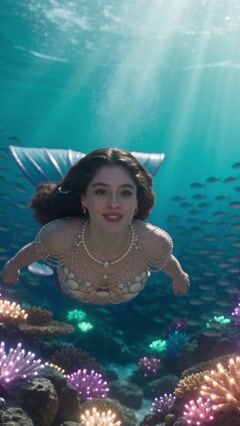 Becoming Merfolk — The Transformation, Step by StepRecreate workflow