
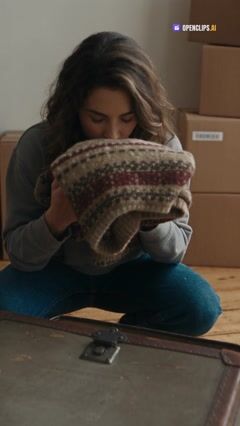

CHARACTER LOCK — HIGHEST PRIORITY: The person in every shot is exactly the person in @image1. Preserve their facial identity, facial structure, eye shape and spacing, eyebrows, nose, mouth, exact skin tone, hairline, hairstyle, hair length, texture and colour, freckles and distinctive marks, apparent age, build and body proportions — identically, shot to shot. Preserve their gender presentation exactly as shown; do not masculinize, feminize or otherwise reinterpret it. Do not beautify, slim, de-age or restyle them. No face changes, no identity drift. No other people share their face. Use they / their / them only. ATTACHED IMAGES ARE MANDATORY AND FINAL: If an avatar image is attached, that is the person — reproduce them exactly, in every single frame, and never invent a different face, hairline, hair colour, skin tone, body or age. The attached images outrank every word written below them: wherever an attached image and this text disagree, follow the image. @image1 is identity only — face, hair, skin — not the cafe, not the bookshelves, not a frozen smiling headshot, not the green waffle sweater as locked wardrobe. Photocopy the person from @image1 into a quiet bedroom being packed. Casual home clothes, not cafe knitwear. The worn cardigan in the box is a separate prop — an older, softer, lived-in knit, folded, not the green waffle sweater from @image1. ASSET MAP: @image1 — the character. HANDS: hands are always anatomically correct with five fingers each, naturally proportioned, in every shot they appear. PACING: This is a slow, unhurried scene. Let each action land and hold for a beat before the next begins — no rushed cuts, no compressed motion. Stillness is allowed and wanted. Tell the following story in exactly 3 shots, same character throughout, with genuine emotional stakes — a real, complete arc from avoidance to a conscious decision, not just a mood. Clear visual beginning, twist and ending — never ambiguous or faded-out. STORY: In a room with several packed and sealed boxes already stacked against one wall — clearly done some time ago — one box sits alone and untouched in the middle of the floor, visibly older, dustier than the rest, as if it’s been walked past for months. The character finally sits down in front of it, takes a slow breath, and opens it. Inside is a single worn cardigan, folded neatly. They lift it out with both hands, and without thinking, bring it close and breathe in, eyes closing for a moment — an old, familiar smell still caught in the fabric. They hold it a while, just sitting with it. Then, deliberately, they stand, cross the room, and instead of folding it back into the box, drape the cardigan over the back of a chair by the window — a place it will be seen every day, not stored away. They step back and look at it there a moment before leaving the box behind, empty, on the floor. STYLE: Slow, quiet handheld realism, soft overcast daylight through a window, shallow depth of field, camera holding steady on small gestures rather than following fast movement. Vertical 9:16. Continuous real motion, no freeze-frame. Never freeze on the reference still. No on-screen text, no subtitles, no watermark, no title card. AUDIO (native, synced, no BGM, no voiceover, no narration): the quiet creak of a room, a slow exhale before opening the box, the soft rustle of fabric being lifted, a held breath, footsteps crossing the room, and quiet stillness as the scene settles. SHOT 1 (0-9s): Open already inside the moment — no static establishing beat. The character is seated in front of the one untouched, dustier box, other sealed boxes visible stacked behind them, already established as done long ago. They take a slow breath and open it. Let this breathe — no rush to the next beat. SHOT 2 (9-18s): The turn. They lift out a worn, folded cardigan with both hands, bring it close, and breathe it in, eyes closing briefly. They sit with it a while, not moving on immediately — this pause is the emotional core of the shot, not a transition to rush past. SHOT 3 (18-28s): The resolution. They rise, cross the room, and drape the cardigan over the back of a chair by the window instead of returning it to the box. They step back, looking at it there for a moment, the empty box left open on the floor behind them. A clear, complete, unhurried ending — not a fade-out, not a still.
Drag the clip sideways
Turn your dog into a samurai ronin on the run — an epic, misty-marsh chase and a daring leap to escape across the water on a wooden boat. Plug in ANY dog and swap the hero.
GIANT SCALE — Skate Up the Giant @image1 is a giant person reclining on a grassy hilltop at golden hour; @image2 is a tiny skater who rides a skateboard up @image1's giant body as the camera travels up to end on the giant's face. Surreal, dreamy scale-VFX. Plug in ANY two avatars.
PRODUCT LOCK — HIGHEST PRIORITY: The product in every shot it appears is exactly as shown in @image1, unchanged and not regenerated — same shape, colour, materials, label and logo text every time it appears. No redesign, no restyling, no substituting a similar-looking item. Never add any lettering or logo that is not already visible on the reference photo. ASSET MAP: @image1 — the product, exactly as shown, unchanged and not regenerated. SINGLE SUBJECT — HIGHEST PRIORITY: Only one person’s hands appear in this entire video, the same pair throughout, doing every action. No other people, no other hands, no second set of arms ever enter the frame. Camera stays at counter/hand height for all three shots — the person’s face is never required and should not be framed; keep the composition on hands, bowl, ingredients and the product only. HANDS: hands are always anatomically correct with five fingers each, naturally proportioned, in every shot. Tell the following story in exactly 3 shots with a clear visual beginning, twist and ending. The product from @image1 is the twist/resolution — it naturally solves the problem set up in shot 1. STORY: Hands scoop a heaping, uneven spoonful of flour into a mixing bowl by eye, tipping it in loosely — beside the bowl, a first batch of oddly flat, unevenly spread cookies sits cooling on a tray, clearly a failed attempt. The same hands push the tray aside, place a clean bowl onto the product from @image1, and reset it to zero. This time flour is added slowly and carefully, a thin steady stream, until it settles at the exact amount needed. The hands fold the dough, portion it into neat, evenly sized rounds on a tray, and slide it into the oven. Moments later the same hands pull out a new tray — golden, uniform, evenly risen cookies — and carefully pack them into a tin, closing the lid. STYLE: Warm, lived-in kitchen realism, soft natural daylight, shallow depth of field, handheld camera held consistently at counter height throughout, close and steady on hands and surfaces. Vertical 9:16. Continuous real motion, no freeze-frame. No on-screen text, no subtitles, no watermark, no logo beyond what the product itself shows, no title card. Never show a checkerboard, transparency grid or empty studio sweep — @image1 lives on a kitchen counter. AUDIO (native, synced, no BGM, no voiceover, no narration): the soft scrape of a spoon in flour, a quiet exhale at the failed batch, the gentle rustle of the product being set down, flour pouring in a light steady stream, dough being shaped, an oven timer, and the soft click of a tin lid closing. SHOT 1 (0-6s): Open already in motion — no static establishing beat. Close on hands scooping a heaping, uneven spoonful of flour into a bowl. A tray of flat, unevenly baked cookies sits visible beside the bowl, already established as a failed first attempt. Camera stays at counter height, hands and tray in clear focus, no face in frame. SHOT 2 (6-12s): The product is introduced exactly as shown in @image1. The same hands place a clean bowl on it, zero it, and pour flour in slowly and precisely, watching it settle at the exact amount. Camera holds steady on the product and hands throughout. SHOT 3 (12-18s): The resolution. The same hands shape the dough into neat, even rounds, then pull a finished tray of golden, uniform cookies from the oven and pack them carefully into a tin, closing the lid. A clear, satisfying, settled ending — not a fade-out, not a still.
15 seconds, 9:16. Photoreal. Match the ORIGINAL FILM grammar. Lana is PLANTED — she does not walk. ONE shot. Slow push-in from full-body to close-up. No hard cuts. LANA LOCK: @image1 is Lana — photocopy her face and hair colour exactly as shown, hair in a bun; dressed in an ivory silk shirt, camel trousers, gold chain, nude pumps. Adult. KEEP this outfit. Same woman every frame. No turtleneck. No pleated skirt. SETTING: modern glass-and-wood CORPORATE OFFICE corridor. Desks, glass rooms, warm daylight. NOT a school. No lockers. No ninjas. No weapons. EXTRAS: colleagues in BLACK SUITS, approaching with papers, folders, pens, coffee cups. 0.0–2.0s LOCKED full-body. Lana STANDS center, facing camera, arms at her sides, calm. Black-suited colleagues rush AT her at NORMAL SPEED with papers. 2.0–4.0s She raises her RIGHT HAND, OPEN PALM toward camera — the same stop-gesture as the source. Still planted. Still calm. 4.0–9.0s SLOW MOTION. Papers, pens, folders, coffee cups FLY around her. Colleagues STEP BACK, thrown off balance. Her hair lifts and drifts as if in wind. Camera SLOWLY PUSHES IN. Palm still toward camera. 9.0–11.5s Tighter. She switches to a raised INDEX FINGER (same as the source). Hair still in slow-mo wind. Debris still floating. Extras receding. 11.5–15.0s CLOSE-UP of her face. Chaos falls out of frame. She lifts her LEFT HAND to her left ear / hair, calm, like the source ending. HOLD. AUDIO: office, whoosh on the palm, paper flutter. No speech. NEGATIVE: walking, school, ninjas, batons, turtleneck, hair recast, overlay type, extra celebrity faces, tracking-back walk.
@image1 (construction shell) is the opening state and @image2 (finished interior) is the closing state of one room. Every surface, object and architectural detail is taken from them without reinterpretation or drift, and the camera viewpoint, height and lens match across both. The camera pushes slowly and steadily straight forward at a constant speed, eye-level, easing into a slight downward tilt as it advances so the ceiling fills more of the upper frame. Across that one continuous move the room finishes itself around the camera: the sand mound, cement sacks, buckets, cable coil and rubble clear from the floor, the bare slab resolving into a woven jute rug; the raw concrete walls take on cream limewash plaster; the rectangular voids overhead close into the warm timber slatted ceiling with its recessed downlights; the opening in the far wall glazes over onto dense green planting and bright sky; and the low linen sofa, wooden coffee table, floor lamp, blank cream canvas and potted palms settle into place. The change is physical and continuous, built out of the room itself rather than cross-faded between two pictures, and it completes before the move ends. No on-screen text, captions or titles of any kind. Audio: quiet interior room tone only. No voices, no narration, no music.


PRODUCT LOCK — HIGHEST PRIORITY: The product in every shot it appears is exactly as shown in @image1, unchanged and not regenerated — same shape, colour, materials, label and logo text every time it appears. No redesign, no restyling, no substituting a similar-looking item. Never add any lettering or logo that is not already visible on the reference photo. ASSET MAP: @image1 — the product, exactly as shown, unchanged and not regenerated. SINGLE SUBJECT — HIGHEST PRIORITY: Only one person’s hands appear in this entire video, the same pair throughout, doing every action. No other people, no other hands, no second set of arms ever enter the frame. Camera stays at chest/hand height for all three shots — the person’s face is never required and should not be framed; keep the composition on hands, boxes, the wall and the product only. HANDS: hands are always anatomically correct with five fingers each, naturally proportioned, in every shot. CONTINUITY: There are exactly two boxes in this scene, established together in shot 1 and never confused: Box A is a plain, unlabeled moving box being taped shut. Box B sits open beside it the entire time, already marked “KEEP” in thick marker on its side from the very first shot — it is never sealed until the final shot, and no other box is introduced later. Tell the following story in exactly 3 shots with a clear visual beginning, twist and ending. The product from @image1 is the twist/resolution — it naturally solves the problem set up in shot 1. STORY: Hands press tape across the top of Box A, a plain moving box, sealing it shut in an otherwise empty, echoing room. Beside it, Box B sits open, already marked “KEEP” on its side, waiting half-empty. Setting Box A aside, the hands pause — on the bare wall behind, the product from @image1 still hangs where it always has, its years of pencil marks and dates faded but visible on it, easy to have overlooked among the packing. The hands reach up and lift it down before it gets left behind. They roll it up carefully from the bottom and tie it closed. They lower it into Box B — the “KEEP” box, still open and waiting exactly as it was — and fold the flaps shut over it. STYLE: Warm, lived-in realism, soft daylight through a bare window, shallow depth of field, handheld camera held consistently at chest/hand height throughout. Vertical 9:16. Continuous real motion, no freeze-frame. No on-screen text, no subtitles, no watermark, no logo beyond what the product itself shows, no title card. AUDIO (native, synced, no BGM, no voiceover, no narration): tape being pressed onto cardboard, the hollow echo of an empty room, a small pause, the soft rustle of the product being taken down and rolled up, and the quiet fold of box flaps closing. SHOT 1 (0-6s): Open already in motion — no static establishing beat. Hands finish taping Box A shut. Box B sits open beside it, “KEEP” clearly marked on its side, established here and not introduced later. Hands set Box A aside and pause, attention shifting toward the wall behind. Camera at chest/hand height, no face in frame. SHOT 2 (6-12s): The product is the twist itself, exactly as shown in @image1 — still hanging on the otherwise bare wall. The hands lift it down, roll it up carefully from the bottom, and tie it closed. Camera holds steady on the product throughout the motion. SHOT 3 (12-18s): The resolution. The hands lower the rolled product into Box B — the same open “KEEP” box from shot 1, unchanged — and fold its flaps shut. A clear, quiet, settled ending — not a fade-out, not a still.
15 seconds, 16:9. ONE UNINTERRUPTED SHOT. No cuts. No slow motion. Photoreal cinematic. CAR LOCK: @image1 is THE HERO CAR — photocopy this exact car: same body, colours, wing, lights, wheels and roof as shown. Same car every frame. A dark-gray pursuit hypercar follows. Sunset megacity. Burning asteroid fragments in the sky. 0.0–2.0s Camera flying BACKWARD at road level ahead of the hero car on a 12-lane elevated freeway. It weaves between trucks and buses. Camera a few meters ahead. 2.0–5.0s A fragment hits a skyscraper. Explosion, glass, shockwave. Camera swings around the hero car as it drifts between two buses. Pursuit closes. 5.0–8.0s Asteroid strikes ahead. Highway lifts into a ramp. The hero car accelerates up, becomes airborne. Camera dives with it. Tires kiss a moving semi-trailer roof for under a second, then launch to another level. 8.0–12.0s Larger fragment overhead, sky orange. Skyscraper collapsing sideways. The hero car drives onto the falling glass facade, racing horizontally across it. Pursuit follows. Glass under tires. 12.0–15.0s Launches back onto the freeway. Camera rotates around the FRONT of the hero car. Skyscraper crashes behind. Enormous asteroid on the horizon. Blast wave racing toward both cars. End a fraction of a second BEFORE it reaches the car. AUDIO: engines, impacts, wind, glass. No speech. NEGATIVE: a different hero car than @image1, overlay type, hard cuts, slow-mo, teleport, brand logos, extra people as heroes.
16 seconds, 9:16. Photoreal winter cabin. Match the ORIGINAL FILM beats. Not a storyboard. MATEO LOCK: @image1 is Mateo — photocopy their face, hair, facial hair and features exactly as in @image1. Adult. IGNORE the clothes in @image1. Outfit: cream cable-knit sweater, dark pants, brown boots. Same person every shot. 0.0–3.0s Intimate close-up of Mateo resting indoors. Warm golden sunlight across HIS face through the window. Eyes open, peaceful. He MOVES slightly. 3.0–6.0s Wide: snowy wooden balcony, pine forest, mountains, sunrise. Empty railing first. 6.0–9.0s Mateo’s hand in the cream sweater sleeve, feeding small birds on the snow-covered railing. Natural bird motion. 9.0–12.0s Inside: his hands holding a steaming ceramic cup beside a bamboo-handle kettle, snowy window. Cream knit sleeves. 12.0–14.5s From behind: he walks a snow-covered wooden path, cream sweater, dark pants, brown boots. Cabins and pines. 14.5–16.0s Wide aerial-style of snow-covered cabins, pine forest, mountains, glowing sun. HOLD. AUDIO: winter wind, birds, kettle, footsteps. No speech. NEGATIVE: recast of @image1, extra people, overlay type, black long coat, Istanbul, NYC.
An interior room, held completely consistent for the whole shot — the same room, the same layout, the same furniture in the same places, shot from a locked-off camera. The camera is on a tripod and never pans, tilts, pushes or drifts, and nothing in the room is repositioned, added or removed. Only colour, finish and the graphic elements change. The room begins stripped of all colour: every surface — cabinetry, worktops, furniture, light fittings, floor, walls and every object in it — rendered in the same flat chalk white and pale grey, matte and unsaturated, as though the space has been built and furnished but never finished. A small rounded rectangular label sits in the upper left, soft translucent grey with white capital letters reading BEFORE. The motion runs as one continuous take: A flat circular colour wheel rises into frame above the centre of the room, spinning as it grows. It resolves at full size into a clean pie of solid colour segments drawn from the room's own finished palette, and holds in the upper half of the frame, still turning slowly. The wheel then contracts, shrinking back toward its centre while continuing to rotate, until it is a small disc. The disc breaks apart. Each segment releases as a separate soft-edged coloured dot, and the dots scatter outward across the room at different sizes and speeds, drifting through the air in front of the cabinets, across the furniture and past the light fittings, some crossing the frame, some slowing and hanging. The dots settle and fade out one by one as they touch the surfaces around them. In the same movement the label crossfades: the word BEFORE dissolves away and the word AFTER fades up in its place within the same grey pill. As the last dots disappear, the room's colour resolves — the flat colourless surfaces take on their finished tones and materials, the lighting warms, and the shot holds steady on the completed room. Clean photorealistic interior look, sharp focus throughout, straight verticals, no lens distortion. No people. No camera movement at any point. No text other than the words BEFORE and AFTER in the label.


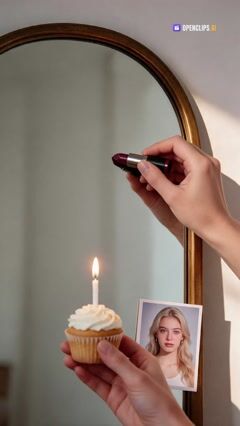 Lipstick Mirror GreetingRecreate workflow