
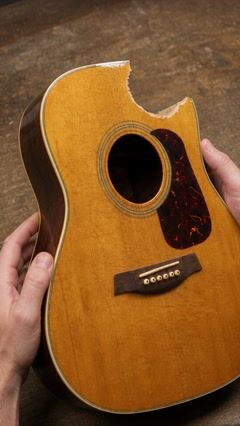
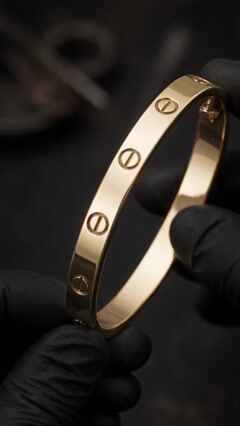
@image1 is an absolute lock for the object: shape, proportions, material, colour, surface pattern and markings are taken from it exactly, with no drift, restyling or reinterpretation in any shot. @image2 is the storyboard — follow it exactly, matching shot order, framing and camera distance panel for panel. Look: real handheld macro craft footage shot on a long lens. Natural workshop light, warm and directional. Shallow depth of field with a soft falloff, fine surface texture and real specular highlights on metal. Slight organic hand movement in every frame, live-action realism throughout. Hands hold the object over a worn wooden workbench, a piece missing from its upper edge, and a small steel tool taps once at the broken notch. Then the camera closes to macro as a fine tool bevels and cleans the raw edge, the shavings catching the light. Then the object is braced against a wooden block and a tool presses a soft lump of bright metal into the missing notch until it sits proud of the surface. Then a flat blade files the added metal flush, pale dust falling away across the bench. Then a burnishing tool sweeps along the seam and the metal brightens to a mirror sheen. Then the object turns slowly in soft even light, the polished metal repair carrying a travelling highlight along the mended edge. Camera: one move per beat and no more — a slow push in, a small reframe, a gentle tilt. Keep the object centred and continuously in frame. Audio: natural workshop sound only — tool contact, fine scraping, the settle of the object on wood. No music, no voice. Do not generate any text, captions, subtitles, titles, watermarks or logos. No faces and no bodies — only the working hands. No cuts to a different object, no second object, no duplicated copies of the object in frame.
Drag the clip sideways


HIGHEST PRIORITY — THREE FACE LOCKS. Photocopy each tag. Do not invent a stock trio. Do not morph. Do not average faces. Three distinct people in every wide shot. @image1 is LANA — photocopy her exact face, bone structure, mouth, nose, brows, skin and hair exactly as shown. IGNORE any clothing, accessories or sunglasses in @image1. Eyes visible. No sunglasses anywhere in this film. @image2 is MATEO — photocopy his exact face, bone structure, hair and facial hair exactly as shown. IGNORE any clothing in @image2. @image3 is ERIC — photocopy his exact face, bone structure, hair exactly as shown. IGNORE any clothing or background in @image3. WARDROBE FROM THIS FILM ONLY (not the stills): - Lana (@image1): light blue short-sleeve t-shirt, medium-blue jeans, black sneakers. Hair loose in the wind, exactly as in @image1. - Mateo (@image2): heather-grey short-sleeve t-shirt, medium-blue jeans, black sneakers. Front rider. - Eric (@image3): white short-sleeve t-shirt, medium-blue jeans, black sneakers. Bare heads. No helmets. Each rides their own longboard (not a short skateboard). Wheels spin. Real weight shifts, lean into turns, wind in hair and cloth. 30 seconds, 16:9, photoreal, natural daylight. Winding coastal mountain road over a turquoise ocean and a seaside city (Hawaii-style: green hills, hotels, beach). Bright blue sky, white clouds. Ultra-realistic physics, road motion blur, wide-angle, action-camera, smooth stabilize. Frame 0 is ALREADY at speed — never a studio portrait, never a grey still. AUDIO: wheels on tarmac, wind rush, distant surf. No speech. No lyrics. No song. 0.0–3.0s LOW TRACKING, already racing downhill. Camera near the tarmac behind/beside the trio. Mateo (@image2) in front, Lana (@image1) left/rear in the light-blue tee, Eric (@image3) right/rear in the white tee. Faces readable. Hair and clothes whipping. 3.0–6.5s CLOSER FOLLOW. Mateo carves a sweeping right-hand bend, board on edge, body committed. Lana and Eric tucked behind him. Wheels blur. Ocean flashes left. 6.5–12.0s HIGH AERIAL of the S-curve mountain road. Three small longboarders racing the ribbon of asphalt. Turquoise water, white surf, beach hotels, lush green slope. Strong sense of speed. Same three people — do not recast. 12.0–18.0s GROUND FOLLOW from behind and slightly left. Mateo still leads. Lana left, Eric right. Boards, jeans, tees match the wardrobe lock. Coastal drop on the left. 18.0–24.0s DRAMATIC SIDE ANGLE, low, traveling with them. Close enough to read Lana's face then Mateo's then Eric's as they pass — each matches its tag. Wind, motion blur on the road, sharp on the riders. 24.0–30.0s BEHIND THEM downhill, three-quarter. Ocean left, city ahead. Same three, same clothes, same boards. Hold the run. Cut. NO ON-SCREEN TEXT, titles, logos, watermarks, subtitles, helmets, sunglasses, clothing from the face photos. NEGATIVE: different faces, fourth rider, studio headshot as frame 0, empty boards, short skateboards, night, rain.
Your avatar fights a tornado in the city, is dragged and lifted into the funnel, and ends screaming inside the spinning vortex. Music only, loud. See the video step for the full prompt.
MODEL: Seedance 2.5 — use this model specifically. Do NOT use any other model for this generation. FORMAT: 9:16 (vertical) QUALITY: High-fidelity, 4K render, sharp detail, no compression artifacts CHARACTER LOCK — HIGHEST PRIORITY: The character in every shot is exactly the person shown in @image1 — same face, facial features, hairstyle, skin tone, build and gender presentation throughout all 3 shots. No identity drift between shots. Do not beautify, slim, de-age or restyle them. Refer to them only as they/them in this prompt. @image1 is identity only — face, hair, skin — not the sunny café, not the cobblestone patio, not a seated still. Photocopy the person from @image1 into a rainy city bus-stop scene. ASSET MAP: @image1 — the character. Tell the following story in exactly 3 shots, same character throughout, with a clear visual beginning, twist and ending — never an ambiguous or faded-out close. STORY: The character stands alone at a city bus stop as rain suddenly starts pouring — everyone around them opens an umbrella, but they have none and huddle miserably under the tiny stop roof, getting splashed anyway. A stranger nearby silently steps closer and holds their umbrella out over them instead, sharing it without a word. They look up, surprised, then smile — the two end up walking off together down the street under the one shared umbrella, laughing, just as the rain eases and warm light spills from a café window ahead. STYLE: Warm, relatable live-action realism, soft naturalistic lighting, handheld documentary-style camera energy. Continuous real motion. Never freeze on the reference still. No on-screen text, no subtitles, no logos, no title card. AUDIO (native, synced, no music, no voiceover, no narration): rain pattering on pavement and the stop roof, city ambient noise, footsteps, the rustle of an umbrella opening, a warm shared laugh at the end. SHOT 1 (0-6s): Establish the character clearly at the bus stop in pouring rain. Handheld 35mm, medium-wide then push in. Rain starts hard in the first second — wet asphalt, droplets, people around them already sheltered under umbrellas. They have none. They huddle under the tiny stop roof, shoulders up, getting splashed anyway. The problem is immediately obvious. Crowd extras under umbrellas are background only. Face readable. SHOT 2 (6-12s): The twist. A stranger steps in from frame-left; their umbrella enters frame and tilts to cover them too (fabric rustle). Close enough to read their face: surprise, then a genuine warm smile. Rain still heavy. Handheld, eye-level. The stranger is a real second person sharing the umbrella — keep @image1's face locked on the character. SHOT 3 (12-18s): Resolution. Both walk together down the wet street under the one shared umbrella, relaxed and laughing (heard, not voiced as dialogue). Rain visibly eases. Warm golden light from a café window ahead. Handheld follow, then a clear last beat: they keep walking into that light — a finished ending, not a fade-out, not a still.
ATTACHED IMAGES ARE MANDATORY AND FINAL. @image1 (poster establishing frame) is an absolute lock. Face, body, hair, build and skin are taken from it exactly and never drift, morph or get replaced in any beat. Its render style, palette, lighting, graphic system and framing are the look of the whole piece: photoreal premium editorial fashion photography, high-contrast clean studio light, visible skin texture and separated hair strands, real fabric weave and drape - never illustration, 3D render, cartoon or painterly. @image2 (wardrobe rail) is the sole source of truth for every outfit. Each beat below names one LOOK by label; dress the character in that exact set from the rail - its TOP PIECE, BOTTOM PIECE and FOOTWEAR - and nothing else. Never add, remove, substitute, restyle, re-cut or re-colour a garment, and never invent an outfit that is not on the rail. The character stays centred in frame for the entire piece. Not narrative - a beat-driven lookbook. The whole piece runs as one continuous take: outfits and layouts change on the beat through sharp in-frame glitch transitions, the display type tearing and shearing sideways with a red scan-line break and a brief datamosh smear, never a cut to a different place. Palette holds throughout: black and white base with red accents. Graphic system holds throughout, and its scale is deliberate. Only the oversized display headline carries readable letters - it is always huge, heavy and cropped by the frame edges. Every smaller editorial element is a clean geometric mark, not small text: solid bars, hairline rules, tick strips, barcode blocks, crosshair registration marks, corner brackets, thin frame borders and light modular grids, with red used only as an accent bar or rule. Keep these marks few, large and crisply edged. Do not render small paragraphs, fine print, dense numeral strings or any lettering too small to read cleanly. Beats, in order, each holding for the same length of time: 1. LOOK 01. Camera locked. They stand naturally, centred. The huge black type reading ONE HIT expands rapidly behind them and the editorial furniture snaps in on the beat, turning the clean studio into a bold magazine poster. 2. LOOK 01. Fast push-in to a close-up. They turn gently toward the lens, hair moving naturally, direct eye contact, calm and confident. The ground simplifies to black and white with film grain. 3. LOOK 02. The outfit changes on the beat. They hold a natural fashion pose, centred. The layout rebuilds completely around them into a new arrangement with an oversized headline, a barcode block and corner brackets. 4. LOOK 03. Medium shot. They take one confident step forward. The display type re-sets rapidly behind them; black and white stay dominant with stronger red accents. 5. LOOK 04. They make a gentle half-turn, hair swinging naturally. The ground flips to red and white - a huge headline, a scan-line band, heavy rules and a bold border. 6. LOOK 05. They lean slightly forward, relaxed and confident. Subtle low angle. Large red type slides into frame on the beat and locks hard against the frame edge. 7. LOOK 06. They drop into a crouching pose. Quick push-in. The layout completely rearranges around them, the headline and the marks landing in new positions. 8. LOOK 07. They stand again. Camera pulls back to a medium shot. The ground returns to black and white with a large headline and barcode elements. 9. LOOK 08. They walk confidently toward the lens. The ground switches to red and black; a new headline, scan-line bands and grid blocks stack in rapidly and the pacing tightens. 10. LOOK 09. Arms crossed, standing confidently, centred. Camera settles into a clean medium shot. The layout gradually simplifies until only a few premium magazine marks remain, a final graphic mark resolves, and the frame freezes on the last beat. Camera stays controlled throughout - locked holds, quick push-ins, subtle pull-backs, pose changes, graphic transitions and layout swaps. Maintain realistic hair movement, fabric physics and natural poses. Avoid: face drift, character replacement, body morphing, extra limbs, distorted hands, unstable proportions, messy typography, chaotic camera movement, random backgrounds, cartoon style, low-quality CGI, watermark, unwanted subtitles. No on-screen words other than ONE HIT.


Your avatar turns to ash and is carried off on the wind, aware and reacting with a dramatic raised hand, in a windswept field at golden hour. Music only, loud. See the video step for the full prompt.
CHARACTER LOCK — HIGHEST PRIORITY: The character in every shot is exactly the person shown in @image1 — same face, facial features, hairstyle, skin tone, build and gender presentation throughout all 3 shots. No identity drift between shots. Do not beautify, slim, de-age or restyle the face or hair. @image1 is identity only — face, hair, skin, necklace — not the sunny café, not the cobblestone patio, not a seated-at-a-table still, not a teacup, not a woven handbag. Photocopy the person from @image1 onto a city sidewalk as a street musician. ASSET MAP: @image1 — the character. Tell the following story in exactly 3 shots, same character throughout, with a clear visual beginning, twist and ending — never an ambiguous or faded-out close. STORY: A street musician sits on a sidewalk corner playing guitar to an almost empty street, their open case holding just a few scattered coins. People walk past without stopping, and the musician glances at the low afternoon sun, visibly discouraged, considering packing up. Then a small child breaks away from a nearby parent, walks up, drops a coin into the case, and starts spontaneously dancing to the rhythm — clumsy, joyful, completely unselfconscious. A couple of passersby stop to watch and smile. Word seems to spread in real time: within moments a proper small crowd has gathered around the musician, clapping along to the beat, more coins landing in the case, the musician now playing with visible renewed energy and joy, golden late-afternoon light warming the whole scene. STYLE: Warm, grounded live-action realism, soft golden-hour lighting, gentle handheld documentary-style camera energy, no stylization or slow-motion tricks. Vertical 9:16. Continuous real motion. Never freeze on the reference still. No on-screen text, no subtitles, no logos, no title card. AUDIO (native, synced, no added music track, no voiceover, no narration): live acoustic guitar playing throughout — the guitar itself carries the sound. Quiet street ambience at first, a coin dropping into the case, scattered footsteps slowing to a stop, then a swelling crowd murmur with rhythmic clapping by the end. SHOT 1 (0.0-9.0s): Establish the character clearly — sitting on the sidewalk corner playing guitar, case open with only a few coins, people walking past without stopping. Handheld 35mm, medium-wide then push in. The discouragement must be immediately obvious: a glance at the low afternoon sun, a tired shift in posture, maybe starting to reach for the case as if to pack up. Face readable. Passersby are background only. Guitar is being played for real — fingers moving on strings. SHOT 2 (9.0-18.0s): The twist — a small child approaches, drops a coin into the open case (heard), and begins dancing unselfconsciously to the music — clumsy, joyful. The musician’s surprised, delighted reaction is clear and readable on @image1’s face. One or two passersby slow down and stop to watch, smiling. Handheld, eye-level. Child, parent and passersby are real extra people — keep @image1’s face locked on the musician only. SHOT 3 (18.0-28.0s): The resolution — a small crowd has now gathered, clapping along in rhythm, more coins visibly landing in the case, the musician playing with clear renewed joy and energy, golden late-afternoon light across the whole scene. Handheld among the crowd then a clear last beat: musician still playing, crowd still there, a finished warm ending — not a fade-out, not a still.
@image1 is the PEACH — photocopy that fruit exactly as shown — skin, colour, flesh and pit. IGNORE any bowl, board, or table in @image1. The film is on chilled dark slate, not wood. Not grapes. Not berries. Not a bottle. 10 seconds, 16:9, cinematic photoreal artisanal culinary commercial. Extreme macro, ultra-shallow DOF, real frost and cryogenic vapor. Palette: the peach's own colours exactly as in @image1, warm amber, against matte dark slate. No people. AUDIO: ice, fruit split, liquid, churn motor, scoop scrape. No speech. No music lyrics. 0.0–2.5s Tight cluster of frost-kissed peaches from @image1 cascading onto chilled raw slate. Skins split in macro slow motion: translucent pulp and juice in the exact colours of @image1, microscopic mist off the cold stone. Natural peach fuzz and bloom catch morning light. 2.5–5.0s Zero-gravity vortex: cold-pressed peach nectar, fine citrus zest, spun agave syrup collide and emulsify as mid-air crystalline ribbons. Only the @image1 peach colours and amber — no purple grape. 5.0–7.5s Churning cylinder. Sub-zero polished stainless dashers whip the mixture into dense velvety peach sorbet. Sub-zero vapors escape the chamber. Colour is peach, not violet. 7.5–10.0s Ultra-macro stainless scoop carving the mass, rolling a perfect ridged sphere with frost crystals, taut peach translucence, one suspended droplet of concentrated peach reduction. Hold. NO ON-SCREEN TEXT, logos, watermarks, subtitles, grapes, concord, muscat, purple juice, cartoon, slush, plastic.
@image1 is an absolute lock for the object: shape, proportions, colour, material, surface finish and markings are taken from it exactly and must not drift, morph or be reinterpreted in any shot. @image2 is the storyboard and is followed exactly — same shot order, same framing, same hand positions, same camera distance, same bench and lighting. The object begins heavily soiled, dulled and discoloured, and is restored across the film to the exact condition shown in @image1. Nothing else about it changes. Five shots of equal length, hard cuts between them, no dissolves. Shot 1: gloved hands work a small abrasive pad back and forth across a soiled area in short firm strokes. Loose deposits lift, flake away and drift down out of frame. Shot 2: hard cut. The hands fold a dark cloth and draw it along the same area in slow overlapping passes, carrying away the loosened residue and leaving the surface beneath uneven and partly revealed. Shot 3: hard cut. A fingertip carrying a small dab of pale compound presses to the surface and works it in tight, even circles, leaving a soft opaque film in its track. Shot 4: hard cut. A clean cloth wrapped over the fingers draws steadily along the object and lifts the film away. The surface brightens behind the cloth as it travels, catching the lamp light in small moving glints along the cleaned edges. Shot 5: hard cut. The hands withdraw out of frame and the finished object is held alone while the lamp light travels slowly across its surface and settles. Camera: locked-off macro, one fixed framing per shot. No push in, no pull back, no pan, no tilt, no orbit, no handheld drift. Audio: close ASMR. The dry grain of the abrasive pad, the soft drag of cloth across the surface, the faint squeak of a fingertip working compound in circles, quiet room tone underneath. No music, no voice, no narration. Do not generate any text, captions, subtitles, watermarks or logos.


Your avatar melts like a candle, aware and reacting, until the whole body runs out into a pool of wax on the floor of their room. Music only, loud. See the video step for the full prompt.
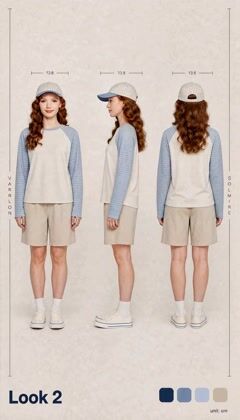 Lookbook Spec-Sheet TurnaroundRecreate workflow