
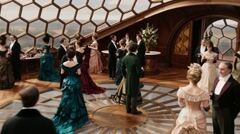
A single continuous 14-second one-take that travels from a colossal flying turtle in open sky, through an open pane in its glass shell, into the promenade beneath it, and ends on one passenger raising a glass to camera. No cuts anywhere. Photographic, live-action blockbuster cinematography, shot on large-format digital, fine real-world texture detail. NOT an illustration, NOT a digital painting. THE SUBJECT: an immense flying turtle, easily two hundred metres across. Its body is ancient and real — deeply creased grey-green hide, a broad blunt head extended forward on a thick wrinkled neck, four enormous flippers beating in slow deliberate strokes, and a short tail. It must read unmistakably as a turtle in the very first frame, never as a dome or a blimp. Its shell is a vast Victorian glasshouse: hexagonal panes of glass set in riveted brass framing, the panes following the natural hexagonal scute pattern of a real turtle shell exactly. Warm red lamplight burns along every brass seam from inside, so the whole shell glows red along its joints. High on the shell’s flank, one large hexagonal pane stands hinged open like a greenhouse vent. It glides slowly and steadily through a bright cloud sea above a forested landscape. Dozens of small hot air balloons drift in the distance. SCALE IS THE STORY: the shot must make the viewer recalibrate three times. First the turtle reads as a landscape feature. Then, as the camera nears, the angle on the glass changes, the sky reflection breaks apart, and tiny human figures appear inside the shell — it becomes architecture. Then it becomes a room. Then a face. Each step must be legible, and the moment the reflection breaks is the most important beat in the film. 0-3s: exterior wide. The turtle glides across frame through bright cloud, seen whole against sky and distant forest — head, all four flippers and tail clearly in frame. Its glass shell is completely opaque from this angle, a mirror of pale sky and moving cloud, revealing nothing of what is inside. The camera tracks alongside, matching its speed. Nothing else happens — the scale is established. 3-6s: the camera closes and swings around the flank. The reflection on the glass slides away and breaks, and through the panes the interior suddenly resolves: warm light, brass, and dozens of tiny passengers. The true size lands. The camera continues its arc and passes cleanly through the single open hinged pane, brass frame sweeping past the lens on both sides. 6-9s: inside now, gliding out over a circular promenade deck beneath the shell — a curving glass-and-brass arcade, warm lit, the hexagonal panes arching overhead with the cloud sea and balloons visible through them. Passengers stand at a railing looking out. 9-12s: the camera settles to human height and moves laterally in a slow curve through the crowd — passengers in Belle Epoque dress at a bar, gowns in deep teal and wine, gentlemen in frock coats and cravats. 12-14s: it arrives on one young man in a dark green frock coat. He turns toward the lens, raises a crystal coupe of red wine, and smiles directly at camera — warm, knowing, a small private salute to the viewer. Hold. End on this. Colour: cool silver-grey brass, grey-green hide and pale blue sky outside, warm amber and brass inside. The cool exterior and the warm interior are deliberately opposed. Exactly one saturated colour runs through the whole film — deep red: the lamplight along the shell’s brass seams, and the wine in the glass at the end. They rhyme. Light: bright high-key daylight, sun from behind and above, strong bounce off the cloud floor. Hard specular reflections sliding across the glass shell. Interior lit warm by contrast, shafts of daylight cutting down through the hexagonal panes. Clean and open, not moody. Grade: rich and clean, slightly lifted blacks, natural saturation, cinematic blockbuster contrast. Fine film grain. No crushing, no teal-orange push. Lens and camera: wide angle throughout with slight barrel distortion, deep focus in the exterior and the pane passage, shallower as it reaches human distance. One unbroken smooth glide — confident, steady, gently accelerating and decelerating, never handheld, never shaky, never whipping. The motion is elegant, not frantic. Texture: dense detail everywhere — deeply creased reptile hide, riveted brass framing, thick imperfect glass with visible reflections and slight distortion, glass panels, rigging, period costume detail in the fabrics. The world feels built, heavy and real. The turtle is a living animal, not a machine — the hide moves and flexes as the flippers beat. Audio: quiet and atmospheric — wind, the slow heavy beat of the flippers and a low structural creak of brass and glass outside, crossfading as the camera enters into warm interior murmur, glassware, distant conversation and a light string ensemble. No narration, no score swell, no stingers. Constraints: no captions, no text overlays, no watermarks, no cuts, no camera shake, no modern clothing, no additional saturated colours, no wings, no mechanical parts on the animal itself, the turtle never opens its mouth and never looks at camera, and the man at the end is the only person who ever looks at the lens.
Drag the clip sideways
15-second 16:9 stylized game-cinematic. Painterly oil-clay surfaces, chunky sculpted cloth, grim ruined street, high-contrast acid-green magic, heroic third-person camera, stop-motion clay texture. Not photoreal. @image1 is absolute character truth. Photocopy the sheet. Do not describe appearance, hair, clothes, or face. Use they / their / them only. 0–3s: Extreme close-up. A palm gathers a dense ball of acid-green fire. Hat brim frames the shot. Slow raise of the hand. 3–6s: Pull wide. They stand in a glowing green rune circle on a ruined street at dusk. Monster silhouettes pack the wreckage ahead. Hand still rising. 6–9s: Green flame detonates from the palm. Shockwave. A tide of green-veined creatures fills the ruins. 9–12s: They lift off the ground. Floating beams smash through the horde. The whole street is inside the cast. 12–15s: Snap to a close grin, eyes catching the green light. Camera holds as the street floods with the spell. AUDIO: spell charge, explosion, creature roar, no lyrics. No on-screen text.


THREE FACES — PHOTOCOPY THE STILLS. Do not invent people. @image1 = LANA, MAIN. Photocopy face, long wavy blonde hair, black cat-eye sunglasses. She is the bookend: first and last looks. Do not keep the ivory wool coat for this film — she wears a lime-green and yellow ribbed zip track jacket, high collar, over a navy turtleneck, chunky gold earrings. Same Lana every time she appears. @image2 = MEI. Photocopy face. Mid looks: dark ponytail, white ribbed sports crop with yellow trim, yellow neck scarf, white shorts, squat pose, yellow nails. Same Mei. @image3 = ERIK. Photocopy face. Mid looks: chrome/cyborg limbs and neon lime shorts, then a close-up in a clear visor / transparent-tech chest plate. Same Erik. Identity only — not a spa robe. 9 SECONDS, 1:1. Electric cobalt-blue studio, black letterbox, glitch collage: sliding rectangles, X marks, yellow/cyan bars, offset layers. Fast fashion-edit cuts. No brand logos, no trefoil, no wordmarks. 0–2s Lana, green-yellow track jacket, red-tinted cat-eyes, cobalt behind, glitch overlays, she poses and the layers slide. 2–4s smash to Mei squatting, crop + scarf, glitch boxes over the shorts. 4–6s Erik chrome-limb run / neon shorts, then visor close-up, more glitch. 6–9s back to Lana, same jacket, she moves toward camera, glitch, hold. No titles. AUDIO: punchy electronic beat, whooshes on cuts. No speech.

A premium cinematic forest-retreat ad: one guest moves from a moss-roofed treehouse lounge to the deck over a jade lake, where a calm pale resident creature makes them smile, ending on an invitation to stay. Intimate, misty, quietly luxurious, with a natural product-placement moment for any item.

15-second cinematic Snickers chocolate campaign. Bold red luxury studio, warm golden sunlight. Woman with blonde hair in light pink top. Unwrapped Snickers bar showing chocolate, caramel, peanuts. Multiple cinematic angles: wide shot, extreme close-up of eating moment, relaxed poses, overhead product shots, suspended chocolate pieces floating, slow-motion hand grab from shelf. Professional beauty-product photography lighting, smooth dynamic camera movements. Playful luxury indulgence aesthetic. Natural foley audio - hand movements, chocolate sounds, eating, breathing, warm ambient tone. NO music. Exactly 15 seconds.


Generate 15-second anime music video (16:9, 2K). Pure 2D cel animation + torn-paper collage aesthetic (ink black, warning red, paper white). Female swordfighter protagonist with antagonist silhouette shadow-pursuer. 8 cinematic shots with hard cuts. Kinetic typography synchronized to action. Original K-pop hip-hop × cyber-grunge soundtrack with foley. Character lock: protagonist identical throughout. Antagonist appears only in shots 3, 6, 8. Two still moments for pacing. Hard cut to black on final beat.


Exactly 12 seconds. 16:9. Photoreal handheld street clip. ONE CONTINUOUS TAKE. CAMERA: He walks TOWARD us the whole time. Front three-quarter, then closer front. We see his FACE and the FRONT of every jacket. Not over-the-shoulder. Not walking away. @image1 is the man — lock this exact face, hair, age. Bare head. NO CAP, no hat, no beanie, no hood up — hair visible in every frame. Frame 1 is already on the wet zebra crossing, already walking toward camera, already in outfit 1. NEVER a studio portrait. SET: Overcast wet city, wet asphalt, zebra crossing, huge classical stone cathedral with columns behind him. Cool grey daylight, light rain, cars passing. NO HATS AT ALL. Three jackets only. OUTFIT 1 (start): black leather jacket, dark trousers, no cap. Walking toward us. Front of the leather clearly readable. 0.0-3.5s — Walking toward camera. A hollow olive-green bomber jacket floats in the air to his right, empty, slightly translucent. He grabs it with his right hand. Particle dissolve: black leather becomes the olive bomber. Cap never appears. Same face, hair uncovered. Front of the new bomber fills the frame. 3.5-7.5s — Olive bomber, still walking toward us, checking the front zipper. A hollow grey pinstripe double-breasted overcoat floats to his left, empty. He grabs it. 7.5-12.0s — Particle dissolve into the grey pinstripe overcoat (no cap, no red hat). He keeps walking TOWARD camera until he is a medium close-up, coat front fully visible. Abrupt end. Same man. Rain on each fabric. Distant unreadable pedestrians only. No on-screen text. No logos. No music. No baseball cap in any second. AUDIO: rain, wet footsteps, traffic, fabric whoosh on each swap. Duration: exactly 12 seconds. Aspect ratio: 16:9.

[Generation Goal] @image1 launches from the high launch ledge toward the lower destination roof. Their mechanical wings malfunction during the descent, folding around them into an armored cocoon before they crash into the roof. They force the wings open, stand amid the dust, and impatiently close a wingtip that refuses to stay folded. Begin with clear spatial geography, build into a forceful impact, and finish with understated physical comedy. [Reference Material Roles] @image1 is an absolute character lock. Face, body, hair, costume, wing materials and silhouette are taken from it exactly and preserved through every mechanical configuration, with no drift or reinterpretation in any shot. Do not adopt its neutral background. @image2 is the environment lock. The launch ledge, the destination roof, the surrounding architecture, materials and lighting direction are taken from it exactly. Begin with the destination roof intact; preserve the damage after impact. Do not take any person from it. [Visual Style] Premium painterly fantasy animation. Stylized dimensional forms combined with hand-painted 2D brush textures, graphic facial lighting, visible painterly edges, asymmetric shadow shapes, rich material detail, expressive poses, and strong readable silhouettes. Use brief, controlled brush-like motion smears along fast-moving wing edges. Dramatic but controlled contrast, atmospheric depth, and sharp architecture. Skin, fabric, architecture, armor, and mechanical surfaces retain tactile definition and subtle wear. [Event Script] Wide shot from a slightly elevated rear three-quarter angle. @image1 stands on the high launch ledge in the left foreground. Across the gap, the lower destination roof occupies the right midground, with the distance behind it establishing depth. Keep them and the landing area clearly readable together. They step to the edge, look directly toward the open roof, and lower their weight into a launch stance. Their folded wings begin to open. HARD CUT. Full-body profile shot from ledge height, with the destination roof visible lower on the right. They push off with both legs and clear the ledge, moving left-to-right. The camera tracks right beside them as the ledge recedes. Wing spars extend through visible hinges; overlapping feather plates spread into a complete flight silhouette. End with both wings open and supporting their glide. Continue the same shot without a cut. The camera follows them forward and downward as they angle their chest toward the destination roof and extend their legs behind them. Both wings hold a balanced, steady spread, and the relic core glows evenly. The roof grows larger below and ahead as the gap closes. End in a controlled diagonal descent running from upper-left toward lower-right. HARD CUT. Full shot from a slightly elevated rear three-quarter angle, showing their body and both wing joints. The camera tracks along their descent. Their right outer wing joint abruptly snaps beyond its normal angle and locks. Only then does uneven lift roll their body sideways. Their head turns toward the failed wing as the relic core flickers. The destination roof remains visible below, making the approaching danger clear. End with them losing control while continuing toward the same landing area. HARD CUT. Full-body shot from a three-quarter frontal angle, camera tracking downward beside them. They tuck their knees toward their chest as both wing roots rotate forward. The metal feathers overlap around their arms, head, and bent legs, mechanically enclosing them in a tapered armored cocoon. A final narrow seam closes over their alarmed eyes. The shell remains visibly made from their original wing plates. End with the cocoon fully closed and still falling. HARD CUT. Low-angle wide shot from roof level, looking diagonally across the landing area. The cocoon strikes from upper-left and gouges a short path toward screen-right. Contact lifts a wave of roof surface along its path that breaks and scatters outward. A single sharp camera jolt marks the impact, then the frame settles. Heavy fragments fall in short arcs and bounce down the slope while fine dust expands behind the sliding shell. The cocoon stops in a shallow trench, supported by the structure beneath. End with the shell motionless inside the dust. HARD CUT. Static medium shot at cocoon height, three-quarter angle. Debris settles around the closed shell and the dust begins to thin. A single muffled punch from inside knocks an overlapping plate outward. A gloved hand pushes through the seam, grips its edge, and strains against it. The opening widens just enough to reveal one furious eye. End with their hand gripping the plate and the shell partially open. HARD CUT. Low-angle full shot from the front-left, keeping their boots, torso, and wing assembly visible. They plant both boots on the exposed roof support and force the shell apart. The left wing releases first, swinging clear of their body and folding behind their shoulder; the right wing catches halfway. They brace, jerk their right shoulder backward, and pull the resistant mechanism free. Its hinges snap into alignment in sequence as they straighten to full standing height. Dust drifts away from their silhouette; both wings now form compact vertical stacks behind their back. HARD CUT. Static medium shot at eye level from the front-left, holding their face and right shoulder mechanism together. They give the faulty right wing a narrow-eyed sideways glare, lips pressed together, then look forward with exhausted composure. Only after they look away does the upper wingtip spring open beside their shoulder with a small metallic squeak. Without looking back, they reach across with their left hand and press it firmly into its latch. Their hand drops. End on their unimpressed expression as one final fragment lands beside them. [Maintain Consistency] Keep the same person and attached wing assembly throughout. The right wing is the malfunctioning wing. The cocoon forms from the existing metal feathers rotating and overlapping through mechanical joints; those same components unfold and nest behind their shoulders. The high ledge remains the launch point, and the lower roof remains the destination. Keep all cameras on the same side of the flight and skid axis, preserving left-to-right travel. Maintain lighting direction, the gouge in the roof, and accumulated debris across cuts. Use natural-speed action: a deliberate launch, brief stable glide, sudden malfunction, fast fall, heavy impact, resistant mechanical recovery, and a clearly readable final comic beat. Give every beat comparable screen time so the sequence reads evenly from launch to final gesture, with no beat rushed and none held long. [Audio] <Soles scrape the ledge, followed by a firm push-off.> <Wing hinges extend and feather plates click into position as wind builds.> <A harsh ratchet snap interrupts the steady flight noise; the relic core sputters.> <Rapid overlapping metal clicks seal the cocoon.> <A heavy impact, brittle fracturing, grinding metal, and bouncing debris.> <A brief lull, then one muffled punch from inside the shell.> <Straining hinges, sliding plates, sequential latch snaps, and a firm final locking click.> <A small wingtip squeak, a dry closing clack, and one last fragment tick.> No dialogue, narration, or music. Their mouth remains naturally closed. No subtitles or on-screen text. [Rendering Exclusions] No clean anime cel-shading, thin anime line art, glossy generic CGI, photorealism, flat cartoon rendering, film grain, muddy textures, excessive bloom, noisy AI-looking detail, or blurry architecture.


【Generation Goal】 Generate a whimsical, cinematic, unhurried illustrated story in which two people set a single paper lantern onto still water at dusk, watch it drift, discover the pond filling with many more, share the sight with each other, and finally sit down together at the water's edge as the whole garden glows. 【Visual Style】 A classic feature-animation look — appealing rounded character design, large expressive eyes, soft full forms and warm readable faces — rendered as a hand-painted illustration with gouache and watercolour surfaces, luminous glazed colour, softly broken tonal transitions and controlled visible brush texture. Forms are sculpted by light and by the edges of the paint rather than drawn with contour lines. Glowing evening colour throughout: warm lantern light against cool blue evening shadow, coloured shadows, soft painterly highlights, elegant reflections and richly detailed foliage. Do not render ink outlines or line-art contours, cel shading, flat banded shadows, comic, manga, anime or webtoon styling, vector or flat-illustration fills, or photoreal imagery. 【Reference Asset Roles】 @image1 defines the first character's face, hair, body proportions and clothing; take the identity and costume entirely from it and do not adopt its neutral background. @image2 defines the second character's face, hair, body proportions and clothing; take the identity and costume entirely from it and do not adopt its neutral background. @image3 defines the location: the garden, the pond, the stone ledge, the bridges, the foliage, the lantern posts and the lighting; do not take any person from it. @image4 is the storyboard and governs shot order, framing, staging, character position and camera geography; read it left to right and then top to bottom, and do not adopt its panel grid, gutters or flat layout into the video. 【Subjects and Relationships】 There are exactly two people throughout, defined by @image1 and @image2. They remain the same two continuous people in every shot, never swapped, duplicated, replaced or altered in face, hair or clothing. Use they / their / them for both. They are warm and easy with one another, and their attention is mostly on the lantern and on each other. One paper lantern begins the sequence; the many lanterns that appear later are additional and the first one is never removed. The ledge, the near bank and the far side of the pond are parts of one continuous location. 【Event Script】 Stage 1: Both stand together at the near edge of the water, @image1 on the left and @image2 on the right, a small paper lantern resting on the flat stone ledge between them. Both look down at it and wait. At the end, the lantern is still on the ledge and neither has touched it. Stage 2: @image1 bends slightly and lifts the lantern from the ledge with both hands. @image2 stays close beside them, hands clasped beneath the chin, watching it closely. Both bodies angle inward toward the lantern. At the end, the lantern is held in @image1's two hands. Stage 3: @image1 crouches and lowers the lantern carefully onto the surface of the water. @image2 leans in from the right, watching. At the end, the lantern is resting on the water directly in front of them and @image1's hands have come away. Stage 4: Both stand side by side, looking down as the lantern drifts a short way out. @image2's expression opens in amazement; @image1 smiles. Reflections ripple across the water beneath it. At the end, the lantern is a little way from the bank and both are still watching it. Stage 5: Further out, more lanterns begin to glow across the water. @image2 reaches across and lightly touches @image1's sleeve, drawing their attention toward the far side. @image1 turns their head the same way. At the end, both are looking out across the pond together. Stage 6: The two have moved beneath a low trailing branch, still side by side, both facing the water. @image2 extends one arm and points out toward dozens of floating lanterns. @image1 looks where they point and smiles more brightly. Flower petals drift on the surface. At the end, the arm is still extended and both are looking out. Stage 7: @image2 turns to @image1 with delight, and @image1 turns back to them with affection. Behind them the water is filled with glowing lanterns, the bridges and the layered foliage. At the end, they are looking at each other. Stage 8: Both sit down together on the stone ledge at the water's edge, shoulders almost touching, facing forward toward the glowing water. The camera pulls gently back into a wide shot holding the whole lantern-filled garden under the deepening evening sky. The shot holds on that final state. Throughout, the water stays almost still and the lanterns drift slowly, their reflections shifting under them. Petals move on the surface, the trailing branches stir faintly, and the sky deepens gradually from pink toward blue. All movement is slow, soft and continuous; nothing is hurried and there are no fast cuts. 【Sound】 <Very quiet water lapping at a stone edge>, <a soft evening breeze moving through leaves>, <faint insects in the foliage>, <the small papery sound of a lantern set onto water>, <quiet movement of cloth as they shift and sit>. No one speaks, no narration, no music, and no subtitles appear on screen. Both characters keep their mouths naturally closed except where the script describes an open expression. 【Maintain Consistency】 Keep each character's identity, face, hair and clothing exactly as defined by @image1 and @image2 in every shot, with no drift, swapping or reinterpretation. Keep the garden, pond, ledge, bridges, foliage and lighting consistent with @image3. Keep the first lantern present once it is on the water, keep the number of lanterns growing and never shrinking, keep the near bank and the far side of the pond consistently oriented, and keep the shot order, framing and camera geography matching @image4.


An authentic in-store iPhone review: a creator inside a busy Apple Store holds the new iPhone @image2, talks through its design, display and cameras, turns it to camera to show it off and taps the screen naturally. Real handheld vlog energy, busy retail background, natural sound.

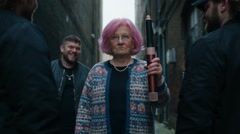 Pink AirwrapRecreate workflow