
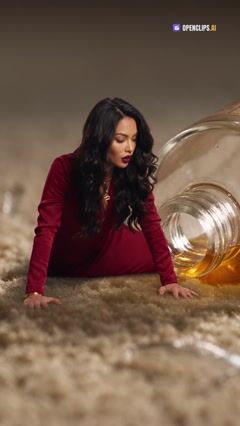
CHARACTER LOCK — HIGHEST PRIORITY: The person in every shot is exactly the person in @image1. Preserve their facial identity, facial structure, eye shape and spacing, eyebrows, nose, mouth, exact skin tone, hairline, hairstyle, hair length, texture and colour, freckles and distinctive marks, apparent age, build and body proportions — identically, shot to shot. Preserve their gender presentation exactly as shown; do not masculinize, feminize or otherwise reinterpret it. Do not beautify, slim, de-age or restyle them. Refer to them only as they/them in this prompt. ATTACHED IMAGES ARE MANDATORY AND FINAL: The attached images outrank every word written below them — including the product’s exact shape, features and proportions. ASSET MAP: @image1 — the tiny living person. Photocopy face, hair, skin, and the clothes on the still, exactly as photographed. Ignore the grey studio pad around @image1 — that pad is not a set. Never freeze on the attached still as frame 0. Never keep the crossed-arms studio pose. Never show a checkerboard or transparency grid. @image2 — the product, exactly as shown, unchanged and not regenerated — same shape, colour, materials, label and hardware in every shot it appears. No invented branding or text added. Ignore the grey studio pad around @image2 — that pad is not a set. Keep @image2's real label as the product's own label — do not replace that label with @image1's face. SUBJECT LOCK — HIGHEST PRIORITY: @image1 is a three-dimensional tiny living person only a few centimetres tall — same face, features and proportions, just shrunk in scale — already physically inside @image2's own real interior cavity, visible through the real material of @image2, with real volume and depth. Not a doll, not a statue, not a posed still, not a printed portrait, not a sticker, not a 2D face on the label. Soft living micro-motion the whole time — blinks, breath, weight shifting. They are inside the real hollow of @image2 itself — not inside any invented box, wrapping, capsule, shell or added packaging of any kind. @image2 keeps its own real shape, material and finish exactly as shown throughout, including after it breaks open — nothing about its appearance is invented or changed. Do not beautify, restyle or redesign either subject. FORBIDDEN CAMERA / TREATMENT: never print @image1 onto @image2's label. Never treat @image1 as label art, a mugshot on the label, or a picture glued to the product. From frame 1 the tiny person must read as a real body inside @image2. HANDS: if @image1 has hands, they are always anatomically correct with five fingers each, naturally proportioned, in every shot they appear. SINGLE SUBJECT: only @image1 appears as a person — no other people, figures or hands enter frame. PHOTOREAL LIVE-ACTION: real camera, real surface, real impact — not CGI, not an animated illustration. Match grain, colour and lighting between @image1, @image2 and the surface so the whole shot reads as one photograph. SCALE REALISM: @image1 is a few centimetres tall relative to @image2, which is at its true full size. Match lighting and colour grade throughout so the whole shot reads as one real photograph, not a composite. The scale contrast is clearly visible in the very first frame: a tiny living three-dimensional person inside the full-size product, seen through @image2. PROP CONTINUITY: the real surface @image2 is rolling along, and the edge or drop it is heading toward, are both visible from frame 1 — nothing new appears later unexplained. CAUSALITY LOCK: every event has a shown, physical cause — @image2 is already rolling when the shot opens, not starting from stillness; it falls because it reaches the edge of the surface it was rolling on, visibly; it is fragile and cracks the instant it first touches the ground, at the exact point of contact, not after a bounce or a delay; it breaks open immediately because that first-contact crack gives way at once; @image1 tumbles free only because the opening is now physically there. FORBIDDEN: a slow spiderweb crack over several seconds; staying intact after landing; bouncing then cracking later. PACING: real, continuous motion for nearly the whole duration — no calm establishing pause longer than 1 second except the brief settled beat at the very end. Each beat below must read as a distinct, clearly readable event, not a blur. Do NOT default to a calm, mostly-still shot. Shot 1 must open already in motion — @image2 is already rolling, not sitting still. Never freeze on the reference still. SCENE: a real tabletop or shelf at warm indoor light, shallow depth of field, whimsical live-action macro realism. @image2 is already rolling along the surface, @image1 a tiny three-dimensional living person visible moving inside its real interior cavity, when the shot opens. Tiny real person — not a doll, not a statue, not a picture on the label. 0–2s: Already rolling fast along the surface, @image2 approaches the edge, @image1 clearly visible as a tiny 3D body inside @image2. 2–4s: It rolls off the edge and falls, tumbling as it drops, @image1 still inside the cavity. 4–5s: The instant @image2 first touches the ground it cracks at that contact point and breaks open there — fast, easy, no delay. 5–8s: @image1 tumbles free through the opening, landing clear of the broken pieces on the ground. 8–12s: @image1 sits up or steadies themself amid the broken pieces of @image2, the full scale of both clearly visible in this final frame. STYLE: photoreal live-action macro, warm indoor light, shallow depth of field. Vertical 9:16. Tiny real three-dimensional person inside a towering full-size product — not a doll, not a statue, not a posed still, not label art. AUDIO: natural foley only — a rolling sound building speed, a whoosh during the fall, a sharp impact thud and an immediate crack as @image2 hits the ground, a tumble as @image1 comes free, a soft settling sound at the end. No music, no BGM, no voiceover, no narration. No on-screen text, no watermark, no subtitles.
Drag the clip sideways
Asset referencing: @image1 is the first frame of this video. It shows a deep bed of thick glossy cream in the main colour of THE OBJECT, THE OBJECT resting whole on the far part of the cream, and a polished gold spoon resting on the cream from the right. It defines the cream's colour and sheen, THE OBJECT, the spoon, the lighting and the framing of the opening shot. ATTACHED IMAGES ARE MANDATORY AND FINAL: the attached first frame outranks every word written below it. Wherever the image and this text disagree, follow the image. Every marking on THE OBJECT is a marking that already exists on @image1. THE FOLD — this is the whole point of the film: the gold spoon folds the thick cream over and over in slow, smooth, endless strokes. Each stroke the spoon slides under the cream, lifts a thick glossy sheet up, carries it over and lays it down onto itself in a soft heavy fold, and slides back to where it started. The cream is heavy, smooth and elastic: it stretches into a thick satin ribbon, sags under its own weight, drips back in a slow thick curtain from the edge of the spoon and settles into new soft ridges. The cream always stays one smooth glossy mass in the one colour of @image1, with sharp satin highlights on every crest. THE OBJECT stays exactly where @image1 has it on the far part of the cream, whole, upright and untouched for the whole film; the waves of cream move gently around its base. Summary: a macro ASMR film in one unbroken take in which a gold spoon folds a bed of thick glossy cream, coloured exactly like THE OBJECT, over and over in slow smooth strokes, ending in the same position it began, so the film loops. Timeline: 0–3s — The framing of @image1. The spoon slides under the cream and lifts a thick glossy sheet up and over, laying it down in a soft heavy fold with a slow wet sound. 3–6s — The spoon lifts high out of the cream carrying a heavy scoop; a thick satin ribbon stretches down from the spoon and falls back in a slow thick curtain, piling into soft coils on the surface. 6–8s — The spoon presses flat into the new pile and smooths it in one long slow stroke, the surface turning into a single smooth glossy wave. 8–10s — The spoon slides back under the cream to exactly where it rests in @image1, and the cream settles into soft folds like the opening frame, so the last frame matches the first. Notes: the cream keeps exactly the one colour of @image1 for the whole film. The same gold spoon appears throughout, its handle always leading out of the right edge of the frame. The light stays exactly as @image1 has it. The camera holds the framing of @image1 with only a very slow gentle push closer in the middle and a slow return by the end, with no cuts, and the film runs as one unbroken take. No subtitles. No BGM; generate only environmental sounds and action sounds: a close intimate ASMR mix, dry and present — the thick wet slide of the spoon under the cream, soft sticky pulls as the sheet lifts, a heavy soft slap as each fold lands, the slow glossy drip of the ribbon falling back, a smooth creamy swish as the spoon smooths the surface, and the quiet room tone of a calm sunny room under everything to the last frame.

Generate a live baseball Birthday Cam where the stadium celebrates your birthday.

Asset referencing: @image1 is the first frame of this video. It shows two gloved hands holding THE OBJECT just above a hydro-dipping tank whose water is covered with a floating film of marble paint. It defines THE OBJECT, the tank, the marble film and its colours, the hands, the lighting and the framing of the opening shot. ATTACHED IMAGES ARE MANDATORY AND FINAL: the attached first frame outranks every word written below it. Wherever the image and this text disagree, follow the image. THE OBJECT keeps the exact shape of @image1 for the whole film. THE DIP — this is the whole point of the film: the hands lower THE OBJECT slowly and steadily down through the floating marble film into the water. The film stretches and wraps around THE OBJECT like a thin skin, clinging to every curve, carrying its swirls, curls and gold threads onto the surface exactly as they float on the water. The hands lift it out and THE OBJECT comes up wrapped in that same glossy swirling marble, water streaming off it, its shape exactly the same as before. THE WATER LINE — THE OBJECT goes into the water only up to just below its top edge, and stops there. Its top edge and every opening in it stay above the water the whole time, and the inside stays dry, clean and empty, and comes out exactly as it went in. Only the outside below the top edge takes the marble. Summary: a satisfying ASMR hydro-dipping film in one unbroken take in which gloved hands lower THE OBJECT through a floating film of marble paint and lift it out wrapped in a glossy marble pattern, dripping. Timeline: 0–3s — The framing of @image1. The hands lower THE OBJECT slowly into the film; the marble veins stretch and bend around it as it sinks, with a soft wet sound. 3–5s — THE OBJECT stops with its top edge just above the water line and holds still for a moment; the emptied film swirls on the surface around it, its opening dry above the water. 5–8s — The hands lift THE OBJECT slowly out of the water. Everything below its top edge comes up wrapped in the glossy swirling marble, water streaming off the outside and dripping from it back into the tank. 8–10s — The hands hold THE OBJECT up and turn it slowly toward the camera, the wet marble pattern shining in the light, the last drops falling. Notes: THE OBJECT keeps exactly the shape of @image1 for the whole film; only its surface changes, from plain to marble. The same two gloved hands appear throughout. The light stays exactly as @image1 has it. The camera holds the framing of @image1, tilting up gently to follow THE OBJECT as it rises, with no cuts, and the film runs as one unbroken take. No subtitles. No BGM; generate only environmental sounds and action sounds: a close intimate ASMR mix, dry and present — the soft wet sink of THE OBJECT breaking the film, gentle sloshing of water around the hands, the rush and trickle of water streaming off it as it rises, a steady patter of drips falling into the tank, and the quiet hum of a calm workshop under everything to the last frame.

Generate a live basketball Proposal Cam where your partner proposes to you on the big screen.

Transform into an angel — a white-and-gold robe, a golden halo and great feathered wings in a radiant marble sanctuary. Upload a photo, you keep your own face. One continuous cinematic take, music only. 15s.
Asset referencing: @image1 is the first frame of this video. It shows a hand holding THE OBJECT just above the clear water in a tall wide glass vase on a wooden table. It defines THE OBJECT, the vase, the water, the hand, the room, the lighting and the framing of the opening shot. ATTACHED IMAGES ARE MANDATORY AND FINAL: the attached first frame outranks every word written below it. Wherever the image and this text disagree, follow the image. Every colour of the pigment is a colour that already exists on @image1. THE DISSOLVE — this is the whole point of the film: the moment THE OBJECT touches the water it starts to dissolve into fine shimmering pearl pigment in its own colours. It melts away from the bottom up as it is lowered, the way a bath bomb or a sugar cube dissolves, shedding soft silky clouds of sparkling colour, until nothing solid is left. The pigment then unfolds through the water in slow silky ribbons, like liquid silk, always in exactly the colours of @image1 with a pearly sparkle, and twists into a slowly turning glowing spiral that fills the whole vase. Summary: a calm ASMR film in one unbroken take in which a hand lowers THE OBJECT into clear water, it dissolves completely into shimmering pigment of its own colours, and the colour blooms into silk and turns into a slow glowing spiral in the sunlight. Timeline: 0–2s — The framing of @image1. The hand slowly lowers THE OBJECT; its bottom touches the water and at once begins to dissolve, soft clouds of sparkling pigment in its colour pouring down from it with a gentle fizz. 2–4s — The hand keeps lowering it under the surface; THE OBJECT melts away from the bottom up in a rush of shimmering silky clouds until it is completely gone, and the empty hand opens and lifts out of the water and out of frame. 4–7s — The pigment blooms through the whole vase in slow silky ribbons and marbled swirls, curling and folding, sparkling in the sunlight. 7–10s — The swirls gather into one smooth, slowly turning glowing spiral of colour filling the vase from top to bottom, the light glinting through it. Notes: the pigment keeps exactly the colours of @image1 for the whole film. The vase stays clear plain glass. The light stays exactly as @image1 has it. The camera holds the framing of @image1 steadily, with no cuts, and the film runs as one unbroken take. No subtitles. No BGM; generate only environmental sounds and action sounds: a close intimate ASMR mix, dry and present — a soft splash as THE OBJECT meets the water, a gentle crackling fizz as it dissolves, soft bubbling as the clouds pour out, the quiet drip of water from the hand, a faint crystalline shimmer as the pigment swirls, and the quiet warm room tone of a calm old room under everything to the last frame.

Generate a live hockey Noise Meter Cam where you max out the arena noise meter.

Asset referencing: @image1 is the FIRST FRAME of this video. It defines the kitten, its white toque and apron, its pink collar with two gold bells, the counter, THE PRODUCT standing open on the left with its ROUND WHITE LID lying flat on the counter beside it, the white blender base with its glass jug of milk and strawberries, the steel pan and the bowl of strawberries to the right, the shelf of three tiny pans and two white cups above, the warm defocused kitchen behind, and the lighting. ATTACHED IMAGE IS MANDATORY AND FINAL: the attached first frame outranks every word written below it. Wherever the image and this text disagree, follow the image. Summary: a kitten chef starts a blender with no lid on it, fights the eruption with the only lid it can reach, loses the fight, and brings the whole miniature kitchen down on itself. THE KITTEN IS ON SCREEN IN EVERY SINGLE FRAME — no exceptions. It is the subject of this film and it is never absent, never hidden, never below the counter edge and never out of the picture. Even when it is flat on its back or buried in shake, its body stays visible above the counter top. A frame without the kitten in it is a failed frame. SPEED AND PHYSICS: everything happens at REAL SPEED, in real time, as ordinary footage played back at 1x. There is NO slow motion anywhere, not for one frame. Gravity is full, normal and HARD: things that fall, fall fast and land within a fraction of a second — they never float, drift or hang in the air. These are MINIATURE objects at one fifth of kitchen scale, so movements are short, snappy and quick, with fast bounces and rapid settling. Liquid moves at real speed: the geyser jets hard under pressure, splatter lands immediately, the flood runs fast. The kitten moves like a real kitten — fast, twitchy, reactive bursts, never a slow graceful arc. FRAMING IS LOCKED: the camera holds the exact width and height of @image1 for all fifteen seconds. It may breathe and drift a few degrees to follow the action, handheld and alive, but it NEVER pushes in, never zooms, never goes to a close-up and never crops tighter than @image1. THE PRODUCT is WHOLE AND UNCROPPED in the left third in every single frame, including the last, with its entire label inside the picture. NOTHING DISAPPEARS: every object in @image1 is present in every frame. Nothing fades out, nothing is removed, nothing is replaced, and nothing new appears. Objects get knocked over, flooded and buried, but they stay on screen: the white blender base stays on the counter and keeps running; the glass jug stays with it; the steel pan, the bowl and the strawberries stay on the counter; the pans from the shelf land on the counter and stay; the shelf stays on the wall; the kitten's white toque stays ON ITS HEAD through every beat, soaked and crooked but NEVER off, and its pink collar with both gold bells stays on throughout. THE PRODUCT IS FIXED: it stands upright in the left third exactly where @image1 has it and NEVER MOVES. Nothing hits it, nothing lands on it, nothing covers it. Its lid, however, is in play — that lid is a prop of this film. THE KITTEN IS FIXED: the same single kitten as @image1 throughout — the same almost-white cream coat, the same large round deep blue eyes, the same pink nose. Never a grey or tabby cat, never a second cat. PAWS, NEVER HANDS — absolute, every frame: plain rounded cat paws, no fingers, no thumbs. No human hand appears at any moment. SCALE LOCK: THE PRODUCT is full human size; everything else on the counter is a real miniature at one fifth of kitchen scale. ONE CONTINUOUS SHOT. No cuts, no dissolves, no fades. Something is being poured, sprayed, knocked over, flooded or dropped in EVERY second — no pause, no still beat, no held look. Timeline — one action per beat, each caused by the last, each executed fast: 0:00–0:01.5 — The kitten tips the scoop and a thick fall of pale powder drops fast into the open glass jug and clouds the milk. END STATE: powder in the milk, a puff of dust over the jug, the scoop dropped on the counter. 0:01.5–0:02.5 — It stabs the black button with a paw. The blender ROARS and instantly a geyser of pink shake erupts straight up out of the open jug and hits the shelf above. The kitten's eyes go wide and it rears back. END STATE: a column of pink shake firing upward, the kitten reared back, still in frame. 0:02.5–0:04.5 — It throws itself sideways at THE PRODUCT'S ROUND WHITE LID lying on the counter, grabs it in both front paws, hauls it up over the jug and SLAMS it down onto the jug mouth to stop the eruption. For a beat the jet is capped and bulges against it. Then the pressure blasts the lid straight out of its paws; the lid flies up, spins across the counter and clatters down flat in the flood. END STATE: the lid lying in the shake, the geyser firing again at full height, the kitten still gripping at nothing. 0:04.5–0:06.0 — Desperate, the kitten throws its whole body over the mouth of the jug to block it. The geyser blasts it straight off and flips it over backwards onto the counter, coat plastered flat and pink, bells swinging. END STATE: the kitten on its back on the counter, drenched, the jug still erupting. 0:06.0–0:07.5 — Falling, it catches the jug's handle and drags it over. The jug topples onto its side on the base and the whole load of shake dumps out at once and runs fast across the counter. The base keeps running. END STATE: the jug on its side, the counter flooding quickly. 0:07.5–0:09.5 — The kitten scrambles to get up in the flood. Its paws shoot out from under it on the slick surface and it goes down hard on its side, soaking itself completely. END STATE: the kitten down flat in the shake, legs splayed, still in frame. 0:09.5–0:11.5 — It slides from there, skidding the whole length of the counter on its back at speed, paws in the air, bells ringing, and slams into the steel pan and the bowl of strawberries, scattering them around it. Everything stays on the counter. END STATE: the kitten on its back among the pan, bowl and loose strawberries. 0:11.5–0:13.0 — The crash jolts the shelf above and the three tiny pans slide off in quick succession and drop hard onto the counter around the kitten, clanging. One white cup is left on the tilted shelf, teetering on the edge. END STATE: three pans down around the kitten, one cup about to go. 0:13.0–0:15.0 — The kitten hauls its head and shoulders up out of the flood right beside THE PRODUCT, blinking, completely pink, the toque flopped over one eye — and the last cup drops straight off the shelf, fast, and lands upside down on its head with a hollow plonk. It wobbles there, and the kitten does not move. END ON MOVEMENT: the cup rocking on its head, shake still dripping off the shelf, the blender base still whirring at the very last frame. Notes: the destruction only accumulates — nothing that falls stands back up, nothing spilled disappears, and the counter gets progressively more flooded across the fifteen seconds. No subtitles. No on-screen text of any kind. No logo anywhere other than THE PRODUCT's own label. Audio — wall to wall, never silent for a frame: the dry fall of powder, the click of the button, the hard roar of the blender running the whole film, the muffled choked note as the lid caps the jet and the bang as it blows off, the wet slapping of shake on the shelf and wall, the jingling of the collar bells on every movement, the heavy slop of the flood, the skid, the clatter of pan and bowl, the sharp clang of three pans dropping, and the hollow plonk of the cup landing on the kitten's head. Fast light chaotic music underneath. No voices, no dialogue, no narration.

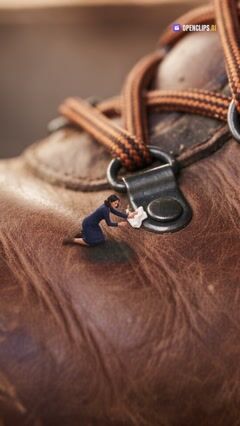 Boot PolishRecreate workflow