
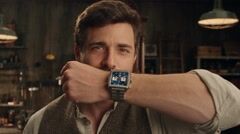


THE TIME TRAVELER — FIVE ERAS IN ONE DAY. An epic, inventive, playful journey through history, at full realtime speed. Every jump in time is one smooth, seamless camera move through the face of the watch: the camera glides into the @image2 watch dial as its hands spin, and glides back out of a round shape in the next era that matches the dial exactly — a sundial, a wagon wheel, a mirror ball, a rocket porthole, a neon ring — so the eras flow into each other in one continuous, magical camera move. AUDIO MIX (ranked, three separate layers): 1. MUSIC — loudest, dominant from the very first frame: an adventurous, whimsical orchestral instrumental with a ticking-clock rhythm, swelling strings and brass, a playful motif that changes colour in every era — a Roman horn, a western harmonica, a 1920s jazz trumpet, a 1960s space-age theremin, a futuristic synth — and a triumphant finale; original, instrumental only. 2. SFX — quiet, under the music: clock ticks and a deep clockwork whirr at every jump, a Roman crowd, horse hooves and a steam whistle, a jazz band, a rocket countdown rumble, a hum of flying cars. 3. VOICE — none; @image1 stays silent the whole clip. Audio suppressor: no voiceover narration, no dialogue, no spoken words, no singing vocals, no lyrics, no library audio bed, no muffled murmuring, no subtitles. The music resolves on a final hit and silence holds the final 0.5s. AUDIO QUALITY: the whole soundtrack is one clean, crisp, studio-mastered stereo mix — the music plays continuously and smoothly from the first frame to the final hit, every pause in the action is filled by the music itself, and every sound effect is clear, natural and matches a visible action on screen. TWO references with separate jobs: @image1 is the time traveler — @image1 keeps the exact same face and features as the reference the whole time, only what is present in the reference. Preserve their gender presentation exactly as shown. Use they / their / them only. @image2 is THE WATCH — take only the watch from @image2 and keep it exactly as the reference whenever it appears: its exact case shape, dial colour, any sub-dials, crown, strap or bracelet and logo. @image1 wears the @image2 watch on the top of the left wrist in every era, the one thing that never changes. WARDROBE — each era has its own outfit, already on @image1 when the camera glides out into that era: a tweed waistcoat and rolled shirtsleeves in the workshop; a white toga in Rome; a long duster coat and cowboy hat in the Wild West; sharp black 1920s evening wear styled to suit their gender presentation as shown in @image1 in the 1920s; a white 1960s spacesuit with the helmet under the arm in 1969; a sleek silver jacket in the future; back to the tweed waistcoat in the workshop at the end. BEATS (30s): 0–4s: THE WORKSHOP — in a cluttered inventor's workshop full of ticking clocks and brass gears, @image1 lifts the left wrist, looks at the @image2 watch with a mischievous grin and turns its crown with two fingers. The hands on the dial begin to spin fast. Camera: close on the @image2 watch, then a smooth push straight into the spinning dial. 4–8s: ANCIENT ROME — the camera glides out of the round face of a stone sundial in a sunny Roman forum, revealing @image1 in a white toga among senators. @image1 looks down at the @image2 watch, laughs in amazement and turns the crown again. Camera: pull-out from the sundial into a wide shot, then a push into the dial. 8–12s: THE WILD WEST — the camera glides out of a spinning wooden wagon wheel on a dusty main street, revealing @image1 in a duster coat and cowboy hat riding a horse at a trot as a steam train puffs past. @image1 tips the hat, glances at the @image2 watch and turns the crown. Camera: pull-out from the wheel into a wide tracking shot, then a push into the dial. 12–16s: THE 1920s — the camera glides out of a glittering mirror ball at a jazz party, revealing @image1 in that 1920s evening wear dancing the Charleston with a crowd in beaded fringe outfits and pinstripes, a brass band playing. @image1 spins, checks the @image2 watch and turns the crown. Camera: pull-out from the mirror ball, circling the dancers, then a push into the dial. 16–20s: 1969 — the camera glides out of a round rocket porthole on a launch pad at dawn, revealing @image1 in the white spacesuit, helmet under the arm, saluting in front of a giant rocket as mission control cheers through the speakers. @image1 turns the crown. Camera: pull-out from the porthole into a low wide shot of the rocket, then a push into the dial. 20–25s: THE FUTURE — the camera glides out of a glowing neon ring on a skyscraper, revealing @image1 in the silver jacket walking through a neon city at night, flying cars streaming overhead and holograms all around. @image1 stops, looks at the @image2 watch with a satisfied smile and turns the crown one last time, the dial spinning as neon light reflects on the glass. Camera: pull-out from the neon ring into a low wide shot, then a tight close-up on the spinning @image2 watch and a push into the dial. 25–30s: HOME — the camera glides out of the round face of the big brass clock on the workshop wall, revealing @image1 back in the workshop in the tweed waistcoat. @image1 holds up the left wrist to the camera with the @image2 watch clearly in view and winks. Camera: pull-out from the wall clock, then a slow push-in on @image1 and the @image2 watch, holding to the last frame. LOOK: ultra-photorealistic, each era with its own colour grade — warm marble gold in Rome, dusty sepia in the West, glittering amber in the 1920s, cool blue dawn in 1969, electric neon in the future — seamless match-cut camera moves, natural motion blur, film grain, clean full frame.
Drag the clip sideways
Halloween night on your porch: the trick-or-treaters hold up their buckets and instead of sweets they get YOUR product, then a black end card with the product and one word. Upload your face and your product.
VERTICAL 9:16 16 seconds. Seedance 2.5. Cinematic action-comedy commercial. Hard cuts crane ↔ boardroom. Wide, macro, POV crosshairs, SLOW-MO. Photoreal. No on-screen text. CHARACTER LOCK: the sniper is exactly @image1. Preserve face, hair, skin, age, build. Preserve their gender presentation exactly as shown. Use they / their / them only. @image1 = FACE only. Photocopy this person. Sniper look: dark tactical clothes, futuristic silver arm armor. On a yellow construction crane over a modern city. @image2 = THIS product. Photocopy it. NEVER a different product. They load @image2 into the sniper rifle. The first shot is a LONG SLOW-MO of @image2 flying. A bucket or box of the same product sits beside them. SET A: yellow crane, city skyline. SET B: sleek glass boardroom. Several people in suits as extras, not extra heroes. One person in a blue top at the table receives the FIRST shot. 0.00–4.00 SETUP. Wide: they lie prone on the crane jib, load @image2 into the chamber. CU eye in the scope. POV crosshairs: distant boardroom. 4.00–10.00 FIRST SHOT — SLOW-MO HERO. Barrel fires. @image2 flies toward camera in LONG SLOW-MOTION. Smoke on the crane. Glass shatters in slow-mo. @image2 flies to the person in the blue top, who then catches it / holds it up, commercial, clean. 10.00–16.00 RAPID FIRE. Scope POV. They grab more of @image2 from the bucket, fire. More product through glass to the suited extras. End wide: table silent, product in hand. Action-comedy score. Same person as @image1. Same product as @image2. Never a studio still as frame 0.
CYBERPUNK HACKER — NEON CITY RUN. A stylish cyberpunk cinematic montage, full realtime speed, sharp cuts between scenes in a neon city of the future. AUDIO MIX (ranked, three separate layers): 1. MUSIC — loudest, dominant from the very first frame: a dark, pulsing synthwave / cyberpunk instrumental with heavy bass, arpeggiated synths and a driving beat; original, instrumental only. 2. SFX — quiet, under the music: neon rain, holographic beeps, fast typing, a motorbike engine starting and revving. 3. VOICE — none; @image1 stays silent the whole clip. Audio suppressor: no voiceover narration, no dialogue, no spoken words, no singing vocals, no lyrics, no library audio bed, no muffled murmuring, no subtitles. The music resolves on a final hit and silence holds the final 0.5s. @image1 is the elite hacker, identity kept EXACTLY from the reference the whole time — same face, hair and features — in a black techwear jacket with glowing trim and fingerless gloves. Preserve their gender presentation exactly as shown. Use they / their / them only. @image2 is THE HEADPHONES — take only the headphones from @image2 and keep them exactly as the reference whenever they appear: their exact shape, colour, headband, ear cups, materials and logo. SETTING: a towering rain-soaked neon megacity at night, holographic billboards, steaming streets, flying traffic overhead. BEATS (20s): 0–4s: @image1 walks through the neon rain along a crowded market street, hood up, reflections glowing on the wet ground. Camera: tracking in front, low. 4–9s: in a hidden rooftop den @image1 puts on the @image2 headphones, lifting them with both hands and settling the ear cups over the ears, then starts typing fast on a glowing keyboard as holographic code screens unfold in the air around them; the @image2 headphones stay on @image1's head for this whole scene. Camera: close on the @image2 headphones, then circling through the floating holograms. 9–12s: @image1 taps a glowing holographic display projected above their wrist, swipes once, and every holographic billboard across the city flips to a green glitch at the same moment. Camera: close on the wrist display, then a wide of the glitching skyline. 12–15s: THE BIKE — down in a wet neon alley a sleek black-and-cyan motorbike stands parked on its kickstand, a matching black full-face helmet with a tinted visor resting on the seat from the start. @image1 walks up, lifts the helmet with both hands, pulls it down over the head, flips the visor down and fastens the chin strap. Then @image1 swings one leg over the seat, sits down on the bike, grips both handlebars, kicks up the kickstand and presses the start button; the headlight and neon trim light up. Camera: medium side shot, holding the whole action in one steady angle. 15–20s: @image1 twists the throttle and the bike pulls away smoothly, the black helmet with the tinted visor staying on @image1's head for the entire ride. @image1 races down a long neon-lit avenue with drones chasing behind and neon trails streaking past. At the end of the avenue towers a giant skyscraper-sized digital billboard: it shows a glossy full-screen advertisement of the @image2 headphones — the @image2 headphones huge, slowly rotating, lit in magenta and cyan, the @image2 logo large and sharp beside them — glowing over the whole city. The bike speeds toward the billboard and passes beneath it. Camera: fast tracking alongside at bike height, then a wide shot from behind as the bike races toward the giant @image2 billboard, holding on the glowing billboard ad to the last frame. LOOK: ultra-photorealistic cinematic cyberpunk grade, deep magenta and cyan neon, wet reflections, natural motion blur, film grain, clean full frame.
FESTIVAL DJ — HEADLINE THE BIGGEST NIGHT OF THE YEAR. A euphoric, high-energy, FOMO-inducing film of the biggest party of the year with @image1 as the headlining DJ: a giant open-air night festival, a sea of people, lasers, fire and confetti, every scene a clear concrete action at full realtime speed, the camera always moving with the beat. AUDIO MIX (ranked, three separate layers): 1. MUSIC — loudest, dominant from the very first frame: a massive, euphoric festival house-and-techno instrumental: a pulsing four-on-the-floor kick, a rolling bassline, soaring synth leads and a long tension build with a rising snare roll that explodes into a huge, earth-shaking drop at 14s, then keeps peaking to a final euphoric anthem; original, instrumental only. 2. SFX — quiet, under the music: a roaring crowd, cheering on the drop, CO2 cannons blasting, fireworks crackling, confetti cannons. 3. VOICE — none; @image1 stays silent the whole clip. Audio suppressor: no voiceover narration, no dialogue, no spoken words, no singing vocals, no lyrics, no library audio bed, no muffled murmuring, no subtitles. The music resolves on a final hit and silence holds the final 0.5s. AUDIO QUALITY: the whole soundtrack is one clean, crisp, studio-mastered stereo mix — the music plays continuously and smoothly from the first frame to the final hit, every pause in the action is filled by the music itself, and every sound effect is clear, natural and matches a visible action on screen. TWO references with separate jobs: @image1 is the DJ — @image1 keeps the exact same face and features as the reference the whole time, only what is present in the reference. Preserve their gender presentation exactly as shown. Use they / their / them only. @image2 is THE HEADPHONES — take only the headphones from @image2 and keep it exactly as the reference whenever it appears: their exact shape, colour, headband, ear cups and logo. @image1 wears the @image2 headphones around the neck or on one ear while mixing, and puts them on and takes them off by hand. WARDROBE — the same in every scene: @image1 wears a simple dark festival outfit, no added jewellery. THE STAGE — a giant open-air festival main stage at night: a huge LED wall, a raised DJ booth with two turntables and a mixer, rows of lasers and flame cannons along the front, and a crowd of tens of thousands stretching to the horizon. BEATS (30s): 0–3s: ARRIVAL — @image1 steps out of a black SUV backstage into a corridor of flashing lights, crew and friends cheering and high-fiving, the roar of the crowd shaking the walls. Camera: handheld tracking behind @image1. 3–6s: THE HEADPHONES — at the top of the stage stairs @image1 lifts the @image2 headphones from around the neck, puts them on with both hands, closes the eyes for a second and smiles. Camera: close-up on the @image2 headphones going on, then on the face lit by the stage glow. 6–10s: THE ENTRANCE — @image1 walks out into the DJ booth as the LED wall explodes in white light and the whole crowd screams, tens of thousands of phones and hands in the air. @image1 raises one fist to the crowd. Camera: from behind @image1 looking out over the endless crowd. 10–14s: THE BUILD — @image1 rides the faders and turns a filter knob on the mixer, one ear cup of the @image2 headphones pressed to the ear, the snare roll building; the crowd crouches down together, waiting. Camera: tight on the hands on the mixer, then a wide of the crouching crowd. 14–18s: THE DROP — @image1 throws both hands up and drops the beat: flame cannons blast columns of fire, CO2 jets shoot white clouds into the air, lasers sweep the sky and the whole crowd jumps at once. Camera: wide from the crowd as everything explodes, then a fast drone sweep over the jumping sea of people. 18–22s: THE CROWD — friends on shoulders scream every beat, strangers hug, hands wave, glitter and sweat in the lasers. Camera: handheld inside the crowd, people dancing all around the lens, the stage glowing behind. 22–26s: THE PEAK — @image1 jumps on top of the DJ booth, arms wide, as confetti cannons fire a storm of silver confetti over the crowd and fireworks burst above the stage. Camera: low from the front row looking up at @image1 against the fireworks. 26–30s: SUNRISE — the first light of dawn breaks behind the stage; @image1 lowers the @image2 headphones around the neck, looks out over the still-dancing crowd with a huge smile and takes a photo of them with a phone. Camera: drone pulling back and rising over the endless crowd in the pink dawn, holding to the last frame. LOOK: ultra-photorealistic festival aftermovie, deep night blues with blazing lasers, fire and confetti, pink dawn at the end, dynamic handheld and drone camera, natural motion blur, fine film grain, clean full frame.
F1 DRIVER — RACE DAY. A cinematic montage at a calm, steady pace, full realtime speed, seven clear scenes of a Formula 1 race day from the garage to the podium. Each scene has room to breathe: every action is shown slowly and completely, every object is handed over or picked up by hand, and each object stays exactly where it was put. AUDIO MIX (ranked, three separate layers): 1. MUSIC — loudest, dominant from the very first frame: a pounding, adrenaline-fuelled cinematic racing instrumental with driving drums, deep synth bass and a soaring, goosebump-inducing triumphant orchestral theme with choir swelling to a huge climax at the podium; original, instrumental only. 2. SFX — quiet, under the music: screaming F1 engines, pit-stop wheel guns, a roaring crowd, a champagne cork popping and spraying, confetti cannons and fireworks. 3. VOICE — none; @image1 stays silent the whole clip. Audio suppressor: no voiceover narration, no dialogue, no spoken words, no singing vocals, no lyrics, no library audio bed, no muffled murmuring, no subtitles. The music resolves on a final hit and silence holds the final 0.5s. AUDIO QUALITY: the whole soundtrack is one clean, crisp, studio-mastered stereo mix — the music plays continuously and smoothly from the first frame to the final hit, every pause in the action is filled by the music itself, and every sound effect is clear, natural and matches a visible action on screen. TWO references with separate jobs: @image1 is the F1 driver, identity kept EXACTLY from @image1 the whole time — same face and features — in a fireproof racing suit with sponsor patches. Preserve their gender presentation exactly as shown. Use they / their / them only. @image2 is THE WATCH — take only the watch from @image2 and keep it exactly as the reference whenever it appears: its exact case shape, dial colour, any sub-dials, crown, strap or bracelet and logo, exactly as shown — nothing invented or redesigned. @image1 wears the @image2 watch normally on the top of the left wrist. THE BALACLAVA — whenever the white fireproof balaclava is worn or removed it is a real racing balaclava with ONE WIDE HORIZONTAL EYE OPENING cut across the front: both eyes, the eyelashes and the bridge of the nose are fully visible through that opening at all times, with the fabric covering only the forehead, cheeks, chin and neck. Never show it as a blank, seamless or featureless hood over the face, never with the eyes covered, and never as a mask with no opening. BEATS (30s): 0–4s: THE GARAGE — @image1 pulls the white fireproof balaclava down over the head and settles it so the eye opening lines up and both eyes look straight out through it, then lifts the helmet from the shelf with both hands, slowly pulls it on, fastens the chin strap and snaps the visor down, then gives the crew a thumbs-up. Camera: close on the hands and the helmet, with the eyes clearly visible through the balaclava opening before the helmet goes on. 4–8s: THE COCKPIT — @image1 climbs over the side of the car and slides down into the cockpit; a mechanic clips the steering wheel onto the column. Camera: rising over the cockpit. 8–12s: LIGHTS OUT — the five red lights above the grid go out and @image1's car launches off the line in a cloud of tyre smoke and leads the pack into the first corner. Camera: low trackside, then a wide of the corner. 12–14s: INTO THE PIT BOX — @image1's car turns into the pit lane and rolls slowly into its pit box, stopping exactly on its marks as the crew in team overalls rush in around it. Camera: high overhead wide shot looking straight down on the car and the pit box. 14–18s: THE TYRE CHANGE — slow and precise, at the front-left wheel, with TWO DIFFERENT TYRES: the OLD tyre on the car is dusty and worn, with YELLOW sidewall markings; the NEW tyre is glossy black and fresh, with bright RED sidewall markings, waiting on the ground in a mechanic's hands beside the car. The front jack lifts the car; a wheel gun spins the nut off; a second mechanic pulls the worn yellow-marked tyre straight off the hub, turns away and carries it out of the frame, leaving the bare hub; a third mechanic lifts the fresh red-marked tyre and pushes it onto the bare hub; the wheel gun spins the nut back on. The car now wears the red-marked tyre. The jack drops and the car pulls away. Camera: a steady low close-up on that one front wheel through the whole change, at wheel height, both tyres clearly visible as they swap. 18–21s: THE FINISH — @image1's car flashes across the painted finish line in first place, a gloved fist pumping out of the cockpit, the helmet still on, as the packed grandstands erupt. Camera: low trackside. 21–25s: PARC FERMÉ — @image1 climbs out of the car, stands up and with both hands slowly lifts the helmet off the head, revealing the white balaclava underneath with both eyes looking straight out through its wide eye opening; @image1 then hooks two fingers under the front edge of the balaclava and peels it up off the face and over the head in one motion, face beaming, and hands the helmet to a team member. @image1 then lifts the left wrist to look at the @image2 watch and smiles. Camera: medium on the helmet coming off and the eyes visible through the balaclava opening, then a first-person view from @image1's own eyes looking down at their own left wrist, so the @image2 watch reads upright and natural, exactly as the wearer sees it. 25–30s: THE PODIUM — a grand, euphoric, triumphant finale. Cut straight from the watch close-up to @image1 already standing on the top step of a huge podium under a blazing golden late-afternoon sky, in front of a packed, roaring grandstand waving team flags. A dark-green magnum of champagne stands upright on the podium step right in front of @image1's feet, clearly visible in the frame from the very first moment of this shot. @image1 is overwhelmed with joy: eyes shining with happy tears, a huge open-mouthed victorious smile, chest heaving with emotion. @image1 lifts the tall golden trophy high above the head in both hands and pumps it triumphantly to the sky again and again as golden confetti cannons blast showers of gold confetti across the podium, fireworks burst over the grandstand and the whole team below jumps, hugs and cheers. @image1 then lowers the trophy and sets it down on the podium step beside their feet, where it stays in frame, bends down, picks up the champagne magnum from the step in front of them with both hands, pops the cork and sprays a huge glittering arc of champagne over the cheering crowd and the team below, laughing with pure euphoria, holding the bottle in both hands until the last frame. One single continuous shot for this whole beat. Camera: starting low and heroic with both the raised trophy and the champagne magnum on the step in frame, slowly craning up and back into a sweeping epic wide of the confetti, fireworks and champagne spray over the ecstatic crowd, the trophy standing on the step, holding to the last frame. LOOK: ultra-photorealistic cinematic motorsport grade, bright sunshine, saturated team colours, natural motion blur, film grain, clean full frame.
GYARU GLOW-UP — GET READY WITH ME, STEP BY STEP. One continuous cinematic take, full realtime speed, an extreme Japanese gyaru makeover shown clearly and in order, every item picked up by hand from the vanity and visibly applied over time, building to a bold final look. AUDIO MIX (ranked, three separate layers): 1. MUSIC — loudest, dominant from the very first frame: a hyper, upbeat J-pop / para-para instrumental with bright synths, a bouncy beat and a catchy hook; original, instrumental only. 2. SFX — quiet, under the music: soft brush strokes, the click of a compact, a light sparkle chime at the end. 3. VOICE — none; the person stays silent the whole clip. Audio suppressor: no voiceover narration, no dialogue, no spoken words, no singing vocals, no lyrics, no library audio bed, no muffled murmuring, no subtitles. The music resolves on a final hit and silence holds the final 0.5s. TWO references of the SAME person: @image2 is the person BEFORE — their natural bare face and natural hair, how the clip begins. @image1 is the same person AFTER — the finished gyaru look the clip builds up to and ends on: copy the final makeup, hair and accessories exactly from @image1. The face, eyes, nose, lips and identity are the same person in every frame from start to finish. Preserve their gender presentation exactly as shown. Use they / their / them only. SETTING (same as @image1): a bright kawaii vanity — ring-light mirror, pink neon heart, plushies on shelves, and on the vanity table in view from the start: a tanned foundation bottle and sponge, a white cream palette with brushes, a contact-lens case, strips of thick false lashes, a sheet of heart and star face stickers, a white lip gloss, bundles of pastel rainbow hair extensions with colourful clips, and a tray of charm necklaces. BEATS (20s), each item visibly taken from the vanity by hand before it goes on, the look growing step by step from @image2 to @image1: 0–4s: the person sits at the mirror looking exactly like @image2, bare natural face and natural hair; picks up the sponge and pats the warm tanned foundation over the face and neck, the colour spreading under each press. Camera: close push-in on the face. 4–9s: THE EYES — picks up a brush and paints the thick bright-white patches around both eyes and the white stripe down the nose; then puts a circle lens into each eye from the lens case; then lifts the thick false lash strips one at a time and presses them along the top and bottom lids. Camera: tight on the eyes. 9–12s: peels the heart and star stickers off the sheet one by one with a fingertip and places them high on each cheek, then paints the lips glossy white. Camera: on the face and fingers. 12–16s: THE HAIR — clips the pastel rainbow extensions into the hair section by section, the colour building up, then snaps in the colourful clips and smooths the hair straight with both hands until it matches @image1. Camera: rise around the head. 16–20s: lifts the charm necklaces from the tray and clasps them on, then turns to the mirror fully in the @image1 look, flips the rainbow hair, throws a big open-mouth smile and a peace sign as glitter sparkles. Camera: ease back to a hero shot matching @image1, holding to the last frame. LOOK: ultra-photorealistic cinematic, bright glossy kawaii grade, shallow depth of field, real skin, lashes, hair and glitter, natural motion blur, film grain, clean frame with no on-screen text, captions, logos or watermark.

ASPEN SKI CHALET — A PERFECT POWDER DAY. An exhilarating winter-luxury day on skis told as one clear story, at full realtime speed, every scene a clear concrete action with real snow physics: skis carving and spraying powder, snow crunching underfoot, breath steaming in the cold air. AUDIO MIX (ranked, three separate layers): 1. MUSIC — loudest, dominant from the very first frame: an uplifting, euphoric indie-electronic instrumental with bright guitars, a driving beat and a soaring chorus, settling into warm, cosy acoustic chords at the fireside; original, instrumental only. 2. SFX — quiet, under the music: skis carving powder, a chairlift creaking, wind, boots on wood, a crackling fire, glasses clinking. 3. VOICE — none; @image1 stays silent the whole clip. Audio suppressor: no voiceover narration, no dialogue, no spoken words, no singing vocals, no lyrics, no library audio bed, no muffled murmuring, no subtitles. The music resolves on a final hit and silence holds the final 0.5s. AUDIO QUALITY: the whole soundtrack is one clean, crisp, studio-mastered stereo mix — the music plays continuously and smoothly from the first frame to the final hit, every pause in the action is filled by the music itself, and every sound effect is clear, natural and matches a visible action on screen. TWO references with separate jobs: @image1 is the skier — @image1 keeps the exact same face and features as the reference the whole time, only what is present in the reference. Preserve their gender presentation exactly as shown. Use they / their / them only. @image2 is THE SKI GOGGLES — take only the ski goggles from @image2 and keep it exactly as the reference whenever it appears: their exact frame shape, lens colour, strap, and any lettering and logo exactly where they are. @image1 wears the @image2 goggles over the eyes or pushed up on the helmet in every scene on the mountain, and takes them off and puts them on by hand. WARDROBE — the same on the mountain in every scene: @image1 wears a sleek black ski jacket, black ski trousers, a black helmet, ski gloves and ski boots, and skis on a pair of white skis with two ski poles. In the chalet @image1 wears a cream knit sweater. BEATS (30s): 0–3s: SUNRISE — in a log chalet @image1 in the cream sweater pulls open the curtains onto snowy peaks glowing pink, steps out onto the balcony and breathes in the cold air. Camera: wide from inside the room. 3–7s: THE GOGGLES — in the wooden boot room @image1, now in ski gear, lifts the @image2 goggles from the bench, turns them so their front faces the camera, stretches the strap over the black helmet and pulls the goggles down over the eyes. Camera: close-up on the @image2 goggles in the hands, then on the face. 7–10s: @image1 rides a chairlift up the mountain, the white skis dangling over fresh untouched powder, poles across the lap. Camera: side view on the chair. 10–14s: @image1 drops into a steep powder bowl on the two skis and carves big, fluid turns, poles planting, a white cloud of powder spraying up at every turn. Camera: wide following from behind, then low as the spray flies at the lens. 14–17s: @image1 skis off a smooth snow kicker, flies through the deep blue sky with both skis parallel and the poles out wide, and lands softly in the powder, skiing on. Camera: low angle from the snow. 17–20s: @image1 stops in a sideways spray of snow at the edge of a ridge, pushes the @image2 goggles up onto the helmet and grins at the endless view of peaks. Camera: close on the face and the @image2 goggles on the helmet. 20–23s: on a sunny mountain-hut terrace @image1, skis standing in the snow rack, laughs with three friends over steaming mugs of hot chocolate. Camera: medium across the table. 23–26s: back at the chalet at dusk @image1 relaxes in a steaming outdoor hot tub as big snowflakes fall, the mountains glowing behind. Camera: wide. 26–30s: THE FIRESIDE — inside the chalet by a roaring stone fireplace, @image1 in the cream sweater sets the @image2 goggles down on the wooden coffee table beside the fire, their front facing the camera, and raises a glass to friends. The camera settles on the @image2 goggles on the table, every detail exactly as in @image2, crisp and sharp in the warm firelight, @image1 and the friends softly behind. Camera: slow push-in to a close-up of the @image2 goggles, holding to the last frame. LOOK: ultra-photorealistic, crisp bright snow, deep blue sky, pink dusk, warm cosy firelight, natural motion blur, film grain, clean full frame.
VERTICAL 9:16 20 seconds. Seedance 2.5. CINEMATIC luxury-hotel ad. Moody warm light. Anamorphic, macros, tracking, SLOW-MO. Immersive sound. Photoreal. No extra captions. CHARACTER LOCK: @image1 and @image2 are exactly those people. Preserve face, hair, skin, age, build, gender presentation. Use they / their / them only. They are GUESTS enjoying the hotel, never staff. Different guest outfits (not uniforms, not name tags). If anyone serves, they are OTHER extras in staff clothes. @image1 = FACE only. Photocopy this person. Guest looks: arrival knit; white waffle robe to the spa; casual guest outfit at breakfast. @image2 = FACE only. Photocopy this person. Guest looks: casual button-down; white waffle robe at night. @image3 = THIS hotel. Photocopy the facade and the hotel NAME on the sign. Every in-world name in the film is THAT name — keycard, lobby, restaurant menu, never a different brand. SPA: when @image1 puts on the bathrobe they walk to the spa; show the spa 1–2 seconds (pool / stone wet area). END: on the bed, ONLY ONE of them lifts ONE silver cloche. The other watches. SLOW-MO: curtain light, robe belt, spa, latte, that single cloche lift, the kiss. 0.00–3.00 Night wipe. The glowing hotel name from @image3. Keycard on the door. 3.00–8.00 Curtains, robe, walk toward the spa (spa visible 1–2s). 8.00–12.00 Latte-art heart. Breakfast as guests; a staff extra serves. Lobby hand-in-hand. 12.00–16.00 Restaurant. Menu shows the same hotel name. Food macros. 16.00–20.00 Robes on the bed. One cloche lift. Champagne. Kiss. City windows. Same two people. Same hotel as @image3. Never a studio still as frame 0.
EVEREST — REACHING THE SUMMIT. A realistic, awe-inspiring cinematic montage of a real high-altitude summit push, full realtime speed, sharp cuts between nine scenes from high camp at midnight to the top of the world. Everything looks like real expedition footage of an experienced mountaineer. AUDIO MIX (ranked, three separate layers): 1. MUSIC — loudest, dominant from the very first frame: an epic, emotional orchestral instrumental with deep strings, a slow-building brass theme and big drums at the summit; original, instrumental only. 2. SFX — quiet, under the music: howling wind, heavy breathing through an oxygen mask, crampons crunching on ice, carabiners clinking on the rope, prayer flags and a summit flag snapping in the wind. 3. VOICE — none; @image1 stays silent the whole clip. Audio suppressor: no voiceover narration, no dialogue, no spoken words, no singing vocals, no lyrics, no library audio bed, no muffled murmuring, no subtitles. The music resolves on a final hit and silence holds the final 0.5s. TWO references with separate jobs: @image1 is the mountaineer, identity kept EXACTLY from @image1 the whole time — same face, hair and features. Preserve their gender presentation exactly as shown. Use they / their / them only. @image2 is THE JACKET — take only the jacket from @image2 and keep it exactly as the reference whenever it appears: its exact shape, colour, material, logo, zips and details. The brand logo on the @image2 jacket is also the logo printed on the summit flag. REAL SUMMIT GEAR — worn the whole climb, the same in every shot: the @image2 jacket as the outer layer over thick insulated down bib trousers; a climbing helmet with a headlamp; dark glacier goggles; an oxygen mask over the nose and mouth with a hose running over the shoulder to an oxygen cylinder in the backpack; a climbing harness around the waist and thighs with carabiners and a mechanical ascender on a short sling clipped to the harness; heavy insulated mountaineering mitts; massive high-altitude boots with steel crampons strapped on; an ice axe on a wrist leash. A fixed safety rope runs up the whole route and @image1 stays clipped into it the entire climb. BEATS (30s): 0–3s: HIGH CAMP, MIDNIGHT — inside a frost-covered tent lit by a headlamp, @image1 zips the @image2 jacket up to the chin, laces the high-altitude boots and straps the steel crampons onto them, breath steaming. Camera: close on the hands and the zip, then the face. 3–6s: GEARING UP — outside under the stars @image1 buckles the harness around the waist and thighs and pulls it tight, checks each carabiner with a tug, fits the oxygen mask over the nose and mouth and tightens its straps, connects the hose, then pulls the goggles down over the eyes and switches on the headlamp. Camera: medium, then close on the carabiners and the mask. 6–9s: THE NIGHT CLIMB — a long line of headlamps snakes up the dark slope; @image1 clips the ascender onto the fixed rope and climbs, sliding the ascender up the rope with one hand and stepping up with the crampons biting into the ice. Camera: wide of the line of lights, then close on the ascender sliding up the rope. 9–12s: THE ROCK STEP — at a steep rock band @image1 reaches an anchor point, clips a second carabiner onto the next section of rope before unclipping from the first, then hauls up the rock, crampons scraping. Camera: close on the carabiner change, then from above. 12–15s: THE RIDGE AT DAWN — the sky turns deep blue; @image1 moves along the knife-edge summit ridge, one hand sliding the ascender along the fixed rope, the other planting the ice axe, wind blasting snow across the @image2 jacket, a sea of clouds thousands of metres below. Camera: wide along the ridge. 15–18s: EXHAUSTION — @image1 stops, leans heavily on the ice axe and breathes hard through the oxygen mask, frost crusted on the mask and the goggle frame, then pushes on with slow, heavy steps. Camera: close on the frosted mask and goggles. 18–21s: THE SUMMIT — @image1 takes the final steps onto the small snowy summit covered in colourful prayer flags as the sun rises over the Himalaya, glowing pink and gold. Camera: low behind @image1, revealing the view. 21–25s: THE FACE — @image1 clips into the summit anchor, pulls the oxygen mask down off the face and pushes the goggles up onto the helmet. The face is frost-bitten and weathered from the climb: cheeks and nose raw and wind-burned red, the tip of the nose pale and frost-nipped, white frost crystals stuck in the eyebrows and eyelashes, cracked, dry, chapped lips, a pale band of skin around the eyes where the goggles sat, tired watery eyes — and a huge, emotional smile. Camera: slow close-up on the face in the golden light. 25–28s: THE FLAG — @image1 pulls a folded flag from inside the @image2 jacket, ties its two corner cords onto the prayer-flag line at the summit and lets it go: the strong wind snaps it fully open and flat. It is a white rectangular flag printed large and centred with exactly the brand logo from @image2 — the same shapes, colours and lettering as the logo on the @image2 jacket. Camera: close on the hands tying the cords, then straight-on at the flag so the @image2 logo is clearly readable against the blue sky. 28–30s: @image1 stands beside the flapping @image2-logo flag and raises both mitts to the sky on the top of the world, still clipped to the anchor. Camera: drone shot circling the summit and pulling far back to reveal the tiny climber and the flag on the peak above the clouds, holding to the last frame. LOOK: ultra-photorealistic expedition-documentary grade, crisp thin high-altitude light, blowing spindrift snow, frost on every surface, natural motion blur, film grain, clean full frame.
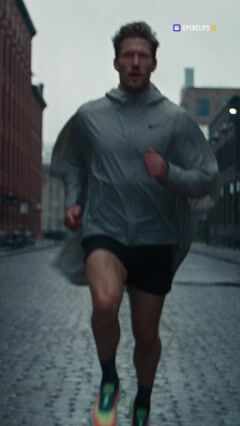 Dawn Run AdRecreate workflow