
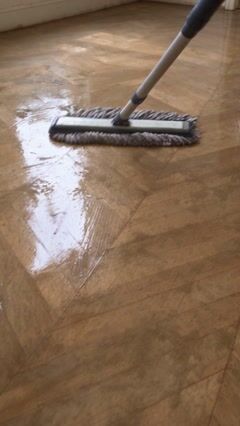
@image1 is the environment lock and the opening frame: the floor material, colour, pattern, grout lines, wall colour, window position and camera geometry are taken from it exactly and hold without drift for the entire clip. @image2 is the storyboard and is followed exactly — same order of shots, same framing, same stage of the cleaning in each. Look: handheld phone-camera realism throughout. Natural daylight from the window, real water physics, real foam behaviour, real surface reflection as the floor goes from matte to wet to glossy, slight handheld sway and reframing between moves, shallow natural depth, no stylisation and no colour grading beyond what the daylight gives. The floor sits dull and still, then a stream of cleaning liquid arcs down into frame and spreads across the surface in a widening pool. A long-handled floor squeegee enters and sweeps through the liquid in one broad stroke, foam blooming and running ahead of the blade. The squeegee works back and forth across the surface in overlapping passes, foam thickening and the dull film lifting away behind it. A rush of rinse water floods across the floor, and the squeegee pushes the grey water away in long raking strokes toward the far edge. A mop head is lowered into a spin bucket and wrung out, then returns and passes across the damp surface in even overlapping strokes. The final stroke clears the frame and the surface settles, dark and glossy, holding the window light in a clean mirrored reflection. Camera: one move per shot, handheld — a slow push in over the pour, a low tracking follow along the squeegee strokes, a tilt down to the bucket, a slow rise back out to the finished floor. No orbiting, no spinning, no crane moves. Audio: the pour and splash of liquid, foam fizzing, rubber squeegee dragging over hard floor, water sheeting and draining, the ratchet of the mop wringer, damp mop strokes. Room tone only — no music, no voice, no narration. No text, no captions, no on-screen graphics, no logos, no brand labels, no watermark. No faces in frame.
Drag the clip sideways


ATTACHED IMAGES ARE MANDATORY AND FINAL: If a reference image is attached, that is the person — reproduce them exactly, in every single frame, and never invent a different face, hairline, hair colour, skin tone, body or age. The attached images outrank every word written below them: wherever an attached image and this text disagree, follow the image. CHARACTER LOCK — HIGHEST PRIORITY: The person is exactly the person in @image1 (character sheet). Preserve their facial identity, facial structure, eye shape and spacing, eyebrows, nose, mouth, exact skin tone, hairline, hairstyle, hair length, texture and colour, freckles and distinctive marks, apparent age, build and body proportions — identically throughout. Preserve their gender presentation exactly as shown; do not masculinize, feminize or otherwise reinterpret it. Do not beautify, slim, de-age or restyle them. No face changes, no identity drift. No other people. PROPORTIONS — ADULT FIGURE CANON: a fully grown adult figure of approximately seven and a half head-heights from crown to sole. Shoulders about two head-widths across, the hip line at just under half the total height, legs from hip to sole about half the total height, and an adult jaw, chin and neck. Match the build, shoulder width and body mass shown in @image1 (character sheet). Never a child or teenage canon — not five to six head-heights, not an oversized head, not shortened legs, not rounded infantile cheeks, not enlarged eyes relative to the face. Create a high-quality fashion MV based on @image1 (character sheet), @image2 (graphic world) and @image3 (storyboard). Style: Pattern Collage Pop x Fashion Editorial x Fashion MV. The feeling is entering a magazine world made of classic patterns, geometric graphics, collage layouts and bold typography. Keep the person realistic, and keep every background and design element flat, sharp, clean 2D graphic design exactly as established in @image2. Avoid rough handmade collage; make it polished, chic, trendy, glossy and editorial. Follow @image3 exactly for shot order, framing, pose, shot size, graphic treatment and type placement. Slight outfit variation across looks is allowed, but they must still read as one continuous character. Motion and camera: this is a fashion MV, not a slideshow. Each segment must have a clear pose-to-pose action: half-step forward, look back, lower gaze then look up, fix hair, touch bag strap, hand near face, seated side look, crouch with soft smile, reach toward camera, light turn, final hero pose. Expressions: composed, confident, polished. Use fast but smooth lateral movement, light push-in and pull-out, alternating close, medium and full shots, detail inserts, and editorial split compositions. Typography: add large, readable fashion typography without covering the face. Use a main NAME title plus supporting English keywords. Words can include: SOFT CHIC, FASHION CUT, LOVELY MOOD, TRENDY LOOK. Vary placement, size, direction and colour while keeping a unified magazine design system. Timeline: eight stylish looks of equal weight, one flowing into the next at a steady pace, ending in a strong final hero shot where the previous graphics and keywords reassemble into a polished magazine-cover composition. Hold on the final frame. Avoid: a different person, face drift, changed skin tone, changed eye shape, changed ethnicity, restyled or recoloured hair, de-aged, child or teenage figure canon, five- or six-head proportions, oversized head, shortened legs, rounded infantile cheeks, enlarged eyes relative to the face, small receding chin, childlike face, doll or chibi proportions, stylised or anime face, beautified or slimmed body, multiple people, static poster feel, stiff motion, overly realistic backgrounds, unreadable text, text over face, childish tone, cheap filters, logos, watermarks, subtitles, exaggerated dance, or goofy expressions.


Generate a live race-day broadcast where you catch a t-shirt fired into the grandstand.

Asset referencing: @image1 is the first frame of this video. It shows a tiny café table held on the palm of a hand, THE DISH served hot on a coin-sized white plate, a tiny glass, napkin and pepper mill beside it, and huge fingertips pinching a tiny silver fork just above it. It defines THE DISH, the table, the props, the hands, the fork, the lighting and the framing of the opening shot. ATTACHED IMAGES ARE MANDATORY AND FINAL: the attached first frame outranks every word written below it. Wherever the image and this text disagree, follow the image. THE DISH is always exactly the dish of @image1 — the same food, the same layers, the same colours. THE BITE — this is the whole point of the film: one slow, perfect first bite of a tiny real dish. The tiny fork sinks into THE DISH, cuts down through it and lifts a small bite slowly up and toward the camera. Whatever is soft or melted in THE DISH stretches with it — long glossy strings of melted cheese, a slow drip of sauce, a curl of steam — pulling out long and thin before they finally let go. The bite stops close to the lens, sharp and glistening, every layer and texture of THE DISH visible inside it, and holds there while the steam drifts up past it. Summary: a miniature-food ASMR film in one unbroken take in which a tiny silver fork takes the first bite of a steaming coin-sized dish and lifts it slowly to the camera in a long glossy stretch. Timeline: 0–2s — The framing of @image1. The fork sinks slowly into THE DISH with a soft wet sound. 2–5s — The fork lifts the bite up; melted and soft parts stretch in long glossy strings; steam rises. 5–8s — The bite rises toward the lens and the camera gently pushes in to meet it; the strings thin out and finally let go and fall back onto the plate. 8–10s — The bite holds close to the lens, sharp and glistening, THE DISH with its new missing corner soft behind it, steam drifting up. Notes: everything stays truly tiny for the whole film — the plate about the size of a coin, the whole table resting on one palm, the fork shorter than a fingertip, the fingertips huge beside them. THE DISH keeps exactly its food, layers and colours from @image1 and only the one bite is taken out of it. The table and the props never move. The camera is a steady macro shot with one slow gentle push in toward the bite, and the film runs as one unbroken take with no cuts. No subtitles. No BGM; generate only environmental sounds and action sounds: a close intimate ASMR mix, dry and present — the soft crunch of a golden crust giving way under the fork, the wet squelch of sauce and soft layers, the faint sticky stretch of melted strings, a tiny clink of the fork against the plate, the quiet hiss of rising steam, and a soft warm room tone, to the last frame.

Generate a live race-day broadcast where the camera finds you singing along in the grandstand, moved to tears.

Ultra-photorealistic vertical 9:16 macro restoration time-lapse, filmed as ONE SINGLE CONTINUOUS UNBROKEN 30-SECOND SHOT. The camera never cuts, never jumps and never leaves the room: it drifts, orbits and pushes in slowly and smoothly around one car in one workshop for the whole thirty seconds. Every frame is inside the same miniature workshop, at the same scale, under the same lighting. THE CAR: the car in the attached reference photo, exactly as shown - same shape, same proportions, same stance, same colour, same era. Do not restyle it and do not turn it into a different car. The shot OPENS on that same car after decades of neglect: paint faded and chalky, rust blooming along its lower edges and wheel arches, flat cracked tyres, cloudy glass, thick dust over every surface. The shot ENDS on that same car restored to the condition the reference photo shows. SET: a cramped miniature restoration workshop - bare oil-stained concrete floor, warm hanging tungsten lamps, tool trolleys, welding bottles, parts racks, a roller door at the far end, dust floating in the light beams. CAST: hundreds of tiny realistic adult workers in dirty overalls, helmets, masks and knee pads, each about as tall as a wheel nut, swarming over the car and across the floor around it. They are continuously visible in every single second of the shot, dozens of different tasks running at the same time - carrying, lifting, sanding, welding, spraying, polishing, tightening, installing - and every worker is a distinct individual person. CAMERA: one continuous take. Slow macro drift, slow orbit and slow push-in, extreme close focus, shallow depth of field, real dust and haze in the lamp beams. No cuts, no dissolves, no wipes, no black frames, no white flashes, no camera teleports. BEAT 1 (0-2s) INSPECT: teams climb rope ladders onto the bonnet and roof, tap the rusted lower edges with tiny hammers, shine torches into the wheel arches, drag clipboards, chalk marks appear on the metal. Macro, shallow focus, warm tungsten light, real dust, real rusted steel, hundreds of tiny workers visible. BEAT 2 (2-4s) STRIP: crews unbolt and carry away every removable part of the front and the exterior trim, hauling each piece across the floor on small trolleys. Macro, shallow focus, warm tungsten light, real dust, real rusted steel, hundreds of tiny workers visible. BEAT 3 (4-6s) WHEELS OFF: workers crank floor jacks under the car, spin the wheel nuts loose with breaker bars and roll the wheels away on their edges; the car settles down onto axle stands. Macro, shallow focus, warm tungsten light, real dust, real rusted steel, hundreds of tiny workers visible. BEAT 4 (6-8s) STRIP THE RUST: dozens of workers drag orbital sanders and wire brushes across the whole body, rust dust flying, bright bare metal spreading outward from under their tools stroke by stroke until the rust is gone. Macro, shallow focus, warm tungsten light, real dust, real bare steel, hundreds of tiny workers visible. BEAT 5 (8-10s) WELD AND REPAIR: teams hammer dents out from behind the panels and weld the seams, showers of real sparks, blue arc light flickering across the tiny faces behind their masks, grinders smoothing the welds flat. Macro, shallow focus, warm tungsten light, real sparks, real bare steel, hundreds of tiny workers visible. BEAT 6 (10-12s) CLEAN AND PREP: crews wipe the bare panels down with solvent rags, mask the glass openings with tiny tape and paper, blow dust off with air lines. Macro, shallow focus, warm tungsten light, real bare steel, hundreds of tiny workers visible. BEAT 7 (12-14s) PRIMER: teams on scaffolds walk the panels with spray guns, laying even matte grey primer that spreads under their passes stroke by stroke, overspray drifting in the lamp light. Macro, shallow focus, warm tungsten light, real paint mist, hundreds of tiny workers visible. BEAT 8 (14-16s) PAINT: workers spray the car's own colour from the reference photo back over the primer, panel by panel, the wet colour advancing visibly behind each gun, reflections building across the panels. Macro, shallow focus, warm tungsten light, real wet paint, hundreds of tiny workers visible. BEAT 9 (16-18s) POLISH: dozens of workers run rotary buffers and cloths across the cured paint, mirror reflections of the hanging lamps blooming across the bonnet and doors as they work. Macro, shallow focus, warm tungsten light, real glossy paint, hundreds of tiny workers visible. BEAT 10 (18-20s) ENGINE: crews winch a rebuilt engine down into the bay on chain hoists and bolt it in, tightening the mounts and threading the hoses and loom by hand. Macro, shallow focus, warm tungsten light, real oily metal, hundreds of tiny workers visible. BEAT 11 (20-22s) SUSPENSION, BRAKES AND WHEELS: teams fit springs, dampers and brake discs, then carry the wheels back one at a time, lift each onto its hub and torque the nuts by hand; the car comes down off the axle stands onto its own wheels. Macro, shallow focus, warm tungsten light, real metal, hundreds of tiny workers visible. BEAT 12 (22-24s) FRONT END AND TRIM: teams carry the front panels, the lights and the bumpers in on trolleys and bolt them into place by hand, others press the exterior trim strips back along the flanks. Every part is carried in and fitted by workers. Macro, shallow focus, warm tungsten light, real glossy paint, hundreds of tiny workers visible. BEAT 13 (24-26s) INTERIOR: crews haul re-trimmed seats in through the doors and bolt them to the floor, others fit the dashboard, the steering wheel and the gear lever, smoothing the upholstery and carpet by hand. Macro, shallow focus, warm tungsten light, real leather and fabric, hundreds of tiny workers visible. BEAT 14 (26-28s) GLASS AND FIRST START: workers lift the windscreen and side glass in on suction cups and seat the rubber seals with tiny rollers, a worker in the driver's seat turns the key, the engine shakes and catches with real exhaust smoke, the lights snap on and throw warm beams across the workshop while crews swarm the body with cloths for a final polish. Macro, shallow focus, warm tungsten light, real clean glass and glossy paint, hundreds of tiny workers visible. BEAT 15 (28-30s) DRIVE OUT: the restored car rolls forward on its own wheels through the open roller door into daylight while hundreds of tiny workers step back, wave and watch it go. Macro, shallow focus, warm light, real dust in the air, hundreds of tiny workers visible. RULES: one single continuous take from first frame to last. The same car from the reference photo, the same workshop, the same scale and the same lighting throughout the entire thirty seconds. Every transformation is performed physically by the workers, piece by piece, with their hands and tools, in real time in front of the camera. Every part that goes back onto the car is carried in and fitted by workers on camera. Nothing appears, disappears or changes by itself. The workers never stop and are never absent from frame. The car's body carries NO badges, NO lettering, NO emblems, NO brand marks and NO number plate text at any point in the shot - every grille, panel and bumper is completely blank. AVOID: cuts, hidden cuts, dissolves, wipes, black frames, white flash frames, camera teleports, jumping to a new camera position, parts appearing or vanishing instantly, panels or wheels fitting themselves, morphing, floating or hovering objects, CGI look, plastic toy look, cartoon, identical duplicated clone workers, full-size humans, empty frames with no workers, a different car from the reference photo, text, captions, subtitles, numbers, logos, badges, emblems, brand marks, lettering on the number plate, watermark.
VERTICAL 9:16 20s 24fps handheld selfie. Mateo holds the phone. Photocopy FACE and hair of @image1 Mateo — identity only, never the clothes from @image1, never a studio headshot as frame 0. Clothes change every location as written. Photocopy the dog from @image2: THIS exact dog — same breed, coat colours, markings, ears, eyes and collar as shown. NOT a different dog. Name spoken: Ellie. Living video, not freeze-frames. Hard cut between countries. At each “smile” a camera shutter + bright white FLASH that fills the frame for a frame, then the cut. 0.0-4.0s PARIS. Eiffel Tower behind. Casual jacket. Ellie sits FAR behind them. They look at the lens and say: “Paris selfie. Ellie, let’s take a picture.” Looks back. She RUNS in, they duck, she jumps, front paws on their shoulders. They smile and say: “And smile.” Shutter + flash. 4.0-8.0s POLAND. Cobblestone square. RED pullover. Hard cut. “Poland selfie. Ellie, let’s take a picture.” Looks back. She runs and jumps onto their back the same way. “And smile.” Flash. 8.0-12.0s BELGIUM. Brick castle. GREY shirt. Hard cut. “Castle selfie. Ellie, let’s take a picture.” Looks back. She jumps onto their back. “And smile.” Flash. 12.0-16.0s US. Brick sidewalk, houses. BLACK puffer. Hard cut. “Ellie, let’s take a selfie.” Looks back. She jumps onto their shoulders. “Smile.” Flash. 16.0-20.0s ITALY. They sit on a grassy lawn, lake and mountains behind. BLACK shirt. Hard cut. “Italy family selfie.” Looks back. She jumps onto their back. “Okay, smile.” Flash ends the clip. Same Mateo every beat. Same dog every beat. No on-screen text. No logos.
Generate a live race-day broadcast where champagne from the podium rains down on you in the crowd.

SCENE CONTEXT A 15-second Pixar-quality 3D animated comedy short, told in 9 fast shots. The goofy cat from @image2 sprints across the backyard from @image1 with the smug dog from @image3 chasing it. Just as the dog catches up, the cat darts through a tiny secret flap-door in the wooden fence that only she knows. The dog slams into the fence. The cat hops onto the top of the fence and grins down at him, mocking. Pure visual comedy, no dialogue. ACTIVE REFERENCES @image1 = BACKYARD: the location, 100% matches the reference. Its lawn, fence, planting, house, furniture and sky exactly as the reference shows them. STYLE AND PLACE REFERENCE; extend the yard freely, never reproduce 1:1 as a still. @image2 = CAT: the hero, 100% matches the reference. Coat colour, markings, eye colour, fur length and build exactly as the reference shows. Identical every frame, no morphing, no drift. NOT an ostrich. @image3 = DOG: the chaser, 100% matches the reference. Breed, coat, colour, ears, eyes and build exactly as the reference shows; open happy mouth with tongue. Identical every frame. NOT a leopard. LOCATION MAP One backyard. Foreground: lawn. Midground: chase path across the grass toward the fence. Background: the fence, planting, house and sky of @image1. Sun high, camera-left, hard shadows. SCALE LOCK Cat is a small house cat. Dog keeps its own size from @image3 and is always too big for the secret door. The secret door is a cat-sized gap/flap at the base of one fence board — too small for the dog. FIRST FRAME Non-empty: rear view of @image2 CAT mid-sprint across the lawn, running away from camera toward the fence, legs at full stride, fur bouncing. Nothing frozen. FORMAT Timed multishot, 9 shots, HARD CUTs at 0:01.5, 0:02.5, 0:03.5, 0:04.5, 0:06.5, 0:07.5, 0:09.5 and 0:12.5. Shot 7 is slow motion. Same characters, same backyard, same sun across every cut. CAMERA SHOT 1 (0:00–0:01.5): wide, low tracking follow behind the cat at running speed, slight bounce. SHOT 2 (0:01.5–0:02.5): medium, low side tracking alongside @image3 DOG running left to right, the dog glancing at camera sly. SHOT 3 (0:02.5–0:03.5): wide, camera fixed low on the grass pointing up; the cat runs over the lens, belly and paws against blue sky. SHOT 4 (0:03.5–0:04.5): close-up, head-on tracking in front of the dog's grinning face. SHOT 5 (0:04.5–0:06.5): wide, static low front; cat runs toward camera on the right, dog closing on the left. SHOT 6 (0:06.5–0:07.5): wide, same front; the cat skids and dives through the tiny secret fence door at the base of the fence. SHOT 7 (0:07.5–0:09.5): medium-wide, slow motion, camera drifting around the impact as the dog CRASHES into the closed fence (not through the flap). SHOT 8 (0:09.5–0:12.5): wide static; dog pancaked / bounced off the fence, dazed, fence rattling. SHOT 9 (0:12.5–0:15): medium-wide static; the cat is ON TOP of the fence, looking down, a mocking grin. Hold. ACTION SHOT 1: cat sprints across the lawn, sand-spray replaced by grass clippings and fur bounce. SHOT 2: dog bounds, cocky, tongue out. SHOT 3: cat's paws hammer past the lens. SHOT 4: dog face fills frame, toothy grin, ready to strike. SHOT 5: cat glances back, panics, eyes wide. SHOT 6: cat slams brakes, skids on grass, and slips through a small secret cat-door / loose board at the bottom of the fence — only she fits. Tail vanishes last. SHOT 7 slow-mo: dog leaps, claws out, SLAMS belly-first into the solid fence. Boards flex. No bounce into the sky. A cartoon BOING of wood, not sand trampoline. SHOT 8: dog slides down the fence, sits dazed, fence still wobbling. Cat is already gone through. SHOT 9: cat hops up onto the TOP of the fence, sits, grins mockingly down at the dog, tail curling. Does not zip away. End on the grin. PHYSICS Grass, not sand. Secret door is cat-sized. Dog cannot fit. Fence has real wood weight. Contact shadows on lawn. Nothing floats. AUDIO Playful chase score, cartoon SFX: pattering paws, panicked cat yowl Shot 5, skid Shot 6, huge wooden WHAM + boing Shot 7, fence rattle Shot 8, smug little cat chirp Shot 9. No dialogue. No on-screen text. STYLE Pixar theatrical 3D matching the three stills. Soft GI, groomed fur, polished family comedy. OUTPUT Seedance 2.5, 1080p, 16:9, 15 seconds. POSITIVE LOCKS Cat stays 100% @image2. Dog stays 100% @image3. Backyard stays @image1. No ostrich, no leopard, no desert, no head-in-sand. No logos, no UI, no subtitles.
EARLY-2000s SALON VLOG @image1 films a self-shot visit to a tiny early-2000s neighbourhood salon on a DV camcorder — hair styling, eyebrow grooming, a facial mask and a fresh-faced reveal on the way out. Plug in ANY avatar. 30s.
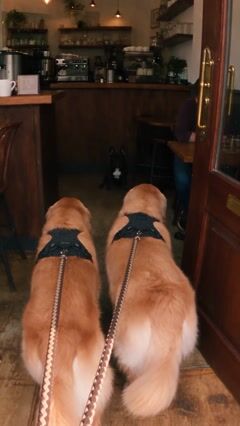 Pet Friendly Cafe Walk-InRecreate workflow