
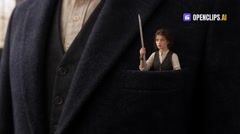
【Generation Goal】 Generate a premium cinematic short film in which someone only a few inches tall crosses a worktable, finds a tear in an enormous jacket, threads a needle taller than they are, repairs the seam by hand, and is finally revealed riding in the breast pocket of the finished jacket as a giant wears it. 【Visual Style】 High-end cinematic 3D animation of polished feature-film quality, with realistic materials, detailed fabric, natural textures, physically based lighting, realistic shadows and subtle depth of field. Cloth reads as real wool and cotton with legible weave, fibre and thread detail and correct weight in every fold. Cloth, wood, metal and paper each read as their own material. Skin is soft and matte with subsurface warmth. Long soft shadows and rich material separation, with the lighting taken from @image2. Do not render a plastic, vinyl, toy or figurine look, cartoon physics, clay or stop-motion surfaces, photoreal live-action photography, ink outlines or line-art contours, cel shading, flat banded shadows, comic, manga, anime or webtoon styling, or vector or flat-illustration fills. 【Reference Asset Roles】 @image1 defines the character's face, hair, body proportions, clothing and accessories; take the identity and costume entirely from it and do not adopt its neutral background. @image2 defines the location and every object in it: the workshop, the worktable, the jacket, the needle, the spool of thread, the measuring tape, the tools and the lighting. It also defines scale — the size relationship between the character and every object is fixed by @image2 and never changes. Do not take any person from it. @image3 is the storyboard and governs shot order, framing, staging, character position and camera geography; read it left to right and then top to bottom, and do not adopt its panel grid, gutters or flat layout into the video. 【Subjects and Relationships】 There is one continuous character throughout, defined by @image1, only a few inches tall. Use they / their / them. They are never swapped, duplicated, replaced or altered in face, hair, clothing, proportions, colours or accessories in any shot. They work with calm, practised care and quiet pride. A second, giant person appears late — first as a hand and wrist entering frame, then as a body wearing the jacket. This giant is always framed so that no face and no head is visible: the hand shot shows only hand and wrist, and the final shot is framed from the chest down. The giant is never described, never turns toward camera and never speaks. The jacket, the needle, the spool of thread, the measuring tape and the worktable stay consistent in size, shape, position and appearance throughout. The tear exists until it is stitched, and once stitched it stays closed. 【Event Script】 Stage 1: A wide low shot along the surface of the worktable. The character walks steadily across the table toward the jacket spread out ahead of them, the coiled measuring tape carried over one shoulder. At the end, they are partway across the table and the jacket fills the ground ahead. Stage 2: They reach the edge of the jacket and stop at the foot of the fabric, tipping their head back to look up as the lapel rises above them. At the end, they are standing still at the base of the cloth, looking up. Stage 3: They climb onto the wool and cross to the failed seam, then crouch beside the open tear and lay a hand on the frayed edge, tracing its length. At the end, they are crouched at the tear with the split clearly open in front of them. Stage 4: They cross to the needle lying on the table and stand at its eye, raising the end of the thread with both arms and feeding it through the open loop. At the end, the thread is through the eye and they hold the doubled end. Stage 5: They set the needle into the wool and haul it through, braced back against the weight, the thread drawing after it in a long line. The cloth dimples and releases around each pass. At the end, the first stitches are laid and the needle is clear of the fabric again. Stage 6: A closer frame travels along the seam as the work continues, the tear closing behind a run of neat even stitches. They kneel at the last stitch and draw it tight. At the end, the tear is fully closed and the seam is clean. Stage 7: They step back onto the jacket, hands on hips, and look along the finished seam. An enormous hand descends into frame, closes on the cloth and lifts it, and they ride the rising fabric, catching their balance. At the end, the jacket is off the table and they are holding on. Stage 8: The camera pulls smoothly and steadily back into a wide shot. A giant stands wearing the repaired jacket, framed from the chest down. The character sits in the breast pocket with the needle held upright beside them, looking out. The shot holds on that final state. Throughout, movement is unhurried and physically believable, with correct anatomy and natural human-like motion. Objects have real weight — the needle is heavy, the cloth resists and settles, the thread has slack. Dust turns slowly in the raking light. Camera moves are smooth and cinematic with stable framing and consistent perspective; there are no rapid cuts, no camera jumps, no morphing, warping or artifacts, and no impossible physics. 【Sound】 <the soft scuff of small footsteps on polished wood>, <cloth shifting and settling under weight>, <the fine rasp of thread drawn through wool>, <a single quiet tap as the needle is set down>, <a distant clock in another room>, <the low hum of a warm afternoon workshop>. No one speaks, no narration, no music, and no subtitles appear on screen. The character keeps their mouth naturally closed throughout. 【Maintain Consistency】 Keep the character's identity, face, hair, clothing, proportions, colours and accessories exactly as defined by @image1 in every shot, with no drift or reinterpretation. Keep the workshop, worktable, jacket, needle, thread, measuring tape and lighting consistent with @image2, and hold the scale relationship between the character and every object fixed throughout. Keep the giant's face and head out of frame in every shot they appear in. Keep the tear closed once it is stitched. Keep the shot order, framing and camera geography matching @image3. Do not generate any text, titles, captions, subtitles, logos or watermarks.
Drag the clip sideways


VINTAGE GRAND PRIX. THREE DRIVERS. NO DIALOGUE. THIRTY SECONDS. 21:9. ASSET MAP - every reference is bound here and cited by tag below: @avatar_1 - the driver of car number 1. Face, hair, skin, age, build and every physical characteristic come entirely from @avatar_1 and never from this text. @avatar_2 - the driver of car number 2. Face, hair, skin, age, build and every physical characteristic come entirely from @avatar_2 and never from this text. @avatar_3 - the driver of car number 3. Face, hair, skin, age, build and every physical characteristic come entirely from @avatar_3 and never from this text. IDENTITY LOCK - HIGHEST PRIORITY: each driver is exactly the person in their own reference. Keep their face, hair, skin tone and build the same from the first frame to the last. Do not restyle them, do not age them up or down, do not slim or bulk the build, never swap which reference drives which car, and never put a fourth driver on the track. Three drivers, the same three, for the whole film. ATTACHED REFERENCES ARE MANDATORY AND FINAL: if a reference is attached, that is the driver - reproduce them exactly, in every shot, and never invent a different one. The attached references outrank every word written below them. CAR AND DRIVER PAIRING - NEVER BREAK IT: @avatar_1 drives the red car with a white roundel and the numeral 1. @avatar_2 drives the dark green car with a white roundel and the numeral 2. @avatar_3 drives the pale blue car with a white roundel and the numeral 3. The numerals on the cars are the only numbers allowed anywhere in the film. WARDROBE LOCK: all three wear the same cut of plain period racing kit - a light canvas one-piece with a wide leather belt, a soft leather helmet and round goggles pushed up on the forehead, and leather gauntlets. The kit differs only in colour, matching each driver's own car. No lettering, no sponsor patches, no badges and no logos anywhere on the kit or the cars. THE CARS: three small open-wheel single-seaters from the late nineteen-fifties - riveted aluminium bodies, exposed suspension arms, tall thin tyres with visible spokes, a single mirror on a stalk, no wings and no modern aerodynamics. They sit low and look hand-built. THE PLACE: an old countryside road circuit at the last hour of daylight. Cracked tarmac, painted red-and-white kerbs, hay bales and low wooden fencing, mown grass banks, a long avenue of trees down one side, a wooden footbridge over the track, a small empty timing tower and a shallow grandstand of bare wooden benches. THE LOOK: shot on film at golden hour and graded warm - long low sun straight down the track, heavy lens flare, dust and pollen lit in the air, shallow depth of field, gentle anamorphic stretch on the highlights, fine grain. Everything is amber, brass and deep green. The sun is always low and always in shot or just outside it. THE CUTTING: exactly seven shots and no more. Each one is long and unhurried and runs its full length without an internal cut. Do not break any shot below into several shorter ones - the camera does the work, not the edit. Shot 1 (5.6s) Wide, low and head-on. The three cars sit side by side on the grid, engines running, heat shimmering off the bonnets, the low sun directly behind them throwing long shadows toward camera. @avatar_1, @avatar_2 and @avatar_3 sit in their cars looking ahead. The camera pushes in slowly. Shot 2 (4.2s) High and wide, looking down on the circuit as the three cars come off the line together and take a long sweeping bend in formation, dust lifting off the kerbs behind them. The camera drifts with them. Shot 3 (5.2s) Low, on the tarmac under the wooden footbridge, looking up the track. A single carrot lies on the racing line right in the foreground, very close to the lens and filling a good part of the bottom of frame, sharp while the track behind it is soft. The three cars come through the bridge's shadow at speed and burst past it, and the carrot is torn apart into a spray of orange fragments across the road. The camera holds low as they pass over. Shot 4 (5.0s) ONE UNBROKEN SHOT, no cut inside it: in the car with @avatar_1, camera mounted just ahead of the cockpit and locked on the face for the full five seconds. Goggles down, jaw set, the whole frame shaking with the road, hedges and trees tearing past in a blur, dust and low sun flaring across the lens. This is the fastest and roughest shot in the film and it must run as a single continuous take. Shot 5 (4.2s) Wide and almost still. The long straight with the sun sitting exactly on the road at the end of it. The three cars are small black silhouettes running dead into the light, their shadows stretched enormous behind them. Almost nothing moves in frame but them. The camera holds. Shot 6 (2.2s) Track level at the grandstand. The cars come past flat out, close to camera, and a marshal standing at the trackside edge of frame waves a small chequered flag on a short wooden pole as they cross the line. The flag is a real cloth flag held in a hand, moving with the wave - it is never a band, strip or banner stretched across the top or bottom of the picture, and never an overlay on the image. Shot 7 (3.7s) The podium at sunset. A real three-step wooden podium stands beside the track with three clearly different heights - a tall centre step, a lower step to its left, a lower step again to its right. @avatar_1 stands on the tall centre step and is visibly higher than the other two. @avatar_2 stands on the left step and @avatar_3 on the right step, both lower. Each of them does something different: one raises both arms, one folds their arms and grins, one is still pulling their goggles off. Do not give the three of them the same pose or the same gesture. Goggles pushed up, dusty and pleased, the last of the sun going down over the trees behind. The camera pushes in slowly and holds to the final frame. MUSIC - THIS FILM IS SCORED AND THE SCORE IS LOUD AND PRESENT, WELL IN FRONT OF THE ENGINES. A warm orchestral score with brass and strings, the sound of an old sports newsreel, and it is tied to three things that happen on screen: It sits low and tense, strings only, while the cars are standing still on the grid. On the exact frame the three cars move off the line, a rising brass note lifts and the full theme starts running, driving and bright, and carries the whole chase. On the exact frame the chequered flag is waved, one big brass swell lands at once, at least twice as loud as anything before it, and then opens out warm and broad over the podium and holds to the final second. Mix the music loud - it should be the first thing anyone hears, and it must be clearly louder at the end than at the start. The engines are always quieter than the music. At every moment of the film the score sits on top and the engines sit underneath it, and the gap between them widens toward the end: over the podium the music is at its loudest of the whole film and the engines have stopped altogether. ENGINE AND ROOM SOUND, KEPT WELL BELOW THE MUSIC AT ALL TIMES: three small unsilenced engines at different pitches, gear changes, tyres over kerbs, gravel flicking up, wind and a flag snapping. These are background texture only - they must never be as loud as the score, never mask it, and they fade out completely on the podium so the last six seconds are music alone. No voices, no commentary, no dialogue, no lyrics, no singing. Do not generate subtitles, captions, on-screen text, a title card, a sponsor board, a brand name, a logo, a wordmark, a watermark or any readable lettering anywhere in frame. The only numbers allowed are the 1, 2 and 3 on the cars. No modern cars, no modern clothing, no rabbits or animals of any kind, no fourth driver, and no change to any driver's face or build at any point.


【REFERENCE】 @image1 is a completed 2 columns × 2 rows 4-panel fashion editorial board featuring the same single subject in 4 different outfits. Define top left as PANEL_01/LOOK_01, top right as PANEL_02/LOOK_02, bottom left as PANEL_03/LOOK_03, bottom right as PANEL_04/LOOK_04. @image1 is an absolute lock for appearance: take face, hair, age appearance, skin tone, body type and proportions from it exactly and hold them identical across all LOOKs, with no drift or reinterpretation in any SHOT. Inherit clothing, shoes, accessories, background composition, base colours, accent colours and text only within the corresponding LOOK for each PANEL. Poses and shooting angles within PANELs are visual references from the start and not fixed. Do not newly set characters, outfits or colours on the text side; do not mix faces, bodies, outfits or colours between PANELs. Usage order is PANEL_01→02→03→04→01→02→03→04. Do not output 2×2 boards, borders, multiple people, or pans/zooms on sheets into the video; expand the corresponding PANEL into an independent full-frame space for each SHOT. 【CONDITION】 All 8 SHOTs, high-quality live-action fashion editorial video. Give all 8 SHOTs equal screen time; no SHOT runs noticeably longer or shorter than any other. Do not make it a video switching between 8 still posters. Ensure each SHOT establishes "starting pose → one clear fashion action → ending pose different from start," with stillness held only at the very end of the final SHOT. Combine natural one or half-step, body and shoulder direction turns, arm and hand position changes, weight shifts, head and gaze, and hair and outfit sway for the subject. Not dancing. Move subject, camera, text and colour blocks simultaneously. Base the entire edit on horizontal panel movement, without vertical scrolling. Within each SHOT, also move text, colour blocks, rectangles and lines left and right at 8–20% differing speeds. For each transition, shift the old LOOK's graphic plane 40–55% of screen width to one side, leaving about half, enter the next LOOK's colour block and text horizontally from the opposite side, pass through a brief uneven split screen, then fully reveal the next LOOK. Vary direction, width and speed per transition; do not repeat the same full-screen wipe. Only one subject during splits. Hard cut subject and outfit at edit points; do not use morphs or crossfades. Displayed text is only FASHION, IN MOTION, LOOK 01, LOOK 02, LOOK 03, LOOK 04, 02, 03. Same Helvetica Neue Condensed family as the adopted board. Make major text fully readable once before moving, without covering the face. 【SHOT FLOW】 [Shot 1] PANEL_01. Full body slightly to the right. From reference pose, move half a step, shift weight and arm position, stop in a different pose facing shoulder and gaze to camera. Camera short horizontal move opposite the subject. After FASHION and LOOK 01 establish, text and rectangle shift half screen left, LOOK_02 colour block enters from right. [Shot 2] PANEL_02. Full body with margins. While stepping horizontally, swing body to 3/4, change hand position to face front. Arc, base colour block and thin lines move horizontally at speeds different from the subject. At end, exit these background elements horizontally, enter PANEL_03 slope horizontally from opposite side. [Shot 3] PANEL_03. From start, the subject's full body fits centre-right on screen and does not follow the background slide. Without walking, from front-facing pose, relax one knee to shift weight to the hip, place one hand on the hip, return outward gaze to camera. Hair and hem sway naturally once with delay. Prohibit off-screen entry, horizontal move, sharp turns. Short push in. 03, slope, halftone and barcode accelerate horizontally, barcode strip slides horizontally to open LOOK_04. [Shot 4] PANEL_04. Full body. Step forward to open the shoulders, land in a pose with changed arm and leg placement. Short pull back. Arc, light colour block and IN MOTION shift left and right, at end retreat half to screen right, restart LOOK_01 grid from left. [Shot 5] PANEL_01. 3/4 to medium. During short push in, twist the upper body, quickly change one arm position and gaze to make the pose different from the first cycle. FASHION, rectangle and grid move horizontally in reverse direction parallax, connect to LOOK_02 rectangle. [Shot 6] PANEL_02. Pull back from medium to full body. Step forward to camera, change shoulder and hand position to land in a different full body pose. Base colour block, arc and thin lines three-layer horizontal move at differing speeds, at end exit these background elements horizontally, enter PANEL_03 slope horizontally from opposite side. [Shot 7] PANEL_03. From start, the subject is in screen centre and does not follow the background slide. During pull from knee-up to full body, slowly rotate about 90 degrees on one foot axis in place, turn the body then face front. Naturally lower both arms to stop in an upright pose. The long hem alone draws one large arc with delay. Maximise sway amplitude, do not increase subject speed. Prohibit off-screen entry, walking, fast horizontal move. Camera also short horizontal move. 03, slope, halftone and barcode cross left and right, open arc plane horizontally to connect to LOOK_04. [Shot 8] PANEL_04. Slowly pull from medium to full body. The subject steps forward to change arm, leg and weight, converging to a hero pose different from the first cycle. Arc and thin lines decelerate horizontal move, hold the end on a fully readable IN MOTION end screen. Do not return to 4 panels. 【NEGATIVE】 Prohibit sequence of still images, long stills per SHOT, repetition of reference poses, motion only at transitions, vertical scrolling, 2×2 board display, multiple people, subject duplication, pans/zooms on sheets, reading order changes, added people/outfits/colours/text, mixing between PANELs, different people, morphs of face/outfit/body, crossfades, all SHOTs same central full body or same scale, same-direction full-screen wipes, text cutoff, text covering face, subtitles, brands, logos, watermarks, limb distortions. overall_soundscape: Very soft, brief clicks and fabric swishes occur only at shot changes, mixed clearly below the music. No dialogue, narration or system voice. non_diegetic_music: A continuous instrumental fashion beat led by a dry kick drum, tight closed hi-hats and a steady synth-bass pulse at 118 BPM. It starts at a clearly audible level on the first frame, remains the dominant audio layer without ducking or fading, and continues through the final frame. No vocals.


Create a 15-second ultra-realistic cinematic 16:9 video. Sound ON. If Montenegro were a chocolate bar. ATTACHED IMAGES ARE THE COUNTRY — photocopy them, do not invent a generic coast or Alps. @image1 is the REAL Sveti Stefan: tiny Adriatic island packed with stone houses and terracotta roofs, connected by a narrow causeway/isthmus, turquoise water, pink-orange stone. @image2 is the REAL Durmitor: high pale-grey limestone peaks, jagged, alpine, sparse snow, not rolling green hills. OPENING: dark chocolate bar, red-gold wrapper, dark table. Hand snaps it. The break REVEALS these two places, unmistakably: first Sveti Stefan as in @image1 (island + isthmus + packed roofs), then Durmitor as in @image2 (high karst massif). Melted chocolate = bay. Crumbs = karst. Finish aerial: Sveti Stefan in water in front, Durmitor peaks behind. Broken chocolate at edges. No Japan, no Fuji, no generic Cinque Terre, no on-screen text. AUDIO: snap, sea, mountain wind. No vocals. Duration 15s. Aspect 16:9.
A 12-second photoreal cinematic 16:9. No on-screen text, no logos, no people. @image1 is the T-rex: pink-cream body, red-pink head spines, ivory snout, leaping through sunset peach clouds. Keep that exact creature until the morph. AUDIO: wind, dinosaur run, then wingbeats. No dialogue. [0-6s] Fully a T-rex the whole time. Runs and leaps through sunset cumulus. Tiny forelimbs, massive tail, scales. Camera tracks. NO feathers yet. NO beak yet. [6-9s] NATURAL morph over these three seconds only — not a snap, not a dissolve to a different animal: second 6: small feathers push through the scales along the back and arms; skin-sails start at the shoulders; second 7: wings lengthen, plumage fills in, the snout shortens and the jaw reshapes into a curved beak — same head turning into a macaw beak, not a cut; second 8-9: macaw colours (red, blue, yellow, green) finish across the body; wings spread. Same creature, same leap, continuous. [9-12s] Full macaw. Flaps and flies through the same peach clouds. End. NEGATIVE: a pop-cut at 3 seconds, a different animal appearing, extra creatures, text, remaining a T-rex after 9s, studio still as frame 1.
ASSET MAP: @image_1 is the first frame of this film and the only reference. The person in @image_1 is the walker and the autumn village in @image_1 is the only location. Identity: the walker in every second is exactly the person in @image_1 - face, skin tone, hairline, hair length and colour, build and gender presentation unchanged, never masculinized or feminized, never restyled, and long hair is never added to a short haircut; the hair moves only as much as its own length allows. No action, gesture, camera note or lighting note anywhere in this text may imply hair that the person does not have: nothing is ever pushed, tucked, swept or blown out of the face, nothing is rimmed or backlit through hair, and where the hair is short or shaved it simply stays short or shaved and barely moves. Only one person walks in this film. The oatmeal cable-knit sweater, the light blue wide-leg jeans, the cream ankle boots, the timber houses, the cobbled lane, the bamboo fence, the firewood, the pumpkins and the amber hillside all come from @image_1 and stay unchanged. THE FORM - THIS IS THE WHOLE FILM: one single unbroken take. No cuts, no dissolves, no jumps and no change of location at any point. The camera never stops moving and never lets the walker out of frame; every change below is a continuous move of one camera, not an edit. Style: ultra-photorealistic live-action, warm late-autumn golden hour - low sun down the lane, amber and rust bounce from the orange canopy, long soft shadows on the cobbles, haze with drifting motes, fallen leaves lifting as the walker passes, real handheld weight, shallow depth of field. 0-5 seconds: the film starts exactly on @image_1 and moves at once - the walker lets go of the doorframe, steps down onto the cobbles and looks into the lens with a small easy smile before walking forward, the camera retreating ahead at walking pace, leaves drifting through the sunlight. 5-10 seconds: still retreating, the camera drifts lower and closer until the walker is held from the waist up, the low sun flaring past one shoulder while the orange canopy slides by on both sides. 10-15 seconds: without any cut the camera arcs around the shoulder of the walker and settles behind, following a few steps back down the lane past dark timber facades, a bamboo fence and drifts of fallen leaves. 15-20 seconds: still one move, the camera rises and pulls back into a high wide crane - the lane falling away, the whole village opening out with its roofs and woodsmoke, the amber mountainside behind and the walker small and centred far below. The move slows and the frame settles on the final second. Continuity: the walker always moves away down the same descending lane so the door is never seen again, five fingers on every hand, the light and the sun direction consistent for the whole take, and no other person ever in frame. Every surface stays free of lettering and signage. No green summer foliage anywhere; the whole film is deep autumn. Audio: boots on stone, dry leaves, light wind, a stream below, distant birds and a soft piano line. Nobody speaks. No subtitles.


A locked static camera, eye level, subject centred and framed head to feet with the floor visible. The camera never moves, zooms or reframes. The setting is one modern apartment living room, unchanged from first frame to last: warm honey-toned wide-plank wood floor, cream-white walls, a low beige sofa with olive-green cushions along the back wall, a squared wood-slab coffee table holding a small stack of books, framed artwork on the left wall, tall black open shelving on the right with a trailing green plant, an open doorway at the right edge, soft even daylight. Along the bottom of the frame sits a row of four small circular white buttons, each holding a tiny icon of one garment. A small white arrow cursor moves between them. They stand centred in their own clothing, weight shifting from one leg to the other, hands settling at the waist, shoulders turning slightly. The cursor slides to the first button and taps it, and the outfit from @image1 replaces what they are wearing in a single instant snap. They smooth the skirt down and lift one hand to the brim of the hat. The cursor taps the second button and the outfit from @image2 snaps into place. They straighten, roll one shoulder to settle the pauldron, and take a half step. The cursor taps the third button and the outfit from @image3 snaps into place. They turn a few degrees to one side, set a hand on the hip, and let the weight shift open the slit. The cursor taps the fourth button and the outfit from @image4 snaps into place. They raise both hands to the back of their head, lower them again, and settle facing camera. Every outfit change is instantaneous, one frame to the next. No dissolve, no morphing, no transition, no fabric growing or unfolding. Room tone only. No dialogue, no speech, no singing, no music. Avoid generating any text, subtitles, captions, logos or watermarks.


22 seconds, 16:9, eight shots, no speech. @image_1 and @image_2 are the two riders and the only attached assets. ATTACHED IMAGES ARE MANDATORY AND FINAL: @image_1 and @image_2 decide who these two people are; where this text and an attached image disagree, the attached image wins. Never draw one rider with the other's face and never swap them between shots. CHARACTER LOCK: the whole film is drawn in the animation style below, and inside that style each rider is unmistakably the person in their own attached asset - same face shape and features, same hair colour, length and texture, same skin tone, same build, same apparent age. Stylised, never re-cast. Preserve the gender presentation of each rider exactly as shown. Every hand in frame has five fingers. HEADS ARE BARE - THIS IS THE POINT: both riders ride bare-headed in every shot, the whole face uncovered and readable, hair loose and streaming in the airflow. WARDROBE LOCK: @image_1 in a fitted forest-green riding suit with cream shoulder panels, @image_2 in a fitted cream suit with rust-orange shoulder panels; both with tan leather slide gloves and dark knee pads. Each suit is fixed, only its drape adapts to that rider. STYLE: a stylised animated short. Solid three-dimensional forms lit by one low sun, with painted surfacing laid over them - matte, warm, simplified. Low autumn light rakes between the trunks and strobes across the riders. Longboard physics are real: gravity, inertia, grip and weight transfer. THE PLACE: a single-lane road winding down a wooded hillside. Birch, beech and maple in gold, amber, rust and deep red, the canopy closing overhead into a tunnel of colour, drifts of fallen leaves along the verges, mossy boulders, a low wooden guardrail and mist in the hollows. Low down the hill the road itself crosses a shallow stream on a small stone bridge: the bridge carries the road, a low stone parapet runs along each side, and the riders ride over it. Everywhere else the road sits on solid ground for its whole width, with verge and forest floor visible along both edges, so it always rests on the hillside and is never lifted above it. [0-3s] Already at full speed - nothing starts from rest. Low camera near the tarmac, tracking behind and to the side; both tucked but heads up and faces visible. [3-5s] The camera drops in front and tracks backwards low to the road. Both faces full to camera, @image_2 half a board ahead, @image_1 tight in the slipstream. [5-8s] First fast corner: @image_2 runs wide, @image_1 takes the inside line, both leaning together, leaves torn off the verge. [8-11s] Whip pan through the trunks, gold smearing across frame, then both burst back into shot lower down the hill. [11-14s] Close on @image_1, front three-quarter, the whole face in frame, hair whipping. [14-17s] A leaf-covered hairpin: both drop a gloved hand and carry a long powerslide, dry leaves exploding off the tarmac. [17-20s] @image_1 pulls out of the slipstream and draws level, then ahead; the two glance across at each other and half-smile, both faces in the same frame. [20-22s] Wide and high from behind: the road runs away into a tunnel of gold and in the middle distance carries the two riders over the little stone bridge, its low parapet passing on either side. They are small and side by side, shrinking into the light. AUDIO: driving instrumental music across the whole cut; under it wheels on tarmac, rush of air, leaves skittering, the scrape of a glove puck in the slide, birds at the end. There is no speech anywhere in this film. The eight shots run back to back with no gaps; the first frame is already moving at speed. No subtitles.


Create a 10-second ultra-photorealistic 16:9 luxury furniture commercial. Sound ON. Continuous first-person POV, 26–28mm, black studio, matte-black leather gloves only. No face. No other people. HERO PRODUCT is exactly a taupe leather swivel armchair from the reference: taupe-brown leather swivel armchair, button-tufted back, rolled arms, olive-green velvet lumbar pillow, polished metal star swivel base with five legs and casters. Photocopy this chair. It must stay identical once chosen. 0–0.8s: a different cream cloud armchair floats center; gloved hand swipes left. 0.8–1.6s: ivory modular chair orbits out; another chair arrives from right. 1.6–2.4s: swipe, curved boucle chair. 2.4–3.2s: swipe, caramel leather chair. 3.2–4.2s: the HERO taupe leather armchair from the reference arrives slowly, rotates frontal, stops with heavy inertia. Green pillow visible. 4.2–5.0s: open-palm STOP. Other chairs recede. 5.0–5.8s: hand presses and slides the hero armrest — leather compression. 5.8–6.6s: chair lands; walnut floor slides under, taupe rug unrolls. 6.6–8.5s: SAME hero chair stays put while a quiet-luxury room assembles around it (walnut walls, coffee table, pendant, curtains). 8.5–10s: panoramic window, warm daylight, slow dolly back. Hero chair 100% identical. Real mass, inertia, friction. No morphing, no UI, no text, no logos. AUDIO: soft whoosh of swipes, leather creak, furniture weight, room settle. No vocals. OPENING: already the first chair in black studio — never a white packshot still. Duration 10s. Aspect 16:9.

 Sci-Fi Character Detail MontageRecreate workflow