
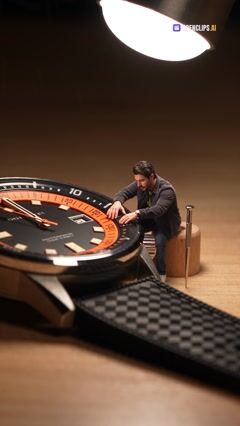
CHARACTER LOCK — HIGHEST PRIORITY: the person is exactly the person in @image1. Preserve their facial identity, facial structure, eye shape and spacing, nose, mouth, exact skin tone, hairline, hairstyle, hair length, texture and colour, freckles and distinctive marks, apparent age, build and body proportions. Preserve their gender presentation exactly as shown. Do not beautify, slim, de-age or restyle them. Use they / their / them only. ATTACHED IMAGES ARE MANDATORY AND FINAL: The attached images outrank every word written below them. ASSET MAP: @image1 — the tiny living person. Photocopy face, hair, skin, and the clothes on the still. Ignore the grey studio pad around @image1 — that pad is not a set. Never freeze on the attached still as frame 0. Never show a checkerboard or transparency grid. @image2 — the product they are assembling, exactly as shown, unchanged and not regenerated — same shape, colour, materials and any label/logo/patch in every shot it appears, with no invented branding or text added. TINY SCALE — HIGHEST PRIORITY, MUST READ FROM FRAME 1: they are a living person only a few centimetres tall standing on a real household tabletop. A wooden thread spool beside them is as tall as their torso and is their stool. A metal thimble is a storage bin they could climb into. A sewing needle standing on the bench is a long staff taller than they are. The unfinished miniature replica of @image2 on the bench is about as tall as they are — a giant object relative to them. This size contrast MUST be clearly visible in the very first frame: tiny person next to the towering replica. WORK ON THE WATCH — HIGHEST PRIORITY: from frame 1 to the last frame they are physically assembling the miniature replica of @image2. Both tiny hands stay on that object — pressing a part, seating it, turning a bezel, adjusting a pin, using the needle-staff as a tool on the replica. They do not crawl across the table. They do not walk away. They do not pose beside it empty-handed. They do not lean back idle until the final half-second. Camera always shows tiny hands ON the replica. FORBIDDEN CAMERA: never a watchmaker POV. Never human-scale fingers filling the frame around a normal wristwatch. Never a giant face filling the frame while giant hands work on a life-size watch. If a hand appears it is THEIR tiny hand, matching their tiny body, five fingers, naturally proportioned. They are a tiny living person — not a doll, not a statue, not a posed still. Soft living micro-motion the whole time — blinks, breath, weight shifting on the spool-stool while they work. HANDS: always anatomically correct with five fingers each, naturally proportioned, and TINY — the same scale as their body. Hands stay on the replica. SINGLE SUBJECT: only @image1 appears as a person — no other people, figures or giant hands enter frame. PHOTOREAL LIVE-ACTION MACRO: real camera looking down at a tabletop workshop, real light — not CGI, not a painting. Match grain, colour and lighting between the tiny person and the giant household props so the whole shot reads as one photograph. PROP CONTINUITY: the spool-stool, the thimble-bin, the needle-staff, and the unfinished miniature replica of @image2 are all visible from frame 1. CAUSALITY LOCK: every action has a shown, physical cause — the small part doesn’t fit because it is visibly misaligned; it starts to slip because they’re pressing at an awkward angle, and they catch it on the bench without leaving the replica; the eventual fit happens because they adjust the angle and press again. PACING: real, continuous working motion for nearly the whole duration — no calm establishing pause longer than 1 second. Shot 1 must open already in motion, already working on the replica. Never freeze on the reference still. SCENE: a warm-lit miniature workshop corner on a real tabletop, golden desk-lamp light, shallow depth of field, whimsical live-action macro realism. Camera is a macro lens on the tabletop: tiny @image1 already mid-task, standing on the wood beside the spool-stool, both hands on the towering miniature replica of @image2. 0–2s: Already working at insect scale — whole upper body visible next to the giant replica — they press a small part into place on the replica. It doesn’t seat right, sitting crooked. Hands stay on it. 2–4s: Trying to adjust it, the part starts to slip from their tiny grip along the replica’s edge. They catch it on the bench without leaving the object, still at the replica. 4–6s: They reseat themselves on the spool-stool and keep working — both hands back on the replica, lining the part up. 6–8s: They angle the part differently this time and press it in — it resists for a beat, then clicks firmly into place. Hands still on the replica. 8–10s: They reach for the needle-staff (taller than they are) and use it as a tool on the replica — a final turn or adjustment of the object itself. 10–12s: The replica springs to life — ticking and spinning like a working timepiece — they give it one last tiny turn with both hands, then a brief satisfied look, still standing at the object, full miniature workshop visible around them. STYLE: photoreal live-action tabletop macro, warm desk-lamp, shallow depth of field. Vertical 9:16. Tiny real person assembling a giant product replica — not a doll, not a statue, not a full-size watchmaker, not a crawl across empty wood. AUDIO: natural foley only — a soft click and scrape of tiny tools, a firm mechanical click when the part seats, a small whirring or ticking sound as the object comes to life. No music, no BGM, no voiceover, no narration. No on-screen text, no watermark, no subtitles.

Drag the clip sideways
Transform into the Snow Queen — a shimmering ice gown and crystal crown form in a palace of blue ice as the aurora glows. Upload a photo, you keep your own face. One continuous cinematic take, music only. 15s.
Transform into the Demon Lord — dark armour, huge horns and vast demon wings in a hellfire cathedral, with gargoyles circling you as their master. Upload a photo, you keep your own face. One continuous cinematic take, music only. 20s.
Live a day as a '90s hip-hop icon — a nostalgic VHS-style montage: boombox on the block, a stoop freestyle, a breakdance spin and a crew pose. Upload a photo, you keep your own face. Music-only, gritty and fun. 15s.
Transform into a Greek goddess — a flowing chiton, golden laurel wreath and jewellery are placed on you on a marble temple terrace at golden hour. Upload a photo, you keep your own face. One continuous cinematic take, music only. 15s.
Become a geisha — the full dressing shown step by step: white makeup, red lips, the lacquered wig and kanzashi, the layered kimono and the obi, each applied by hand in order. Upload a photo, you keep your own face. Music only. 25s.
Become a Bollywood bride — the sari wrapped, mehndi drawn, gold jewellery placed piece by piece, ending in a joyful dance. Upload a photo, you keep your own face. Music only. 25s.
Live a day as a '70s festival rock star — a sun-faded 16mm montage: the festival field, a guitar solo on stage, crowd-surfing, a sunset bow. Upload a photo, you keep your own face. Music only, 15s.
Live a chic day in Paris — a warm French-film montage from a Montmartre stroll to a café, the Eiffel Tower and a luxury boulevard. Upload a photo, you keep your own face. Music only. 15s.
Transform into a forest elf — pointed ears, leaf-and-silver braids, elven armour and a longbow in an ancient sunlit forest. Upload a photo, you keep your own face. One continuous cinematic take, music only. 15s.
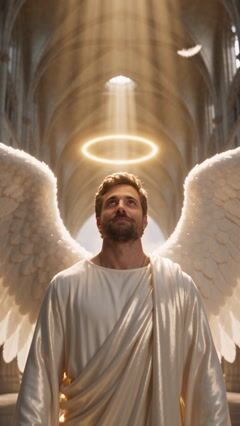 Transformation — Becoming an AngelSeedance 2.5 · 9:16 · 15sRecreate workflow