
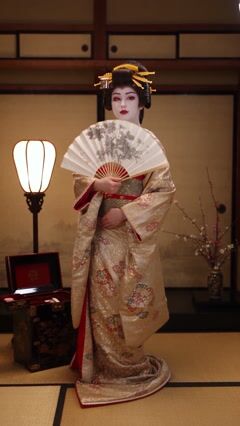

BECOMING A KYOTO STAGE PERFORMER — THE FULL DRESSING, STEP BY STEP. One continuous cinematic 25-second take, full realtime speed, a slow and historically accurate Kyoto stage-performer preparation, each stage shown clearly and in order, nothing skipped. (music only, mixed loud and full so the music dominates from the very first frame: a serene traditional Japanese instrumental with a plucked koto, a soft shakuhachi flute and gentle taiko, building gently; original, no lyrics, no copyrighted melody) <a faint wind-chime and soft room tone far under the music> @image1 keeps the exact same face shape and features as the reference the whole time — same eyes, same nose, only what is present in the reference — seated at a low wooden mirror stand. Preserve their gender presentation exactly as shown. Use they / their / them only. SETTING: a traditional okiya dressing room — tatami-mat floor, paper shoji screens, a low lacquered mirror stand (kyodai), an open lacquered makeup box, hanging paper lanterns and a vase of blossoms. BEATS (25s), slow and clear, hands performing each real step in order: 0–4s: @image1 sits in a plain white cotton under-robe; a hand smooths a thin layer of bintsuke wax over the face, then a wide flat brush lays an even coat of white oshiroi over the face. Camera: close push-in on the face. 4–8s: the same white oshiroi is brushed down the neck and chest, and at the back of the neck the brush carefully leaves the traditional bare W-shape at the hairline (the unpainted nape). Camera: move around to the nape, then back. 8–12s: a small brush paints the lips with red beni, and the eyes and brows are softly lined in red and black. Camera: tight on the face details. 12–16s: THE HAIR — a glossy black lacquered nihongami wig styled in a shimada is lifted with both hands and settled carefully onto the head, then decorative kanzashi hairpins and a patterned kanoko hair ribbon are slid into the hair one by one by hand. Camera: rise around the head to show the hairstyle clearly. 16–21s: THE DRESSING — a white nagajuban under-kimono is wrapped across the body, then a richly patterned silk kimono is layered over it and the collars folded neatly low at the nape; a wide brocade obi is wound around the waist and tied into a large drum knot (taiko musubi) at the back, secured with an obijime cord at the front. Camera: orbit from the back to the front to show the obi and layers. 21–25s: @image1 rises in the full stage-performer garb, takes small graceful steps, lifts a folding paper fan, opens it and turns into a final poised pose. Camera: ease back to a wide hero shot to the last frame. LOOK: ultra-photorealistic cinematic, soft warm lantern grade, shallow depth of field, real silk, lacquer, powder and skin, natural motion blur, film grain, clean frame with no on-screen text, captions, logos or watermark.
Drag the clip sideways
BECOMING THE STAR OF A BOLLYWOOD WEDDING — THE FULL PREPARATION, STEP BY STEP. One continuous cinematic 25-second take, full realtime speed, a slow and real wedding preparation where every item is physically held in hands, taken from a tray or box, and visibly worked onto the body over time — nothing ever appears on its own or jumps into place — ending in a joyful dance. (music only, mixed loud and full so the music dominates from the very first frame: a festive Bollywood instrumental with a driving dhol rhythm, bright strings and a joyful melody, building to a big celebratory dance peak in the final section; original, no lyrics, no copyrighted melody) <a faint warm courtyard ambience far under the music> @image1 keeps the exact same face and bare features as the reference the whole time — same nose, same eyes, same skin, only what is present in the reference — seated then standing at the centre. Preserve their gender presentation exactly as shown. Use they / their / them only. SETTING: an ornate sunlit courtyard draped with marigold-flower garlands, carved pillars, hanging lanterns, with a low table holding an open wooden jewellery box and a brass tray. BEATS (25s), each step a real visible process performed by hands, taking its full time: 0–5s: an attendant's hands lift the folded red-and-gold embroidered silk wedding outfit off the brass tray — a sari or a sherwani with a draped stole, whichever suits their gender presentation as shown in @image1 — and dress @image1 in it layer by layer, tucking the pleats and drawing the long drape up over one shoulder, smoothing the fabric — the outfit visibly going on layer by layer. Camera: slow orbit following the dressing. 5–9s: a hand holds a henna cone and draws looping mehndi patterns onto @image1's open palm and the back of the hand stroke by stroke, the reddish-brown lines appearing under the moving tip and building up into a full design. Camera: tight on the hand as the pattern is drawn. 9–13s: hands lift a gold head ornament out of the open jewellery box — a maang-tikka or a jewelled turban brooch, whichever suits their gender presentation as shown in @image1 — and set it in place at the hair or headwear; then gold earrings or ear studs are picked up and fitted one at a time, only if they suit @image1. Camera: push-in to the head and ears. 13–17s: hands lift a layered gold necklace from the box, bring it around @image1's neck and fasten the clasp at the back; then red-and-gold bangles or gold kadas are slid over @image1's hand onto each wrist one by one, several stacking up on each arm. Camera: follow the hands to the neck then the wrists. 17–20s: @image1 raises the finished hennaed hands and looks at them, then turns slowly in the full wedding outfit as rose petals drift down around them. Camera: ease back to a wide. 20–25s: @image1 breaks into a joyful Bollywood wedding dance — expressive hand mudras, wrists turning, a spin that flares the outfit, light bouncy footwork, bangles glinting — and lands on a radiant final dance pose with both arms raised. Camera: following the dance, holding on the final pose to the last frame. LOOK: ultra-photorealistic cinematic, warm rich festive grade, shallow depth of field, real silk, gold, henna and skin, natural motion blur, film grain, clean frame with no on-screen text, captions, logos or watermark.
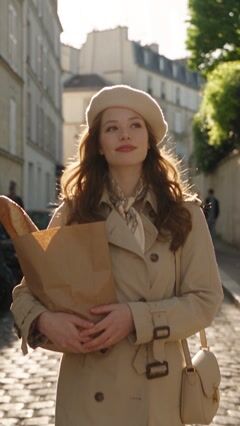
FASHION WEEK — THE GRAND RUNWAY FINALE. One sleek continuous take, full realtime speed, a huge, grand, star-making couture show. AUDIO MIX (ranked, three separate layers): 1. MUSIC — loudest, dominant from the very first frame: a chic, pulsing electronic fashion-show beat with a cool confident groove building to a big triumphant hit; original, instrumental only. 2. SFX — quiet, under the music: rapid camera shutters, a rising crowd cheer and applause. 3. VOICE — none; @image1 stays silent the whole clip. Audio suppressor: no voiceover narration, no dialogue, no spoken words, no singing vocals, no lyrics, no library audio bed, no muffled murmuring, no subtitles. The music resolves on a final hit and silence holds the final 0.5s. TWO references with strictly separate jobs: @image1 provides the FACE, head, hair and identity — the headline star — kept EXACTLY the same the whole time (same face, bone structure, eyes, nose, mouth, skin tone, hairline), always centre-frame and in focus. Preserve their gender presentation exactly as shown. Use they / their / them only. @image2 provides ONLY the OUTFIT: take only the dress from @image2 — its exact shape, silhouette, length, colour, pattern, fabric and details — and fit it naturally onto @image1 for the whole clip. If @image2 shows a model's face or body, that is not used; the person is always and only @image1. @image1 is clearly the most important model in the room, wearing the @image2 dress. SETTING: an enormous grand fashion-show hall — a very long, wide, brightly illuminated glossy catwalk stretching far into the distance, towering lights and giant screens, a huge packed audience in glamorous outfits seated and standing along both sides, and banks of photographers crouched at the end. BEATS (20s), showing the full scale and that @image1 is the star: 0–4s: a wide high establishing shot reveals the vast hall — the enormous runway, the huge crowd on both sides, dramatic lights — as @image1 emerges through a grand backlit entrance at the top of the catwalk in the @image2 dress and begins to walk. Camera: high and wide, then easing down toward @image1. 4–9s: @image1 strides down the vast catwalk as the clear star, the fabric of the @image2 dress moving with each step, while several other elegant runway models walk in spaced formation behind and ahead of @image1 — @image1 stays centre and in front — as the crowd rises to their feet and hundreds of camera flashes fire from both sides. Camera: tracking backward ahead of @image1. 9–14s: the glamorous audience is on their feet applauding and filming on phones, photographers firing cameras up at @image1, who commands all the attention walking straight toward the lens. Camera: low hero angle looking up at @image1 with the crowd and flashes behind. 14–20s: @image1 reaches the end of the runway and strikes a powerful pose in the @image2 dress as the flashes peak and the other models fan out in a line behind; @image1 turns and leads them back up the catwalk. Camera: pull up and wide to reveal the whole grand scene, holding to the last frame. LOOK: ultra-photorealistic cinematic runway grade, crisp bright show lighting, shallow depth of field, real fabric, skin and crowds, natural motion blur, film grain, clean frame with no on-screen text, captions, logos or watermark.
Transform into a forest elf — pointed ears, leaf-and-silver braids, elven armour and a longbow in an ancient sunlit forest. Upload a photo, you keep your own face. One continuous cinematic take, music only. 15s.
Live a day as a billionaire sheikh — palace villa, pet tiger, falcon, supercars and a private jet, over-the-top luxury. Upload a photo, you keep your own face. Music only. 15s.
BECOMING A VIKING WARRIOR — THE FULL ARMING, STEP BY STEP. One continuous cinematic take, full realtime speed, a slow fierce arming shown clearly and in order, each stage given its own time; every piece of gear is physically picked up by hand from a wooden bench and weapon rack and then put on over time. AUDIO MIX (ranked, three separate layers): 1. MUSIC — loudest, dominant from the very first frame: a thunderous Nordic war instrumental with heavy drums, a low horn and a rising chant-like melody; original, instrumental only. 2. SFX — quiet, under the music: a cold wind, leather creaking, buckles clicking, the iron helm settling, and one big battle roar at the end. 3. VOICE — only the single wordless battle roar in the last beat; the warrior stays silent otherwise. Audio suppressor: no voiceover narration, no dialogue, no spoken words, no singing vocals, no lyrics, no library audio bed, no muffled murmuring, no subtitles. The music resolves on a final hit and silence holds the final 0.5s. TWO references of the SAME person: @image2 is the warrior BEFORE — their real face, how the clip begins, in a plain wool tunic. @image1 is the same person AFTER — the finished armoured Viking look the clip builds up to and ends on: copy the final gear, war paint and pose exactly from @image1 — the rounded iron knotwork nasal helm, the huge grey-brown wolf-fur mantle over a long dark cloak, dark leather armour, fur leg bindings and boots, the round planked wooden shield with iron rim and boss, the bearded axe, and three dark charcoal claw-stripes down each cheek. The face, eyes, nose, eyebrows, lips and identity are the same person in every frame from start to finish. HAIR: in every frame the warrior keeps their own natural hair colour and length from @image2; by the end, where it is long enough, it is worn in warrior braids with small metal beads under the helm, exactly as in @image1. SETTING (same as @image1): a snowy cliff edge above a dark grey fjord at misty dawn, wooden longships with glowing torches moored on the water below, drifting snow. Right beside the warrior stand a wooden weapon rack and a fur-draped bench that hold all the gear in view from the start: the folded wolf-fur mantle, the dark cloak, the leather armour, the iron helm, the round shield, the axe and a small clay bowl of charcoal paint. BEATS (25s), each piece visibly taken from the bench or rack by hand before it goes on, the look growing step by step from @image2 to @image1: 0–5s: BRAIDING, SEEN FROM THE FRONT: the warrior, with the face and own hair of @image2, faces the camera in a plain wool tunic, both arms raised and both hands reaching behind the head, working their own hair at the back of the head by feel; the hands stay behind the head the whole time while the face is the focus — a hard, fierce, dangerous stare straight into the lens, jaw set, eyes narrowed, the cold wind pushing loose strands across the face. Camera: frontal medium close-up slowly pushing in on the fierce face. 5–10s: WAR PAINT ON THE CHEEKS: the warrior dips two fingers into the clay bowl of charcoal paint, places the fingertips on the cheekbone just under the eye and drags them straight down the cheek toward the jaw, leaving three dark vertical claw-stripes on the left cheek, then dips again and draws the same three stripes down the right cheek; the stripes build up under the moving fingertips; forehead and eyebrows stay their own natural colour. Camera: tight on the face. 10–15s: the warrior picks the leather armour up off the bench and pulls it on, buckling it at the side; then lifts the dark cloak and swings it over the shoulders, then lifts the heavy wolf-fur mantle off the bench with both hands and settles it around the shoulders and neck, fastening it at the chest with an iron brooch. Camera: orbit around the shoulders. 15–19s: the warrior sits on the bench and wraps fur bindings around each shin with leather cords, one leg then the other, tying them off. Camera: push-in on the hands at the legs. 19–22s: the warrior lifts the iron knotwork nasal helm from the rack with both hands and settles it onto the head over their own hair, the nose guard sliding down between the eyes; takes the round shield from the rack onto the left arm and pulls the axe off the rack with the right hand. Camera: rise to a medium shot. 22–25s: HERO POSE exactly like @image1: the warrior plants both feet wide on the snowy cliff edge, crouches forward behind the round shield held up in front of the body, axe raised out to the side, and ROARS a huge battle cry straight into the lens, mouth wide open, cloak whipping in the wind, longships glowing behind. Camera: low frontal push-in to a close hero shot on the roaring face over the shield rim, holding to the last frame. LOOK: ultra-photorealistic cinematic, cold grey-and-steel grade, misty dawn light, shallow depth of field, real wool, fur, iron, wood, hair and skin, natural motion blur, film grain, clean frame with no on-screen text, captions, logos or watermark.

BECOMING THE DEMON OVERLORD. One continuous cinematic 20-second take, full realtime speed, an epic dark transformation that builds to a powerful reveal. (music only, mixed loud and full so the music dominates from the very first frame: a dark, menacing orchestral with a deep ominous choir, pounding war drums and a huge brass swell at the peak; original, no lyrics, no copyrighted melody) <a faint crackle of fire and a low rumble far under the music> @image1 keeps the exact same face and bare features as the reference the whole time — same eyes, same nose, same skin, only what is present in the reference — standing tall at the centre, powerful and commanding. Preserve their gender presentation exactly as shown. Use they / their / them only. SETTING: a vast dark gothic cathedral-hall of black stone, tall pillars, rivers of molten fire glowing in cracks across the floor, embers and ash drifting up, a deep red-black sky through broken arches. BEATS (20s), the whole figure transforming, each stage clear: 0–5s: @image1 stands in plain dark garb as embers gather around the body; heavy dark armoured plates form over @image1's own torso and shoulders, keeping their own build, a long tattered dark cloak settling behind. Camera: slow push-in. 5–10s: two huge curved horns grow up from the sides of @image1's head, and two massive dark leathery bat-like demon wings unfurl and spread wide from the back — the whole figure growing taller and more imposing as the wings open. Camera: ease back to reveal the full wingspan and horns. 10–15s: @image1 stands at full power, the dark armour laced with faint molten-glowing cracks; several winged stone gargoyle creatures swoop in from the shadows and circle around @image1, wings beating, orbiting their ruler. Camera: slow orbit around @image1 with the gargoyles wheeling past. 15–20s: @image1 spreads the demon wings wide, raises one hand, and the gargoyles wheel around in formation against the hellfire light; @image1 settles into a mighty commanding hero pose, ruler of the hall. Camera: rise to a wide low-angle hero shot, holding on the pose to the last frame. LOOK: ultra-photorealistic cinematic dark-fantasy, deep red-and-black infernal grade, real stone, metal, leathery wings and skin, embers and firelight, shallow depth of field, natural motion blur, film grain, clean frame with no on-screen text, captions, logos or watermark.
A 1950s DATE AT THE DINER. A charming 20-second montage shot to look like vintage 1950s Kodachrome home-movie film, full realtime speed, soft jump cuts, ending in a dance. (music only, mixed loud and full so the music dominates from the very first frame: an upbeat 1950s rockabilly / jive instrumental with a walking bass, bright guitar and a swinging, danceable rhythm; original, no lyrics, no copyrighted melody) <a faint diner chatter and hand-claps far under the music> TWO distinct people, both their identities kept EXACTLY from the references the whole time — @image1 is the star of the date with the exact face, hair and features of the first reference, playful and glamorous in a polka-dot 1950s outfit styled to suit their gender presentation as shown in @image1, their own hair exactly as in @image1; @image2 is their date with the exact face, hair and features of the second reference, in a cuffed white tee and jeans, their own hair exactly as in @image2. They are two clearly different people, never swapping faces or merging, and they are the only two people featured in frame. Preserve their gender presentation exactly as shown. Use they / their / them only. VINTAGE LOOK throughout: authentic 1950s Kodachrome film — warm saturated pastel colours, fine film grain, gentle flicker, slightly soft focus, nostalgic and cheerful. BEATS (20s): 0–5s: @image1 and @image2 sit across from each other in a red vinyl booth in a classic chrome-and-checkerboard diner on a date; @image1 waves over the server and a burger and fries are slid onto the table, both smiling at each other. Camera: slow push-in on the booth. 5–10s: @image1 and @image2 share one tall milkshake with two straws, leaning in close, and @image1 takes a sip and laughs. Camera: medium, easing in. 10–13s: @image1 hops up and drops a coin into the chrome jukebox; the music kicks in and @image1 snaps their fingers and spins round toward @image2. Camera: follow @image1 to the jukebox and back. 13–20s: @image1 and @image2 jive and swing-dance together in the middle of the diner — @image2 spins @image1 out and back, they bounce and step in sync, @image2 gives @image1 a quick lift, clothes flaring, other diners clapping from the booths — and they land together in a playful final dance pose. Camera: handheld, tracking the dance, holding on the final pose to the last frame. LOOK: nostalgic, glossy 1950s Americana grade, clean frame with no on-screen text, captions, logos or watermark.
DAY IN THE LIFE OF A SAFARI ADVENTURER — RIDING THE ELEPHANT. A warm montage with a golden savanna film look, full realtime speed, soft jump cuts between short scenes, full of movement. AUDIO MIX (ranked, three separate layers): 1. MUSIC — loudest, dominant from the very first frame: an adventurous African-percussion-and-strings instrumental with a warm, sweeping, uplifting melody; original, instrumental only. 2. SFX — quiet, under the music: a soft savanna breeze, distant birds, a splash of river water and one soft elephant trumpet. 3. VOICE — none; @image1 stays silent the whole clip. Audio suppressor: no voiceover narration, no dialogue, no spoken words, no singing vocals, no lyrics, no library audio bed, no muffled murmuring, no subtitles. The music resolves on a final hit and silence holds the final 0.5s. @image1 is the adventurer and the star of every scene, identity kept EXACTLY from the reference the whole time — same face, hair and features throughout — in a khaki explorer's outfit and a wide-brim hat. BEATS (20s): 0–5s: @image1 rides high on the back of a large African elephant that walks steadily across golden savanna grass, @image1 holding the harness and grinning with the wind in their face. Camera: sweeping alongside, rising to a wide. 5–9s: the elephant wades into a wide river and lifts its trunk to spray a glittering arc of water into the air, @image1 laughing and shielding their face on its back. Camera: tracking across the water. 9–13s: at a sunny wildlife sanctuary @image1 crouches beside a relaxed leopard lying in the shade and gently strokes its back and head, the big cat calm and content, @image1 smiling in wonder. Camera: slow push-in on the gentle moment. 13–16s: back riding the elephant, @image1 passes a group of giraffes and zebras and points toward them. Camera: over the shoulder past @image1 to the animals. 16–20s: the elephant stops on a ridge at sunset overlooking a herd on the plain below, and @image1 rises on its back and throws both arms wide against the blazing orange sky. Camera: crane up and hold on the pose to the last frame. LOOK: warm golden safari grade, soft film grain, sweeping and cinematic, clean frame with no on-screen text, captions, logos or watermark.
RULER OF THE WHITE WOLVES. One continuous cinematic epic-fantasy take, full realtime speed, like a scene from a big fantasy film. AUDIO MIX (ranked, three separate layers): 1. MUSIC — loudest, dominant from the very first frame: a majestic Nordic-fantasy orchestral with deep drums, low horns, warm strings and a soaring choir-like synth pad building to a grand theme; original, instrumental only. 2. SFX — quiet, under the music: soft paws crunching through snow, a cold forest wind, and one long wolf howl at the end. 3. VOICE — none; @image1 stays silent the whole clip. Audio suppressor: no voiceover narration, no dialogue, no spoken words, no singing vocals, no lyrics, no library audio bed, no muffled murmuring, no subtitles. The music resolves on a final hit and silence holds the final 0.5s. @image1 is the ruler of the wolf pack, identity kept EXACTLY from the reference the whole time — same face, hair and features throughout — in a long dark wool cloak with a thick white fur collar over dark leather clothing. Preserve their gender presentation exactly as shown. Use they / their / them only. THE WOLVES — a pack of eight enormous white wolves, photoreal and lifelike like real animals: thick white-and-silver fur moving in the wind, calm pale-gold eyes, powerful shoulders. The pack leader is the biggest, the size of a horse, with a broad silver-white chest. All of them loyal and calm with @image1, their family. SETTING: a vast snowy pine forest at blue dusk, tall dark trees heavy with snow, soft snowfall, a full moon rising over a rocky cliff at the forest edge. BEATS (15s): 0–4s: wide cinematic shot — @image1 walks alone through the deep snow between the giant pines as the white wolves step out of the trees one by one on both sides and fall in beside @image1, walking with them. Camera: wide, slow dolly alongside showing the whole pack. 4–7s: the huge pack leader walks up and lowers its head to @image1, who smiles and presses a hand into the thick fur of its neck; the wolf closes its eyes calmly. Camera: slow push-in on the gentle moment. 7–11s: @image1 swings up and sits on the broad back of the pack leader, holding its thick neck fur, and the giant wolf lopes forward through the snowy forest at an easy steady pace, the whole pack running in formation behind, snow spraying up from their paws, cloak streaming. Camera: low tracking shot racing parallel alongside at the same speed. 11–15s: they burst out of the trees onto the rocky cliff edge under the huge full moon; @image1, still sitting on the pack leader, raises one arm high as all eight wolves lift their heads and howl at the moon together. Camera: crane up and pull back to a wide silhouette of @image1 and the howling pack against the moon, holding to the last frame. LOOK: ultra-photorealistic cinematic fantasy, cold blue moonlight grade with warm highlights on the faces, real fur, snow, wool and skin, shallow depth of field, natural motion blur, film grain, clean frame with no on-screen text, captions, logos or watermark.
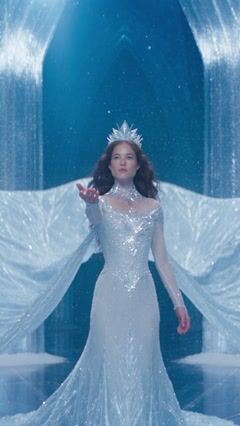 Transformation — The Snow SovereignRecreate workflow