
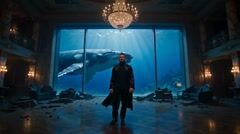
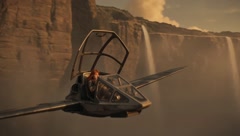
Five worlds, one traveller, zero visible cuts. It opens on the eyes - so close you can read them - and the camera pulls back until an impossibly long old-European hotel corridor unfolds behind: warm golden lamps, hundreds of identical doors, one of them the only one that matters. A hand reaches for the brass handle, white light swallows the lens, and the walk continues straight out onto an Icelandic black-sand beach - dark cliffs, rain, wind dragging the fabric sideways. On that empty beach stands the next door. Through it: neon Tokyo at midnight, wet asphalt mirroring the signs, crowds parting, a futuristic motorcycle tearing across the foreground so close it blacks out the frame - and when it clears, the ballroom is underwater. A drowned luxury hall, chandeliers, blue light shafts, a whale gliding silently past the glass. Then hundreds of silver fish rush the lens, become golden desert wind, and the wind opens onto a dune at sunset with one final door on the crest. It opens above the clouds. Every cut is done in camera - through light, through a doorway, behind a passing vehicle, inside a swarm - so the whole 28 seconds read as a single impossible walk. Shot like 35mm anamorphic: backward tracking, low rising orbits, a slow 180 around the figure, wind and water in every frame. You bring three references: one avatar and two outfits. The face stays yours the whole way; the wardrobe changes once, in the desert, exactly where the story turns. The journey is already built.
Drag the clip sideways


Nothing about the product from @image_1 changes in any shot - keep it exactly as it is. Ignore the background of @image_1: the plain studio backdrop it sits on does not appear anywhere in this film. BACKGROUND COLOUR RULE, applies to EVERY shot: the whole environment is built out of the blue taken straight from @image_1 - a saturated deep-blue field, brightest in a broad uneven halo behind the product and deepening into rich midnight navy at the edges of the frame. The fog, the haze, the reflections and the water all carry that same blue. No white studio, no grey, no teal, no seamless backdrop - every shot reads unmistakably as that one blue, with the only warm accents coming from @image_1 itself. Lighting in every shot: no soft fill anywhere. A powerful blue backlight blooms through dense low fog and falls off hard into deep navy at the edges. One razor-thin specular line burns down the left edge; a brilliant white-blue edge light traces the right side; @image_1 is backlit so it burns from within. High contrast, deep crushed blacks, dramatic chiaroscuro throughout. Opening shot: extreme macro on condensation droplets sliding down the chilled surface in slow motion, deep blue light glowing behind them, the razor-thin specular line burning down the edge, everything else falling into darkness. The camera then smoothly pulls back and drops to a low hero angle as @image_1 is revealed towering on a wet blue mirror floor that runs edge to edge and out of frame - no visible slab, tile, tray or plinth edges anywhere. A violent slow-motion wall of water bursts upward around the base, its crown rising as high as the middle of @image_1, hundreds of droplets and jagged ice shards flying through the blue light, cold vapour pouring off the chilled surface. Final shot: the camera settles into a centred low hero composition with @image_1 towering and filling nearly the full height of the frame, sharply focused, water settling into ripples on the mirror floor, cold mist drifting low, the deep blue glow behind it falling away into black. Ultra-realistic commercial cinematography, high-speed slow motion, physically accurate water and reflections, smooth deliberate camera movement, premium advertising aesthetic, dramatic moody cinematic lighting, shallow depth of field, highly detailed, 4K, vertical 9:16, no people, only the single product from @image_1 in frame, no extra text.

Generate a photorealistic self-shot travel vlog: a traveller spends one warm afternoon in a small hilltop town and then rides a horse at a countryside stable just outside its walls.


Generate a high-speed dark-fantasy battle. Cinematic manga aesthetic, hand-drawn ink animation.


IDENTITY: @avatar - their face and hair identity only. @avatar defines nothing else: completely ignore its clothing, pose, framing, background, lighting and color palette. Every location, wardrobe, camera move and light in this clip comes from the description below. A cinematic luxury fashion commercial featuring @avatar wearing the @product, walking confidently through glossy studio floors, a bright luxury corridor, a nighttime city street, and a modern marble lobby. Include macro close-ups of the product's texture and liquid-like reflections, followed by a warm beige studio product shot displaying the product variants on a pedestal, with glowing text: "WALK YOUR MOMENT." Ultra-realistic, cinematic lighting, sharp reflections, shallow depth of field, premium fashion editorial aesthetic, 8K detail. Unbranded: no logos, no brand names, no visible labels, monograms or readable signage anywhere.


[Global Setting] Sunlit magical underwater garden at golden hour. Soft warm golden light filtering down through clear turquoise water. Coral flowers, swaying seagrass, sparkling bubbles and magical light particles drifting through the water. Bright cheerful colors. Dreamy cinematic anime aesthetic. [Character — @image_1] The character is @image_1, rendered fully in this cute rounded anime 3D style exactly as it appears in @image_1 — face, hair, outfit and proportions come entirely from @image_1 and never change. @image_1 defines the character only: every location, prop, camera move and light in this clip comes from the description below. Innocent, joyful, energetic presence. Adorable expressions. Hair and clothing sway weightlessly in the water. [Scene Description] [Opening, 0–6s] Wide shot of the magical underwater garden at golden hour. Golden light shimmers down from the surface; sparkles and tiny bubbles float through the water. @image_1 sits on soft seagrass surrounded by colorful coral flowers, completely alone. @image_1 looks up toward the glittering surface with a bright smile, eyes sparkling, holding a small woven basket of glowing sea flowers close. Soft music begins — gentle and cheerful. Camera slowly circles around @image_1 capturing this peaceful joy. [Playful Moment, 6–15s] @image_1 pushes off the seabed with pure joy, spinning weightlessly in the water, arms outstretched, giggling (light cheerful laugh, softly muffled by the water). Flower petals swirl around @image_1 through the spin. Magical sparkles follow every movement like trails of light. @image_1 picks glowing sea flowers and twirls them, creating little arcs of petals, bubbles and sparkles. Expressions shift — wonder, joy, pure happiness. Camera follows the playful movements, slow and fluid. The garden responds to that joy — coral flowers glow brighter, sparkles intensify. [Magical Interaction, 15–24s] A cute little fish appears — small, chubby and round, storybook design, big gentle eyes, soft coral-pink and cream coloring, tiny fluttering fins. @image_1 notices, eyes going wide with delight, and gently extends a hand. The little fish cautiously swims closer. @image_1 giggles as it gently nuzzles @image_1's hand. @image_1 settles back down onto the seagrass and the little fish hovers calmly beside @image_1. They share a quiet moment together. @image_1 pets the little fish gently, both completely content. A soft magical aura surrounds them both. Sparkles intensify. The scene is pure innocence and magic. [Closing Moment, 24–30s] @image_1 lies back on the soft seagrass looking up toward the sunlit surface. The little fish settles into the seagrass beside @image_1. Golden light floods the scene through the water. Sparkles and tiny bubbles float lazily upward. @image_1 smiles peacefully with eyes closed, completely happy and at peace. Camera pulls back slowly to show the tiny figure of @image_1 in the vast beautiful underwater garden, surrounded by magical light. The music reaches a soft gentle peak. Hold on this moment of pure peaceful joy. [Audio] Soft gentle music box melody with light orchestral strings and soft chimes, gently muffled as if heard underwater. Light happy giggles (pure joy, not mocking, softly bubbly). Flower petals and seagrass rustling softly in the current. Magical sparkle sounds (subtle, not overdone — soft chiming/tinkling). Gentle fish sounds (soft bubbly blub, tiny fin flutter). Soft bubble sounds with every movement. Final moment: just music and the sound of gentle currents drifting through the coral garden. [Visual Style] — Anime 3D stylized (rounded appealing designs) — @image_1 is rendered fully in the same cute rounded style as in the reference — Sparkles and magical particles constant — Golden hour lighting — Pastel color palette — Big expressive eyes on the character — Innocent and pure atmosphere — No violence, darkness, or tension — Pure joy and wonder [Tone] Pure cuteness. Innocent joy. Magical and peaceful. This is a moment of complete happiness and connection with the underwater world. Wholesome and heartwarming. [Consistency] — One character throughout — always @image_1 — Same magical underwater garden location — Peaceful atmosphere maintained — Sparkles and magic elements constant — Music upbeat but gentle — No dialogue ever — Just SFX and music — Pure positivity — All motion is slow, fluid and weightless — underwater grace at all times, the whole body stays intact and graceful, hair and clothing flow gently


Create an ultra-realistic, cinematic fast-paced action movie scene inside the cockpit of an older twin-engine regional passenger airliner at night, flying through a thunderstorm, using intense handheld cinematography, realistic movement, dramatic sound design, and believable aircraft motion. CONTINUITY: @avatar wears the same plain dark navy long-sleeved top in every shot. The cockpit is an older analog flight deck - rows of round mechanical dials, toggle switches and worn levers, no digital screens. The only light is the green-amber glow of the instrument panel plus sudden white flashes of lightning through the windshield, with heavy rain streaking across the glass throughout. No airline branding, no logos, no readable text anywhere on the aircraft, the instruments or the clothing. 0-6s: @avatar steps into the dark cockpit and suddenly realizes both pilot seats are empty. @avatar stares at the empty seats in shock, face lit from below by the instrument glow, a lightning flash briefly filling the windshield. Use tight handheld shots, quick cuts, and subtle camera shake to create immediate tension. 6-13s: @avatar races toward the left seat and takes control. Cut between @avatar's determined expression, their hands closing around the worn control yoke, and analog needles and warning lights jumping across the panel around them. 13-21s: The aircraft slams into violent storm turbulence and jolts hard. @avatar grips the yoke and struggles to keep the plane stable while alarms, rattling metal and hammering rain fill the scene. Lightning strobes through the windshield in bursts. The camera moves dynamically with the action. 21-30s: Start on an extreme close-up of @avatar's focused expression seen from outside, through the rain-covered windshield. The camera pulls steadily backward through the glass, revealing the lit cockpit, then the nose, then the whole aircraft - a twin-engine regional passenger airliner with a plain unbranded fuselage - until it is small against enormous black storm clouds with lightning firing deep inside them. End on that wide aerial. Style: Ultra-realistic Hollywood action-film cinematography, natural textures, realistic facial expressions, handheld camera, cinematic motion blur, dramatic lighting, immersive sound effects, tense orchestral score, realistic aircraft physics, seamless editing, and strong visual continuity.

Generate a motion-graphic reveal trailer, built from retro media-player chrome.

THE PRODUCT: the exact product from the product reference images, identical in every shot — same silhouette, materials, colors, details and branding. In worn shots the wearer appears only from the knees down; the shoe is always the hero. SHOTS: 01 — Opening: the shoe in its open box, slow top-angle push-in. 02 — Hero: clean side-profile beauty shot in a dark studio. 03 — Material: extreme macro of the upper and its signature details. 04 — Tongue: macro of the tongue label, slow tilt. 05 — Heel: close-up pan across the heel tab. 06 — Lifestyle: worn on an urban street, low-angle wide. 07 — Walking: low tracking shot of the shoe in motion. 08 — Stairs: side tracking shot climbing concrete steps. 09 — Urban run: fast follow shot through the city. 10 — 360 float: the shoe floating in a dark studio, full orbit — the drop. 11 — Sole: extreme close-up of the outsole texture. 12 — Splash: high-speed slow-motion water impact around the shoe. 13 — City vibes: the shoe against a city skyline. 14 — Final hero: premium low-angle beauty profile. 15 — End frame: the shoe beside large product-name branding in the accent color. STYLE: Premium cinematic lighting with soft dramatic shadows, luxury ad meets streetwear campaign, dark studio alternating with warm urban scenes, accent color drawn from the product's own palette. MUSIC: One continuous instrumental track — ambient intro, beat enters, groove, high-energy drop, peak chorus, fade-out. Diegetic SFX per shot (box, footsteps, whoosh, splash). No narration, no lyrics, no on-screen text except the end-frame branding.


 CRUNCH. FLAVOUR. CHAOS.Recreate workflow