
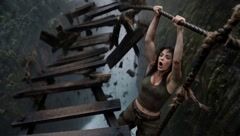

For the target video, the first frame is fully referenced from @image3 (storyboard, panel 1). integrated_multimodal_description: A cinematic photoreal adventure-thriller image-to-video sequence. @image1 (the character sheet) is an absolute character lock: face, body, hair, costume, materials and colours are taken from it exactly, with no drift or reinterpretation in any beat. @image2 (the location plate) is an absolute environment lock: the bridge, the wet stone ruins at the edge, the broken rock lip and the drop below are taken from it exactly and the sequence never leaves that space. @image3 (the storyboard) is followed exactly, beat for beat, matching its shot order, framing and pose. Preserve the exact same single character throughout: same face, bone structure, hair, skin tone, clothing, body type, age impression and humid sweat texture. Only one character is allowed. No other people, no monsters, no new scene, no interior cut, no mirrored duplicate, no extra limbs. The critical location-state chain is locked: first they are still on the bridge deck moving forward; then the bridge breaks and they fall and catch the side rope; then they remain suspended in open air with no stable foothold, and never return to the deck or the edge; only in the final beat do they catch the broken lip and climb up, for the first and only time. Beat 1 — begin on the bridge deck in a low intimate near shot. Start on their hand crushing the thick rope, then lift into their forward-leaning shoulder-and-back effort. They are still on the bridge deck, moving carefully forward. One hand presses the rope, the other steadies it, the leading foot tests forward, knees slightly bent, core tight to stabilise the bridge. Their first emotional layer is focused bridge control with panic suppressed: brows lightly drawn together, eyes fixed on the next foothold, lids tense, nostrils opened by restrained breath, lips slightly parted, jaw locked. They say quietly, <d>[English] Easy... keep moving.</d> Filtered daylight rakes the rope line and the working shoulder; clothing clings and creases under reach and rope pressure. Beat 2 — still on the bridge deck, in a frontal retreating medium shot, moving along the bridge axis toward camera. They accelerate by two quick steps. The wood planks start loosening under them and the bridge suddenly sags. They do not stop; they instantly drop their centre of gravity and keep moving. Their second emotional layer is tightening alertness: brows contract more, gaze narrows sharply, eyes flick between the planks below and the broken lip ahead, nostrils open wider, lips flatten, jaw hardens. Tiny wood splinters and droplets fall through the plank gaps, coarse rope fibres begin fraying, and the bridge shivers with elastic vibration. Beat 3 — the bridge breaks. Begin on a tight structural view of planks and rope, then follow the fall briefly. The planks snap apart, the main rope fibres burst one after another, and the bridge section folds and drops. They fall with it and instinctively grab a side rope with both hands; the rope catches them violently in midair. Make it unmistakable that from this moment they are hanging outside the edge in open air with both feet off the ground and no support beneath them. Their third emotional layer is uncontrolled terror forced into survival: pupils contract hard, eyes open wide but not caricature-wide, brow centre drives down, nostrils strain, teeth clamp, throat loses a breath on the sudden stop. They say, <d>[English] No— hold... hold it!</d> The first half breaks on the arrest; the second is forced self-stabilisation. Hard physics must read: rope fibres snap with different thicknesses and recoil, broken planks and wet wood dust tumble downward, their palms scrape the rope and shed fibres, shoulder joints, arms and back show real tension from the violent stop, hair lifts with fall inertia then drops back heavy against face and neck, straps yank tight and rebound. Beat 4 — they remain hanging in open air. The camera looks slightly downward along the rope from near their shoulder and forearm, but the frame must always retain their hands, rope, and part of their arm or torso. Far below, the white water keeps surging; the falling wood is swallowed immediately by the current, spray breaks into fine droplets, and cold mist lifts upward. They let their eyes drop once toward the void, then immediately drag their head and gaze back toward the broken lip. Their fourth emotional layer is fear seen for a flash and then forcibly contained: eyelids tremble, the eyeballs drop for one instant, lips shake slightly, the inhale catches, then focus re-forms. They say, <d>[English] Don't look down... come on.</d> The first half is lower, like a self-command; the second is shorter and harder. Wind rises from below and lightly shakes damp hair at the temples, the trouser hems, the hem of the top and the straps. Beat 5 — still hanging in midair with no successful support yet. Use a lateral medium close shot at side level, moving with them and the rope as they swing. They turn their body into a pendulum using core, shoulders, knees and hips to drive themselves toward the broken lip. On the first swing they only brush the broken wood with their fingertips, then immediately swing back out into open air again, still fully hanging on the rope with no stable support anywhere on their body. They instantly change grip, tighten their core, bend their knees, roll a shoulder, and load a second swing. Hold the physical effort close here: tightened core, back under strain, stretched strap, forearm tendons standing out, palm friction on rope, fast breathing. Their fifth emotional layer is pain and refusal to give up: after the first failure the brow drops lower, eye corners tighten, nostrils pulse, lips press and release, one mouth corner twitches with pain; before the second effort their gaze locks hard on the broken lip again, sharpening from scattered pain back into focused aggression, and the jaw locks again. They say, <d>[English] One more... come on, move.</d> The rope forms a real loaded arc and rebounds, the palms show small blood streaks and wet abrasion, the broken wood sheds more fragments where they strike it, clothes gather and stretch under swing loads then rebound, and hair whips first then settles against the neck and shoulder. Emphasise throughout that they remain suspended in midair after the first failed attempt. Beat 6 — the first and only moment they truly leave the hanging state. Let the camera push in slightly with their upward drive. On the final swing they reach the highest point, slam a forearm over the broken edge, and only now does a knee successfully hook the remaining wood for the first time. The free hand claws the edge, the core contracts violently, and they drag their full body up, roll half the torso back over the lip, and finally collapse onto the edge, breathing hard. Make it absolutely clear that this is the first genuine contact with the upper edge in the entire video. Their sixth emotional layer is shock after survival and near-collapse: the brows have not fully relaxed, the eyes first pin to the ground and edge, then begin to lose focus half a beat later; nostrils keep flaring fast; the lip line trembles from oxygen debt and pain; the mouth corner twitches faintly; the jaw unlocks little by little. No new dialogue. At the very end, let warm wet backlight from overhead catch the cheek, jaw and neck contour again, while cold bounce from below still lives on the underside of the jaw and inner arms. A few more broken boards drop away behind them to prove the space is still unstable. End without cutting to black, holding on their collapsed position at the broken lip, chest heaving, wet hair hanging down, and the blurred white water still surging behind. overall_soundscape: Continuous environmental bed: humid air, distant insects softened by height, rope strain, bridge wood creaks, and the deep constant roar of the water far below. Emphasise close breath, hand pressure on wet rope, boots on damp planks, faint cloth drag, and their low line <d>[English] Easy... keep moving.</d> Build through plank groans, knot friction, splinters and droplets falling, rope fibres fraying, the bridge rupture, body catch on the side rope, palm scrape against coarse fibre, wind rising from below, whitewater impact far down, pendulum swings, rope tension rise and release, wood edge contact on the failed reach, fragments dropping away, clothes and straps shifting under strain, the final impact of forearm and knee on the edge, fingernails scraping wood, rope rebound, more debris falling, and harsh recovery breathing. No bombastic score, no trailer hits, no extra voices. non_diegetic_music: Keep music minimal and subordinate to the physical environment. If any score is used, make it a restrained low-frequency tension bed that thickens during the hanging section and eases slightly into a shocked, breathless aftermath once they collapse onto the edge. No heroic swell, no horror blast, no melodramatic climax.
Drag the clip sideways


Create a 20-second 16:9 ultra-realistic cinematic live-action video. Sound ON. IDENTITY: The woman is exactly the attached portrait — long wavy black hair, pale skin, green eyes, freckles, pointed elf ears, glossy lips. Same face every frame. Do not beautify or change her. The grey t-shirt is NOT her outfit. OUTFIT: dark fairytale forest gown (deep moss velvet, subtle gold embroidery). Keep it the whole clip. SETTING: enchanted ancient woods — giant mossy trees, fireflies, floating motes, shafts of magical light, mist. Everything magical and fairytale. NOT a concert. NOT a city crowd. GREMLINS: small mischievous forest gremlins (pointed ears, sharp grins, leafy/mossy hides) instead of a human crowd. They surround her among the roots. ACTION (same rhythm as the storm clip): 0–6s: She walks calmly through the dense gremlin throng. They jostle, chatter, climb trunks. 6–12s: She stops still at a clearing. The gremlins suddenly move in rapid synchronized motion — heads snap, arms up — then FREEZE mid-action around her. 12–16s: She looks around while they stay locked. Camera slowly pushes in. 16–20s: She looks into the lens, subtle mysterious smile. Fireflies. OPENING: already in the woods mid-walk. Never a grey studio headshot. No on-screen text. AUDIO: forest, gremlin chatter, magical drone, no songs. Duration 20s. Aspect 16:9.


subject_definitions: @image_1 is the performer. Gender, face, hair, skin and body proportions come entirely from @image_1 and not from this text. @image_1 defines identity only - its clothing, pose, framing, background and lighting are ignored. Every person who appears in this film is an adult. summary: [reference generation] A 15-second 16:9 photorealistic live-action horror scene in which @image_1 is shopping alone in a small night-time convenience store when a stranger walks in, turns on the shop worker, and then hunts @image_1 down the aisles using a voice @image_1 knows. retention_analysis: @image_1 (appears in [Shot 1], [Shot 2], [Shot 4], [Shot 5], [Shot 6], [Shot 7]): fully_preserved - gender, face, hair, skin and body proportions stay exactly as in @image_1 in every shot. detailed_description: Photorealistic live-action with premium theatrical cinematography: real skin texture, believable body mechanics, accurate clothing physics, natural motion blur and real depth of field. One small neighbourhood convenience store at night, keeping the same layout, shelves and stock in every shot. Practical cool-white fluorescent light from the ceiling only, with realistic falloff and hard reflections on refrigerator glass and polished floor. @image_1 wears a mustard-yellow hooded sweatshirt, dark jeans and a small backpack, fixed in cut and colour, only its drape adapting to the body. The stranger stays human-looking and ordinary throughout - a person behaving wrongly, never a monster. Every hand in frame has five separate fingers. [Shot 1] The film opens close on the face of @image_1, lit from the side by a refrigerator door, then the camera pulls back with large amplitude at medium speed to reveal the aisle, the red basket, the worker at the counter and the dark glass doors. [Shot 2] At 00:02.000, a medium shot facing the entrance: the doors slide open and a stranger steps in unsteadily, one hand on the frame. The worker looks up. The camera pushes in with small amplitude at slow speed. [Shot 3] At 00:04.000, a close shot of the stranger. The swaying stops. The eyes focus. One small wrong twitch of the head. The camera holds a static shot. [Shot 4] At 00:06.000, a fast medium-wide shot: the stranger drives at the counter, the worker is slammed back, stock goes on the floor, @image_1 drops the basket and runs. The camera whips right with large amplitude at fast speed. [Shot 5] At 00:08.000, a low camera in an aisle at the eye level of @image_1: @image_1 drops behind the shelf, one hand hard over their own mouth, watching through a gap between packets. The camera holds a static shot. [Shot 6] At 00:10.000, from behind the shelf: the stranger walks into the aisle, looks left, then right, then stops facing the hiding place. The camera pushes in with small amplitude at slow speed. [Shot 7] At 00:12.500, an extreme close shot of @image_1's face, hand over mouth, one tear. The stranger is a blurred shape beyond the shelf. The stranger (S1), speaking from off screen in a warm, familiar, mid-range voice at an unhurried pace, says <d>[English] Sweetheart. Come out. I'm right here.</d> Then <d>[English] Come to me.</d> @image_1 does not move. The camera pushes in with small amplitude at slow speed and holds to the end. overall_soundscape: Refrigerator compressors, a fluorescent buzz, the two-note door chime, footsteps on polished floor, stock hitting the ground, and the tight held breathing of @image_1. After the counter the room tone thins out, so footsteps and breathing carry the last third alone. non_diegetic_music: A single sustained low drone with one slow rising note under it, entering only after the counter. It stays at one even, moderate level and never swells into a stinger.

THREE WOMEN. THREE FACES. PHOTOCOPY EACH TAG. @image1 is LANA — long wavy blonde hair, fair skin. Photocopy her exact face, bone structure, mouth, nose, brows. IGNORE the ivory wool coat, IGNORE the black cat-eye sunglasses, IGNORE the black pumps in @image1. She does NOT wear sunglasses in this film. Eyes visible. @image2 is CATE — long wavy pastel-pink hair, hazel-green eyes. Photocopy her exact face and pink hair. IGNORE any studio grey pad. No white graphic cowboy tee. @image3 is ELARA — silver-grey wavy hair, brown eyes. Photocopy her exact face, bone structure, silver-grey hair. IGNORE the white strapless top, gold cross necklace, and coastal balcony in @image3. They stay these three people in every frame. Do not swap faces. Do not clone one face onto the others. Do not recast. Do not beautify into stock influencers. WARDROBE FROM THIS PROMPT, NOT FROM THE STILLS. Authentic mid-2000s casual mall fashion. Each woman a DIFFERENT outfit from this palette: cropped hoodies, fitted graphic baby-tees, low-rise bootcut jeans, colorful sneakers, small shoulder bags, chunky plastic bracelets, playful hair clips/butterflies. No ivory coat. No sunglasses. No strapless white dress. No gold coin necklace. No heels. LANA (@image1): pale-pink cropped hoodie, white baby-tee peeking, low-rise light-wash bootcut jeans, pink-and-white sneakers, small shoulder bag, butterfly clip in blonde hair. No sunglasses. CATE (@image2): fitted colorful graphic baby-tee (2005 mall graphic, not a cowboy print), low-rise medium-wash bootcut jeans, chunky bracelets, colorful sneakers, small bag, pink hair down with a small clip. ELARA (@image3): mint or lavender cropped hoodie, fitted top, low-rise bootcut jeans, colorful sneakers, chunky bracelets, silver-grey hair with a playful clip. CAMERA is a bulky MiniDV camcorder held by an unseen friend — POV only, no fourth face on camera. Heavy handheld shake, accidental zooms, sudden pans, awkward close-ups, autofocus breathing, imperfect framing, no stabilization. Location: ordinary US suburban shopping mall, around 2005. CRT TVs, CD shop, food court, arcade, clothing stores, vending machines, tiled floors, a small photo booth. No smartphones. No modern LED displays. Style: ultra-realistic 2005 consumer MiniDV. Faded colors, soft contrast, realistic skin, mild digital noise, compression artifacts, blown highlights, autofocus hunting, motion blur, imperfect white balance, slight exposure pumping. 9:16 vertical MiniDV (camcorder held portrait). They MOVE. Laugh, shove, squeeze, sneeze. Never a frozen JPEG of the lock stills. Never open on a studio headshot. No on-screen titles. No brand logos to read. No end card. [TIMELINE — 15 SECONDS] 00:00–00:03 Outside a mall photo booth. LANA announces, “We need a perfect picture!” She dramatically fixes her blonde hair. ELARA secretly messes it up from behind. LANA turns around in confusion. CATE is filming-adjacent in frame, laughing. Handheld MiniDV, 9:16. 00:03–00:06 All three squeeze into the tiny photo booth: LANA blonde, CATE pink hair, ELARA silver-grey. The curtain sticks halfway open, leaving them awkwardly visible to the mall walkway. They try pulling it closed while laughing. 00:06–00:09 Countdown beeps. They pose seriously — then CATE sneezes exactly as the flash fires. LANA and ELARA look at her in shock, then all three burst out laughing. 00:09–00:12 Another photo. ELARA changes poses too early, LANA closes her eyes, CATE accidentally bumps the booth wall. Muffled screaming and laughter. Camera outside the half-open curtain. 00:12–00:15 They emerge holding the photo strip. All three inspect it silently. Faces slowly turn disappointed. LANA: “We paid for THAT?” Everyone collapses laughing. Camcorder zooms aggressively into the terrible photo strip (three faces matching LANA/CATE/ELARA, bad poses), loses focus, cuts to black. Audio: mall ambience, footsteps, distant arcade, photo-booth countdown beeps, flashes, muffled voices, laughter, shopping bags, natural conversation. No added music, no narrator. Humor through bad luck: hair prank → stuck curtain → timed sneeze → ruined poses → terrible strip. Spontaneous, physically realistic. Forgotten 2005 MiniDV mall tape.


Generate a two-shot action video that hard-cuts on a kick from a bedroom to a night street.


A 15-second photoreal 1:1 cinematic. Start from @image1 as the first frame. No on-screen text, no logos. Keep the glass corporate office tower and the lava-veined black bull-demon. @image1 is the opening: the demon is ON ALL FOUR LEGS in the plaza, low and animal, lava cracks in the hide, horns, chains, spiked shoulders. Glass offices behind. Not standing upright. Not the Colosseum. AUDIO: rumble, glass, a building roar. No dialogue. [0-3s] FIRST FRAME LOCK then motion: the demon is on all fours, prowling the wet plaza toward camera. Office workers watch from windows. Steam, lava pulse. [3-5s] It RISES onto two legs in one heavy, dynamic stand-up — not a cut. Camera low, push in. [5-15s] At 5s it GOES FERAL. Mouth wide, a roar. Fire and lava burst from the chest cracks. Visible sound-shockwaves slam the glass. EVERY window on the tower shatters in a cascading burst. Office workers are thrown BACKWARD off their chairs, papers fly. Debris, sparks, more roar. Dynamic, violent, no still holds. End on the standing demon roaring at the broken facade. NEGATIVE: Colosseum, arena, remaining on all fours after 5s, a quiet still pose, on-screen text, extra demons, no glass breaking.
ASSET MAP - every reference is bound here and cited by tag below: @image1 - Avatar 1, the sitter. This is a person; it defines face and identity only. @image2 - Avatar 2, the photographer. This is a different person; it defines face and identity only. CHARACTER LOCK - HIGHEST PRIORITY: the two people in this film are exactly the people in @image1 and @image2, and they are never mixed with each other. For each of them preserve facial identity, facial structure, eye shape and spacing, eyebrows, nose, mouth, exact skin tone, hairline, hairstyle, hair length, texture and colour, freckles and distinctive marks, apparent age, build and body proportions - identically, shot to shot. Preserve each person's gender presentation exactly as shown, and do not masculinize, feminize or otherwise reinterpret it. Do not beautify, slim, de-age or restyle them. Each person wears exactly what their own reference shows, and that clothing stays the same from the first shot to the last. Hands stay complete and correct throughout, with five fingers on every visible hand. Only these two people appear in the film. ATTACHED IMAGES ARE MANDATORY AND FINAL: the attached images outrank every word written below them, and wherever an attached image and this text disagree, the image is followed. @image1 and @image2 define who each person is and what they wear; the pose, framing, background, location and lighting of those images are ignored and come from this text instead. SUMMARY: @image1 sits for a portrait and @image2 photographs them on a large-format camera in a sunlit loft studio, until @image2 sets the self-timer and joins @image1 for a portrait of the two of them together; warm documentary style on a 35mm lens, shallow depth of field, hard afternoon window light throwing long window-frame shadows across a pale plaster wall, cream and amber palette, fine film grain. TIMELINE 0-4s Extreme close-up of @image1 against the sunlit wall, already in motion: @image1 puffs their cheeks and holds the silly face for a beat, then lets it go and settles into stillness as the light moves across their face. The camera holds still, breathing slightly. 4-8s Cut to @image2 standing behind a large-format bellows camera on a wooden tripod, the loft's tall windows and brick wall behind them. @image2 leans to the ground glass, adjusts the bellows with one hand, and looks up over the camera toward @image1. The camera pushes in slowly. 8-11s Cut to a close-up of @image1 as the shutter fires; @image1 breaks into a real smile a moment after the sound. 11-15s Cut to a wide two-shot of the studio: @image2 stands at the tripod on the left with their back half to us, @image1 sits on a wooden stool on the right in the window light, the shadow of the window frame falling across the wall between them. The camera trucks slowly to the right. 15-18s Cut to an extreme close-up of the back of the camera. @image2's hand enters the frame and turns the self-timer lever; a small red lamp starts to blink. The camera holds still. 18-22s Cut to a wide shot: @image2 walks away from the tripod into the set, sits down on the second stool beside @image1, and straightens up facing the lens. The blinking red lamp is visible on the camera in the foreground. 22-26s Cut to a medium two-shot of @image1 and @image2 side by side against the sunlit wall, both facing the lens. They glance at each other and start to laugh. 26-30s The shutter fires. @image1 and @image2 hold the laugh, look back to the lens together, and the frame settles as the window light slides a little further across the wall. The camera holds still to the end. NOTES: the loft, the wall, the stools, the tripod and the direction of the window light stay the same in every shot, and the film is one continuous afternoon. @image1 stays @image1 and @image2 stays @image2 in every shot they appear in. The large-format camera keeps the same body, bellows and tripod from the first shot to the last, and its body is plain matte black with a blank nameplate. No subtitles. No BGM; generate only environmental sounds and action sounds - room tone, footsteps on a wooden floor, the bellows and the shutter, the ticking of the self-timer, and their laughter.


ASSET MAP: @image_1 is the first frame of this film and the only reference. The person in @image_1 is the reader and the city path in @image_1 is the only location. Identity: the reader in every second is exactly the person in @image_1 - face, skin tone, hairline, hair length, texture and colour, build and gender presentation unchanged, never masculinized or feminized, never restyled, and long hair is never added to a short haircut. No action, gesture, camera note or lighting note anywhere in this text may imply hair that the person does not have: nothing is pushed, tucked, swept or spilled over an edge, and nothing is rimmed or backlit through hair. Only one person is in this film. The black t-shirt, the rust-orange trousers, the bare feet, the rope hammock, the two cast-iron lamp posts, the concrete path, the grass, the sprinkler, the newspaper and the city skyline all come from @image_1 and stay unchanged. THE NEWSPAPER AND THE HEAD NEVER SHARE SPACE - HIGHEST PRIORITY: the newspaper lies open low across the lap and thighs for the whole film, exactly where @image_1 has it, and its top edge stays below the collarbone in every single frame. The newspaper is never lifted to the chest, never lifted to the face and never raised in front of the head. The face stays entirely clear of the paper with the street and the sky behind it: the face never overlaps the paper, is never drawn on the paper, is never seen through the paper, and no part of the face or the hair is ever printed inside the newsprint. THE FORM - THIS IS THE WHOLE FILM: one locked-off camera. The camera never pans, never tilts, never tracks, never zooms and never cuts - the frame of @image_1 holds from the first second to the last, and everything that changes happens inside it. Style: ultra-photorealistic live-action, warm cinematic city light, shallow depth of field on the skyline, fine natural grain, no gloss and no stylisation. Natural colors. 0-4 seconds: the film starts exactly on @image_1 and moves at once. The hammock rocks once under a shift of weight and steadies, and the crossed bare feet settle against each other. The reader turns one page of the newspaper flat on the lap, both hands staying low, and smooths it down; the sheets crackle. Behind, the sprinkler arc sweeps across the grass and two pigeons drop down onto the path and begin walking along it. The warm low sun holds on the face. 4-8 seconds: the light begins to go. The amber on the path cools and drains, the sky behind the skyline deepens from gold to blue, the shadows lengthen and go soft at the edges, and the windows of the towers start to pick up small lights. The reader reads on with the chin slightly lowered toward the paper on the lap, blinking slowly. Both lamp heads are still dark. 8-11 seconds: dusk. The street lamps strike on with a short warm buzz. The two lamp heads that hold the hammock are above the top edge of the frame, so the light arrives from directly overhead and drops a clean warm pool straight down onto the hammock, the newspaper and the reader, leaving the rest of the street dark around it; a second later the lamp standing further down the avenue lights too, small and warm in the distance. The reader lifts the chin and looks straight up into the light overhead, face fully lit from above, hands resting flat on the newspaper on the lap. 11-15 seconds: the two pigeons flutter up and land on the foot end of the hammock, settling by the crossed bare feet. The reader turns the head slowly from the lamp toward the lens and looks straight into the camera with a small, unbothered half-smile, holds that look, and one hand smooths the newspaper flat on the lap as the frame settles still on the final second. Continuity: one person throughout, five fingers on every hand, both hammock ropes taut and attached to the lamp posts at each end, the newspaper solid and opaque, the pigeons landing with real bird weight, and one continuous natural light change from low sun to lamp-lit dusk with no jump and no re-grade. Nothing in this film passes through anything else and nothing is ever printed onto another surface. Every surface stays free of readable lettering, signage and logos. Audio: distant traffic, the tick and hiss of the lawn sprinkler, newspaper rustling, pigeon wings and soft cooing, the short electrical buzz as the lamp strikes on, and a light breeze. Nobody speaks. No subtitles.


 Melting CuteRecreate workflow